Welcome to ZDNET! We believe in providing you with the most reliable and transparent recommendations, especially when it comes to the tech that shapes our lives. Our commitment means every product and service we discuss undergoes rigorous, independent testing and research. You can rest assured that our advice is always unbiased and geared towards helping you make the smartest buying decisions.
Our “ZDNET Recommends” badge signifies that a product or service has passed our meticulous review process. This involves countless hours of hands-on testing, thorough research, and extensive comparison shopping. We delve into a wealth of information, from vendor specifications and retailer listings to independent review sites and, crucially, thousands of customer reviews to understand what truly matters to real users.
How ZDNET Stays Impartial and Trustworthy
Transparency is key to our editorial integrity. If you make a purchase through one of our affiliate links, ZDNET may earn a commission. This revenue helps support our operations and allows us to continue delivering high-quality content, but it absolutely never influences what we cover or how we cover it. The price you pay remains unaffected, and neither ZDNET nor our authors receive direct compensation for individual product reviews.
Our strict editorial guidelines ensure that advertiser influence is completely isolated from our content creation. We write for you, our reader, with the sole aim of providing accurate, knowledgeable advice. Every article is meticulously reviewed and fact-checked by our dedicated editorial team to meet the highest standards. Should we ever make an error, we are committed to promptly correcting or clarifying the information, and we encourage you to report any inaccuracies you find through our dedicated form.
My Journey from Apple Maps to Google Maps (and Back Again?)
As a seasoned tech editor, I’m a self-proclaimed Google Maps loyalist. It’s my go-to for everything: driving, walking, finding local businesses, planning trips, and even the occasional deep dive into Street View, exploring ancient Roman streets from my desk. Yet, as a long-time Apple user, I always give Cupertino’s offerings a fair shot.
Back in 2012, when Apple Maps first launched, I tried it for a couple of years. Despite its infamously disastrous debut, I ignored the critics, hoping it would evolve. Over time, however, I drifted towards Google’s ecosystem, and Apple Maps gradually became my backup, the app I’d accidentally open when I meant to launch Google Maps.
But Apple Maps has been steadily improving. Over the last decade, I’ve seen and written about countless updates, like the new Preferred Routes feature in iOS 26, which learns your frequent paths and warns you about delays before you even set off. These advancements piqued my curiosity: could Apple Maps finally be ready to challenge Google Maps for good?
Pitting the Titans Against Each Other: Apple Maps vs. Google Maps in 2026
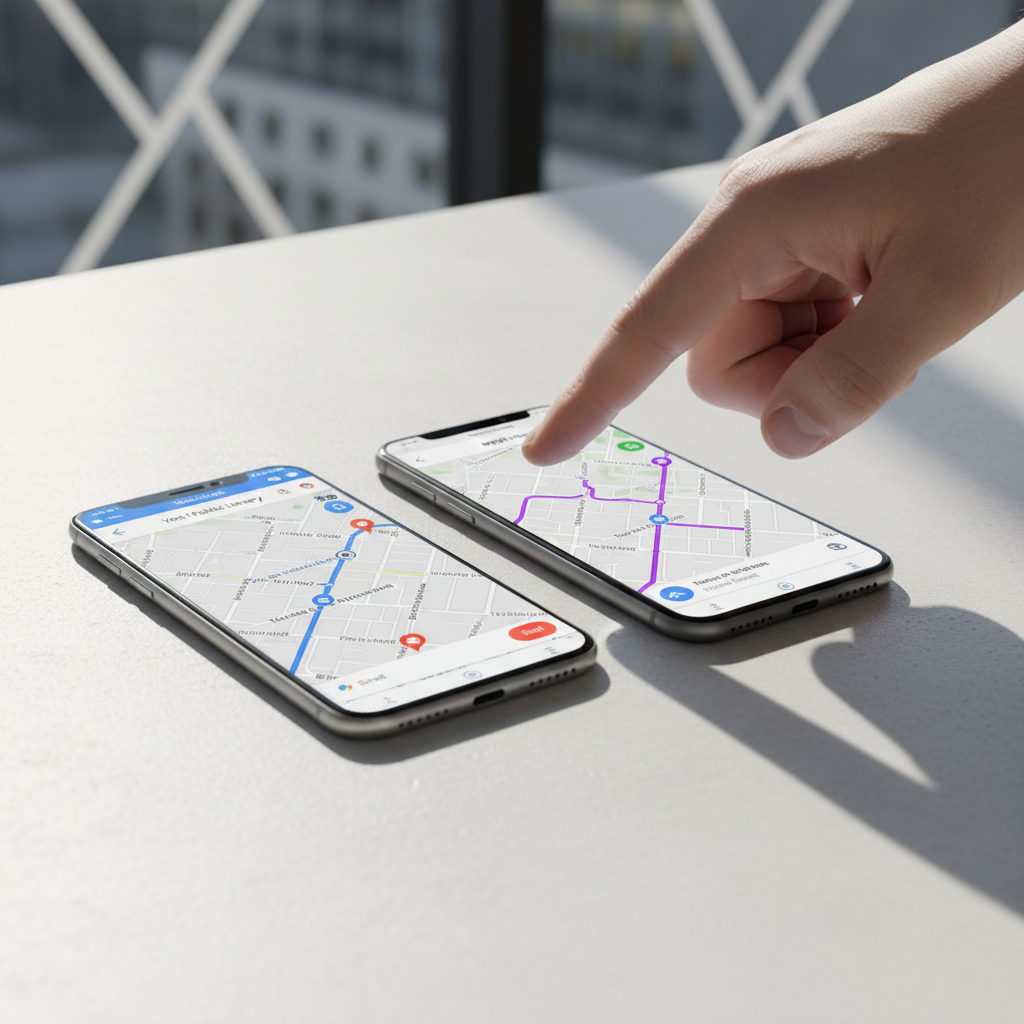
To find out if Apple Maps has truly closed the gap, I put aside my biases and embarked on a feature-by-feature comparison of both apps. My goal was to determine which one offers the superior experience in 2026 across several key areas. I scrutinized everything from navigation and travel modes to traffic reports, speed alerts, offline capabilities, and even emerging AI integrations.
Navigation: Which App Guides You Best?
Apple Maps has significantly matured in its turn-by-turn navigation. It now offers clear lane guidance, accurate stop sign and traffic light cues in supported regions, and helpful speed limit information. The Preferred Routes feature is a standout, learning your routine—like taking a specific back road for a coffee stop—and proactively alerting you to delays without forcing you onto a highway.
Google Maps, while not learning routines in the same nuanced way, excels in its depth of traffic data. It defaults to the fastest route, offering live conditions, comprehensive alerts, and eco-friendly options. Its Immersive Navigation provides realistic 3D route previews, making lane context clearer and helping you understand route trade-offs. Google Maps even uses landmarks for directions, which can be incredibly useful in unfamiliar areas.
While Apple Maps has come a long way, Google Maps still feels like it’s working harder and smarter to get you from A to B, with its rich data and detailed explanations for route choices. For pure navigational prowess and contextual information, Google Maps takes the lead here.
Beyond Driving: Exploring Travel Modes
Both Apple Maps and Google Maps cover the essential travel modes: driving, walking, cycling, public transit, and ride-sharing options. This ensures that regardless of your preferred method of transportation, you’ll find viable routes and directions. From a basic feature perspective, this category is a clear tie, as both apps offer a robust selection.
However, each app offers unique strengths within these modes. Apple Maps, with its clean interface, has become a favorite among hikers, offering detailed, downloadable information for all 63 U.S. national parks. You can browse trails, filter by length and elevation, and create custom routes. Google Maps truly shines in urban environments, providing detailed routes, live schedules, and real-time updates for pedestrians and public transit users. Its AR Live View can even overlay 3D arrows onto the street to guide you, which is incredibly helpful when you’re disoriented by a map view.
Traffic and Incident Reporting: Who Keeps You More Informed?
Apple Maps allows users to report various incidents, including accidents, speed checks, traffic, roadwork, hazards, and road closures, either via Siri, the iPhone app, or CarPlay. It’s a solid system, but Google Maps offers significantly more options for incident reporting.
Google Maps users can report crashes, slowdowns, police presence, construction, lane closures, objects on the road, low visibility, flooded roads, and unplowed roads. This extensive list, combined with Google Maps’ massive user base—estimated at over 2 billion compared to Apple Maps’ 500 million—means it often provides more timely and accurate information. When it comes to comprehensive, real-time traffic and incident awareness, Google Maps is the winner, leveraging its vast community to keep drivers informed.
Police and Speed Trap Alerts: A Basic Offering
For those primarily concerned with avoiding speed traps, dedicated apps like Waze set the gold standard with detailed user-led reporting for various police activities, including mobile cameras and hidden enforcement. Both Apple Maps and Google Maps offer only basic reporting in this area. Apple Maps allows a “speed check” report, while Google Maps offers a generic “police” option, with no further detail. Both apps offer only limited functionality in this specific category, resulting in a tie. If this is a primary concern, you’ll likely need a third-party solution.
Offline Maps and Data Use: Navigating Without Connectivity
Both Google Maps and Apple Maps have made significant strides in offline functionality, making this category a comfortable tie. Google Maps has long been a leader, allowing users to download large areas for turn-by-turn navigation even without service. This is a crucial feature for rural drivers or those frequently traveling through areas with spotty connectivity. Google Maps also offers smart options like auto-downloading recommended areas and controlling downloads over Wi-Fi.
Apple Maps now fully supports offline maps on iPhone, allowing you to download entire regions, manage updates, and receive turn-by-turn directions. This parity in essential offline capabilities ensures that users of either app can confidently navigate off the grid.
Interface and Design: Functionality vs. Simplicity
The interface battle often comes down to personal preference, but for sheer richness of features and discovery, Google Maps takes the crown. Apple Maps offers a clean, streamlined experience. When you open it, you’re presented with clear options for routes, saved places, or recent trips. It’s effective and aesthetically pleasing, appealing to those who prefer minimalism.
Google Maps, however, is a powerhouse of information. It’s densely packed with pins, labels, photos, reviews, and layers for everything from satellite views to air quality and wildfires. It excels as a comprehensive travel and discovery tool, allowing you to research businesses, explore neighborhoods, and even use AR-powered Lens to get information about shops or landmarks. With recent additions like Gemini-powered “insider tips” and “Ask Maps” for conversational searches, Google Maps has evolved far beyond a simple navigation app, offering a feature-rich experience that, while potentially overwhelming for some, provides unparalleled utility.
AI and Voice Assistance: Gemini Takes the Lead
In the realm of artificial intelligence and voice assistance, there’s a clear winner: Google Maps. Apple Maps integrates with Siri, allowing for basic navigation commands and incident reporting. However, it doesn’t offer anything close to the depth and intelligence of Google Maps’ Gemini integration.
With “Ask Maps,” Google Maps provides a Gemini-powered conversational experience, allowing users to ask natural language questions for detailed information and personalized recommendations. This deep AI integration elevates Google Maps from a mere navigation tool to a genuinely smart travel companion, making it superior in this category.
Source: ZDNet – AI
