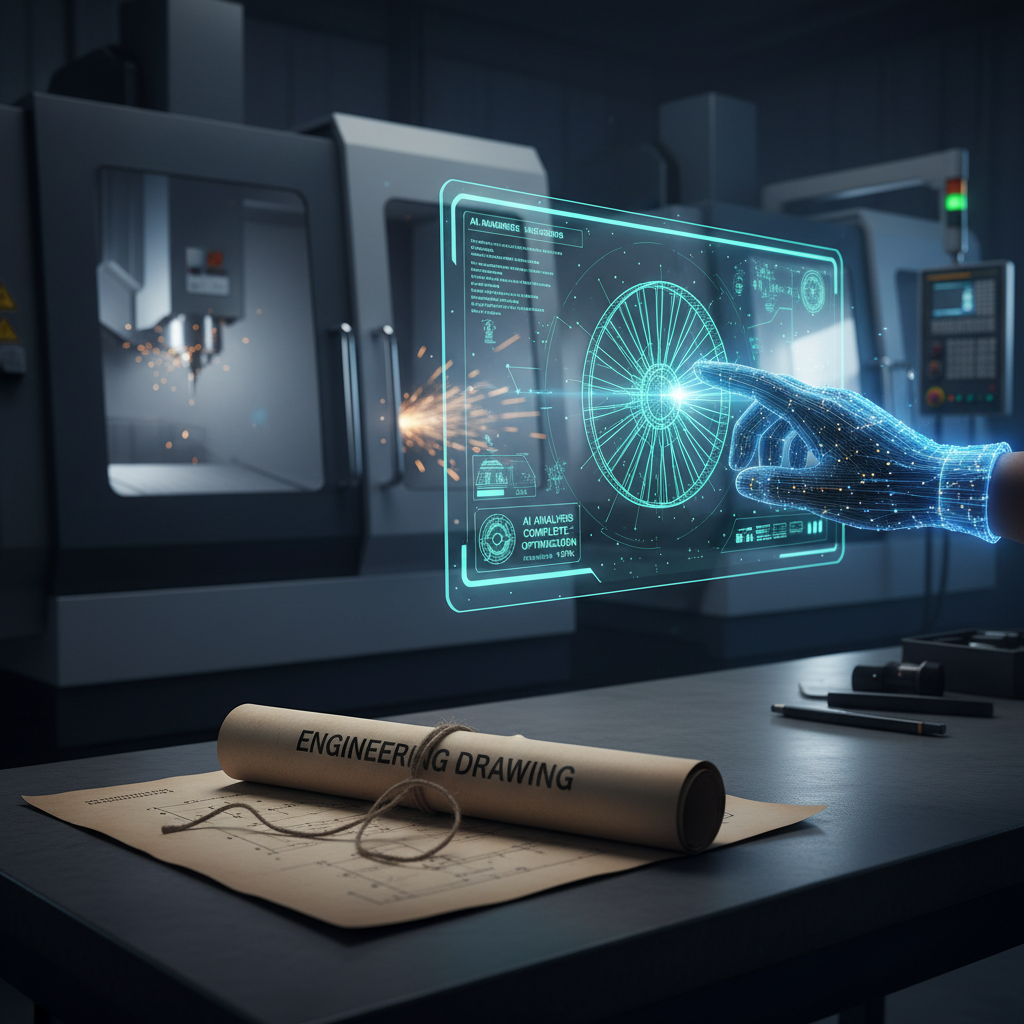
Imagine walking into a typical small CNC machine shop. Ask the manager how they decide whether to take on a new customer job, and you’ll likely hear a familiar story. They print out the engineering drawing, painstakingly read every dimension by hand, physically check tool availability, estimate machine tolerances, and jot down notes on a clipboard.
This laborious process can consume 30 to 60 minutes per drawing. For shops fielding 10 to 20 requests for quotes (RFQs) weekly, this translates to anywhere from 5 to 20 hours of valuable skilled manager time dedicated solely to feasibility analysis. The risks are substantial: accepting a job only to discover mid-production that a crucial tool is missing or a critical tolerance can’t be held, leading to scrapped parts, unhappy customers, and wasted machine time.
This costly and time-consuming problem is precisely what MachinaCheck was designed to eliminate. Built during the AMD Developer Hackathon, MachinaCheck offers a revolutionary solution to automate and optimize the CNC manufacturability assessment process.
Introducing MachinaCheck: Intelligent Manufacturability Assessment
MachinaCheck is a sophisticated multi-agent AI system engineered to streamline and perfect manufacturability analysis. The process is remarkably simple: users upload a STEP file – the industry-standard CAD format – alongside three key inputs: the desired material type, required tolerance, and any specific thread specifications.
Within a mere thirty seconds, MachinaCheck generates a comprehensive manufacturability report. This report clearly states whether the part can be made, identifies all necessary tools, highlights any missing equipment, and recommends concrete actions to take before production begins. No more manual drawing interpretations, no more shop floor walk-arounds, and absolutely no more guesswork.
The AMD MI300X Advantage: Privacy by Design
Our decision to build MachinaCheck on the AMD Instinct MI300X isn’t just a technical preference; it’s a fundamental business requirement for the manufacturing sector. Manufacturing customers routinely operate under strict Non-Disclosure Agreements (NDAs), and their STEP files contain highly sensitive, proprietary geometry representing years of engineering innovation and significant R&D investment.
Transmitting such confidential intellectual property – be it the intricate hole pattern of a medical device or the precise pocket geometry of an aerospace component – to external commercial API endpoints like those offered by public AI services would be a clear breach of confidentiality. This is where the AMD Instinct MI300X truly shines and changes the game entirely. With its massive 192GB of HBM3 VRAM and a blistering 5.3 TB/s of memory bandwidth, we can run powerful models like Qwen 2.5 7B Instruct entirely on-premise.
This means no proprietary geometry ever leaves the shop’s secure infrastructure. The customer’s intellectual property remains precisely where it belongs, fully protected. For us, this isn’t just about ticking a compliance box; it’s what “privacy by design” truly signifies in a demanding manufacturing context, making MachinaCheck viable for real enterprise clients.
MachinaCheck’s Multi-Agent Architecture Explained
MachinaCheck’s robust functionality is powered by a five-component pipeline, expertly constructed using LangChain for agent orchestration and FastAPI for deployment. This modular design ensures both accuracy and efficiency.
- Component 1 – STEP File Parser (Pure Python): This initial component leverages `cadquery`, a Python library built on OpenCASCADE, to parse STEP files directly. It meticulously performs mathematically exact feature extraction, guaranteeing 100% accuracy by reading the geometric data directly – no vision models, no OCR, no approximations. A Ø6.0mm hole is unequivocally identified as Ø6.0mm.
- Agent 1 – Operations Classifier (Qwen 2.5 7B): The extracted geometry, combined with user inputs like material, tolerance, and threads, is then fed to Qwen 2.5 7B, running securely on the AMD MI300X via vLLM. This intelligent agent applies extensive manufacturing domain knowledge to determine precisely “What CNC operations and tools are required to manufacture this part?” For instance, it knows that Steel 304 demands carbide tooling or that a specific tolerance requires a precision machine.
- Agent 2 – Tool Matcher (Pure Python): This component operates without an LLM, leveraging pure deterministic logic. It queries the shop’s internal tool inventory database, cross-referencing required tools against what’s currently available. Using an LLM for a simple database lookup would introduce unnecessary latency and a risk of hallucination, making a direct database query the superior and more reliable choice.
- Agent 3 – Feasibility Decision Agent (Qwen 2.5 7B): The results from the tool matcher are passed back to Qwen. This agent then reasons about the overall situation, producing a structured decision. It outlines whether the job is feasible, provides a confidence score, explains the reasoning, lists actionable items (e.g., “Purchase M10x1.5 tap”), and flags any potential risks.
- Agent 4 – Report Generator (Qwen 2.5 7B): The final agent synthesizes all the gathered information into a professional, easy-to-understand manufacturability report. This comprehensive document includes an overall status, an executive summary, detailed part analysis, tool and machine status, and clear final recommendations, providing managers with all the necessary insights.
Seamless Integration with AMD Instinct MI300X
Deploying Qwen 2.5 7B on the AMD Instinct MI300X using ROCm and vLLM proved to be exceptionally straightforward. The vLLM Quick Start image available on the AMD Developer Cloud comes pre-configured, significantly simplifying the setup process. With a GPU memory utilization of 0.5, we comfortably use approximately 96GB of the available 192GB of VRAM, leaving substantial headroom for future expansion or larger models.
Our agent calls consistently achieve an impressive inference latency of under 3 seconds, ensuring a responsive user experience. LangChain connects seamlessly to vLLM through its OpenAI-compatible endpoint, demonstrating the platform’s versatility and ease of integration.
Through this project, we reinforced the principle of using LLMs strategically – only where complex reasoning is genuinely required. The AMD MI300X’s 192GB VRAM capacity is particularly noteworthy, offering the potential to deploy significantly larger models, like Qwen 2.5 72B, in a production environment for even greater reasoning capabilities.
Experience MachinaCheck for yourself by uploading any STEP file to our demo. See the full power of this multi-agent system and the AMD MI300X in action. This innovative solution was proudly built by Syed Muhammad Sarmad and Sabari Doss R at the AMD Developer Hackathon, leveraging a powerful stack including Qwen 2.5 7B, AMD Instinct MI300X, ROCm, vLLM, LangChain, cadquery, FastAPI, and Next.js.
Source: Hugging Face Blog
