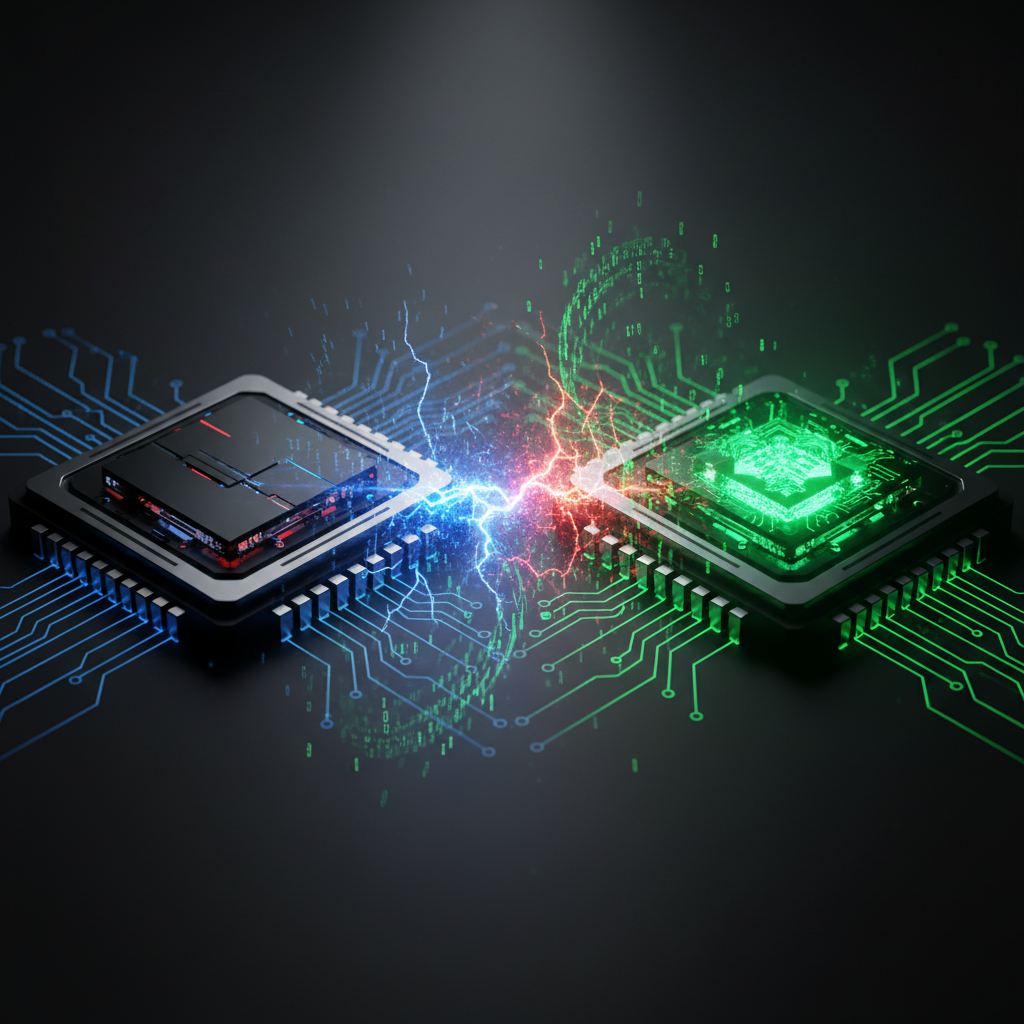
The race to power artificial intelligence is undeniably the most pivotal technological battle of our era. At its heart lies the formidable challenge of building the specialized hardware that trains and deploys increasingly sophisticated AI models. For years, one company has stood as the undisputed champion: Nvidia, with its powerful GPUs leading the charge.
However, a significant shift is brewing, promising to inject new intensity into this high-stakes contest. Google, a long-time innovator in AI, is poised to escalate its challenge, moving beyond just being a major Nvidia customer to becoming a more direct competitor in the AI chip arena. This evolving rivalry between two tech titans is set to reshape the landscape of cloud AI and hardware innovation.
Nvidia’s Reign: The Green Machine’s Dominance
Nvidia has cemented its position as the de facto leader in AI hardware, thanks to its groundbreaking graphics processing units (GPUs). These chips, initially designed for high-end gaming, proved uniquely suited for the parallel processing demands of machine learning workloads. Nvidia’s Hopper and the newer Blackwell architecture are the industry benchmarks, delivering unparalleled performance for training large language models and complex AI algorithms.
Beyond raw silicon, Nvidia’s strength lies in its comprehensive software ecosystem, particularly CUDA (Compute Unified Device Architecture). CUDA provides developers with a robust platform for programming GPUs, creating a powerful moat around Nvidia’s hardware. This integrated hardware-software synergy has made Nvidia GPUs the default choice for virtually every major AI research institution and cloud provider, including Google itself.
Google’s Ambitious Counter: The Rise of TPUs
While relying on Nvidia for many workloads, Google has simultaneously been cultivating its own formidable alternative: the Tensor Processing Unit (TPU). Designed from the ground up specifically for machine learning, TPUs are optimized for the mathematical operations crucial to neural networks, offering significant advantages in both efficiency and performance for certain AI tasks. Initially, TPUs were developed primarily for internal use, powering Google’s own vast AI services like search, translate, and AlphaGo.
Google’s cloud division, however, has increasingly made these custom-designed chips available to external customers through Google Cloud. This strategic move provides enterprises and researchers with access to highly specialized hardware tailored for AI, offering an alternative to general-purpose GPUs. With successive generations, such as the latest Cloud TPU v5e, Google continues to refine and scale its offering, signaling a clear intent to capture a larger share of the AI compute market.
The Impending Twist: A Battle of Ecosystems
The “twist” in this unfolding drama isn’t just about silicon; it’s about ecosystems and market dynamics. Google is not merely offering an alternative chip; it’s building out a comprehensive platform around its TPUs, complete with robust software tools like TensorFlow and JAX. This direct provisioning of custom AI silicon to external clients fundamentally shifts the competitive landscape, challenging Nvidia’s long-standing dominance in cloud AI infrastructure.
This battle is less about one chip definitively beating the other, and more about who can offer the most compelling, integrated solution for diverse AI workloads. Cloud providers and enterprises will increasingly weigh factors such as performance per dollar, ease of integration, and access to developer tools. As Google further democratizes access to its TPUs, it forces a more direct comparison and competitive pressure on Nvidia, particularly within the cloud AI space.
What This Means for the Future of AI
This escalating rivalry between Nvidia and Google promises significant benefits for the broader AI industry. Increased competition drives innovation, leading to more powerful, efficient, and cost-effective AI hardware. Developers and businesses will have a wider array of specialized tools at their disposal, enabling them to build and deploy cutting-edge AI applications with greater flexibility.
Key takeaways for the market include:
- Diversification of AI Hardware: Expect to see more specialized AI accelerators, moving beyond a GPU-centric approach.
- Ecosystem Competition: The battle will extend beyond hardware to software frameworks, developer support, and integration capabilities.
- Cloud Provider Strategies: Cloud giants like Google will leverage their custom silicon as a key differentiator, influencing infrastructure choices for AI development.
- Innovation Acceleration: The intense competition will fuel faster advancements in AI chip design and efficiency.
As AI continues its rapid expansion, the fight for the underlying computing power will only intensify. Google’s aggressive push with TPUs marks a pivotal moment, transforming the AI chip market from a near-monopoly to a dynamic, multi-player arena. This evolution is excellent news for anyone invested in the future of artificial intelligence, promising an era of unprecedented innovation and choice.
Source: Google News – AI Search
