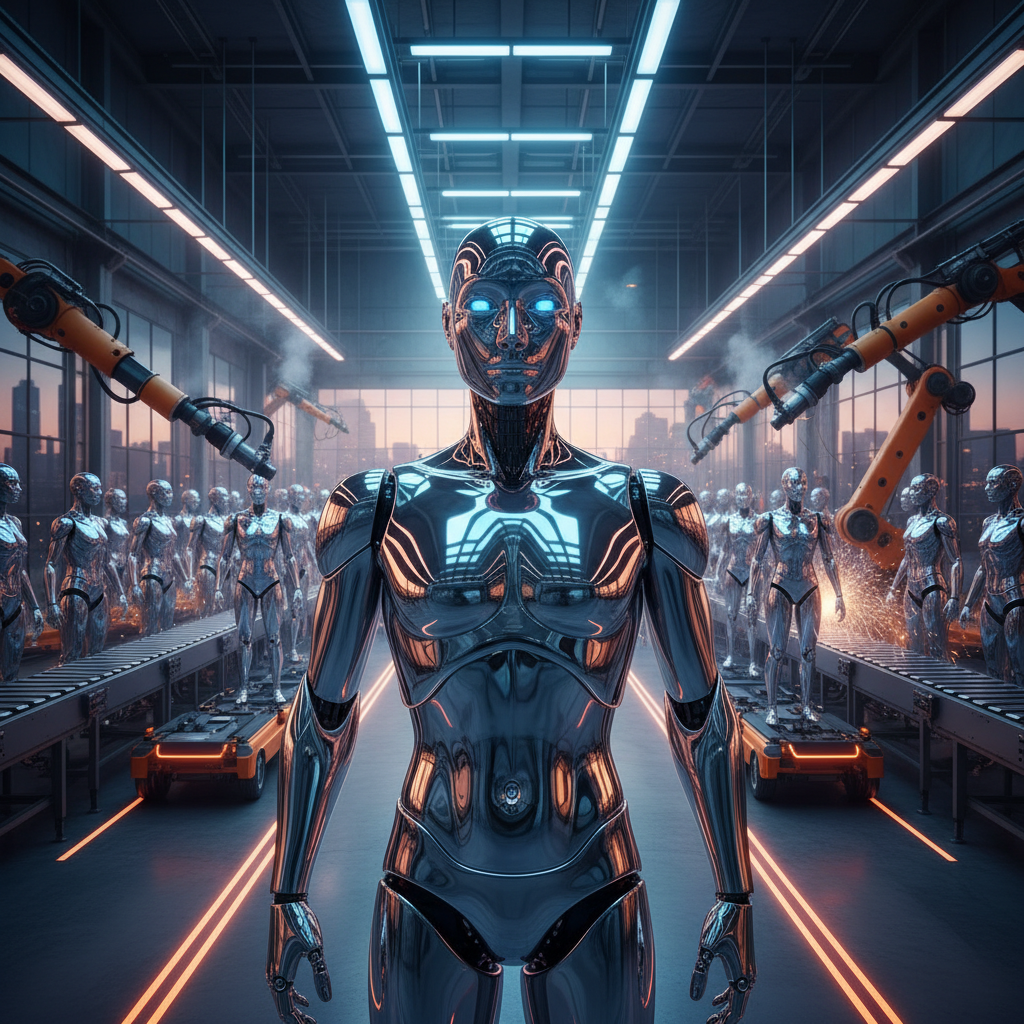
The future of manufacturing is rapidly taking shape, and it looks increasingly like a factory floor staffed by advanced humanoid robots. In a landmark development, British technology firm Humanoid is set to deploy its cutting-edge robots across global factories operated by the German industrial giant, Schaeffler, marking a significant step towards widespread industrial automation.
Humanoid Robots: The New Workforce
This ambitious agreement envisions the deployment of between 1,000 to 2,000 humanoid robots within Schaeffler’s worldwide manufacturing sites by the year 2032. While the exact financial value of this pioneering contract remains undisclosed, the initial phase of robot integration is slated for a crucial rollout between December 2026 and June 2027 at two key Schaeffler sites in Germany.
Initial deployments will see these advanced robots tackling essential tasks such as box handling at Schaeffler’s Herzogenaurach facility, alongside near-full-scale factory testing in Schweinfurt. Humanoid will also provide crucial support, ensuring seamless integration of its robots into Schaeffler’s existing complex production lines, building upon a previously announced technology partnership.
Beyond robot deployment, this partnership features a strategic twist: Schaeffler is slated to become Humanoid’s preferred supplier for specialized joint actuators through 2031. This reciprocal arrangement is expected to fulfill over half of Humanoid’s demand for its innovative wheeled humanoid platforms, covering an impressive at least 1 million actuators over the specified period, solidifying a mutually beneficial supply chain.
Physical AI: Learning from Humans
The collaboration between Humanoid and Schaeffler isn’t just an isolated incident; it signifies a growing trend across various sectors where companies are becoming real-world test sites for ‘physical AI’ systems. This exciting evolution involves intelligent robots designed to interact with and manipulate the physical world, transforming operations from logistics to hospitality.
A prime example comes from South Korea, where AI startup RLWRLD is pioneering a unique approach by collecting extensive worker motion data from diverse environments. This data, gathered from hotels, logistics centers, and retail settings, is proving invaluable for training sophisticated AI robot systems.
At Lotte Hotel Seoul, food and beverage staff are recorded while performing intricate tasks like folding banquet napkins and preparing tableware, using body cameras on their heads and hands. Similarly, logistics workers at CJ are tracked as they lift and handle goods, while staff at Lawson convenience stores reveal how food displays are optimally organized. This comprehensive human movement data is then converted into machine-readable formats, further enhanced by engineers using VR headsets and motion-tracking gloves.
RLWRLD’s engineers emphasize hand dexterity as a critical priority for industrial and service tasks, developing robots capable of delicate manipulations. Demonstrations include wheeled robots with human-like metal hands precisely moving cups at a minibar, or a humanoid opening a box, placing a computer mouse inside, and then neatly closing it on a conveyor belt.
Industry-Wide Adoption and Future Outlook
With such capabilities, RLWRLD firmly believes that industrial deployment is the immediate target, anticipating AI robots for manufacturing to be deployed at scale around 2028. This ambitious timeline resonates with major industry players like Hyundai Motor, which plans to introduce Boston Dynamics humanoids at its global factories, starting with its Georgia plant in 2028.
Similarly, Samsung Electronics has declared its intention to transform all its manufacturing sites into ‘AI-driven factories’ by 2030. This grand vision encompasses both general-purpose humanoids and task-specific robots seamlessly integrated into their production lines, signaling a fundamental shift in industrial operations.
Navigating the Human Element: Concerns and Opportunities
However, this exciting technological surge isn’t without its challenges, particularly regarding the human element. Labor groups in South Korea have voiced significant concerns about the widespread use of worker data and the rapid deployment of robots, fearing potential impacts on employment and the pipeline for skilled labor.
Kim Seok, policy director at the Korean Confederation of Trade Unions, stresses the importance of engaging workers and the government in discussions about AI adoption, asserting that skilled work remains a unique human achievement. Even in hospitality, where Lotte Hotel is exploring robots for cleaning, current humanoids would take several hours to clean a room that a human completes in about 40 minutes, highlighting practical limitations.
Despite these hurdles, Lotte Hotel aims for robots to assist with some cleaning and support tasks by 2029, and is even considering robot rental services for the broader hospitality sector. Ultimately, while humanoids might eventually handle 30-40% of back-of-house event preparation, tasks requiring direct human interaction are still seen as exceptionally difficult to replace.
Source: AI News
