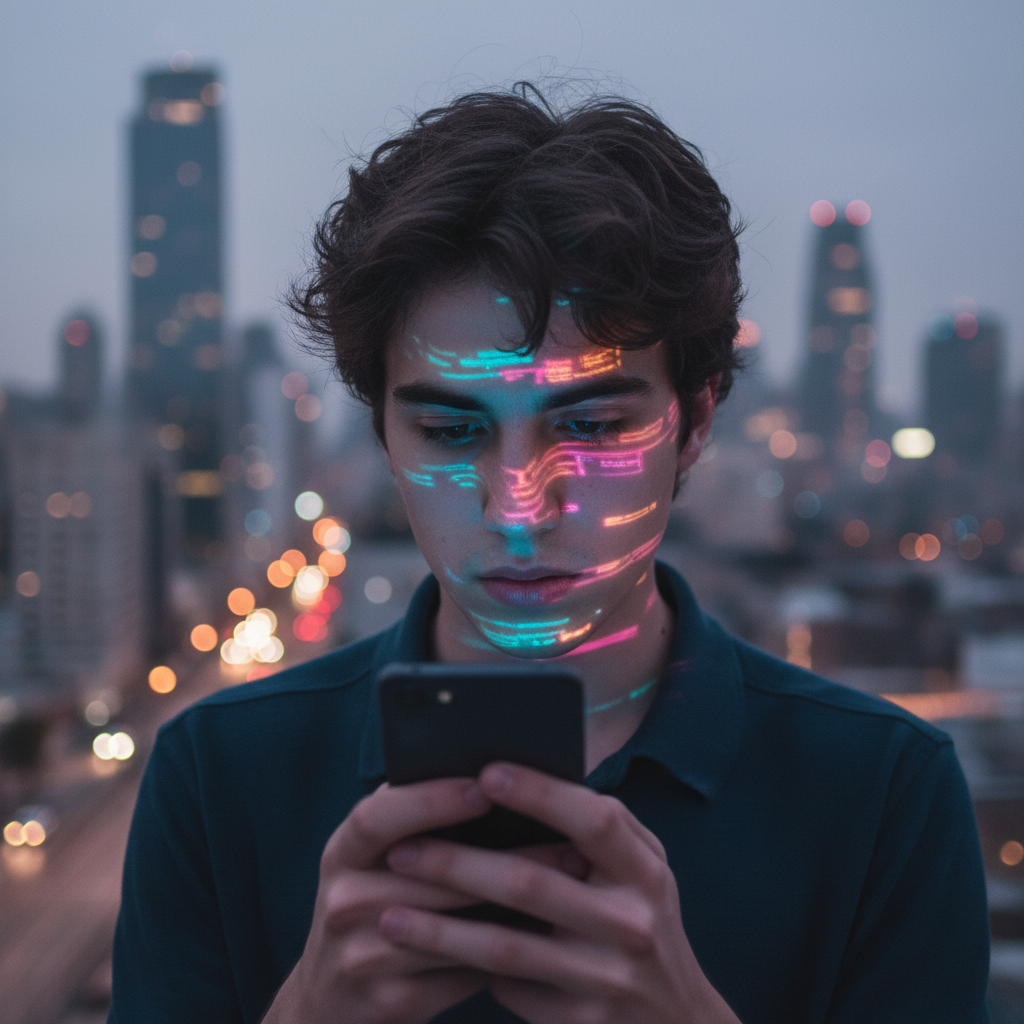
A viral video of a lonely polar bear, swimming between ever-shrinking ice floes, has captured millions of views and sparked an outpouring of raw emotion on platforms like TikTok. Set to a poignant piano score, its comment sections are filled with palpable grief, rage, and a sense of helplessness, particularly from younger generations. This visceral reaction stands in stark contrast to the measured, scientific language of reports from the Intergovernmental Panel on Climate Change (IPCC), which address the very same critical subject.
While both the TikTok video and the scientific report contain their own versions of truth, they communicate on fundamentally different frequencies of human understanding. This divergence highlights a profound shift, especially for Gen Z, the first generation to mature fully immersed in the smartphone era. Their relationship with truth has been fundamentally reshaped, creating new ways of perceiving and interacting with reality.
The Digital Shift and Its Unforeseen Consequences
Beginning around 2010, researchers across various countries started documenting a concerning rise in adolescent anxiety, depression, loneliness, and self-harm. Large-scale surveys across the U.S., UK, Canada, Australia, and Europe revealed similar alarming trends emerging consistently between 2012 and 2014. This timeline directly aligns with the moment smartphones, front-facing cameras, and algorithmically driven content platforms became the dominant forces in adolescent social life.
Studies utilizing data from reputable sources like the Centers for Disease Control and Prevention’s Youth Risk Behavior Survey and the University of Michigan’s Monitoring the Future study confirmed these trends. They showed significant increases in depressive symptoms, sleep disruptions, and feelings of persistent sadness among teenage girls. Simultaneously, researchers noted a sharp decline in face-to-face social interaction coupled with a dramatic surge in online engagement.
However, the transformation extended beyond mere psychological impacts; it was profoundly cultural and cognitive. As social interaction migrated onto platforms optimized for maximum engagement and emotional reaction, the very definition of truth began to shift. Questions of veracity became increasingly filtered through personal identity, emotional responses, and social validation, rather than through slower, more traditional institutional systems of evidence and critical debate. Social media didn’t just change what young people consumed; it altered how they processed reality itself, moving from a shared public truth to a personalized, algorithmically reinforced version.
Algorithms, AI, and the Future of Reality
“Our realities are being shaped by a profit-driven attention economy that prioritizes engagement over well-being,” explains Emma Lembke, Director of Gen Z Advocacy at the Sustainable Media Center. Lembke and her generation are on the front lines, navigating an information landscape where genuine facts often compete with curated narratives. For them, this isn’t an abstract threat but an everyday challenge.
The danger has now escalated far beyond simple misinformation. With the advent of advanced AI, it’s now possible to manufacture convincing fake realities on an unprecedented scale. Deepfake videos, voice clones, and entirely bogus news stories are rapidly dissolving the line between what’s real and what’s not, often faster than society can effectively adapt. Fully AI-generated personas, complete with faces, voices, backstories, and millions of followers, are already active across platforms like Instagram and TikTok, often indistinguishable from human influencers.
This isn’t a problem Gen Z created; it’s one they inherited, and they’re navigating it without a reliable map. Their algorithmic feeds often present reality as pre-curated, emotionally optimized, and computationally amplified, with no inherent obligation to disclose what is genuine. New York University professor and media critic Scott Galloway candidly asserts that AI-powered platforms are more than just social networks; they are powerful “influence engines” shaping what millions of young people see, believe, fear, and accept as real.
Galloway’s core critique highlights how engagement has superseded human judgment as the primary organizing principle of online information. Platforms are designed not for accuracy, empathy, or thoughtful discussion, but for capturing attention and eliciting emotional reactions. He argues, “They aren’t crawling the real world; they aren’t crawling what’s best about us. They’re crawling the comments section,” underscoring the shift towards content that generates the most immediate response.
Gen Z’s Evolving Information Sensibility and Action
The tension between emotional experience and factual truth is starkly evident in discussions surrounding climate change. Climate activist Xiye Bastida, a prominent Gen Z voice, notes that social media allows younger users to experience the crisis through deeply personal stories and firsthand accounts. This fosters an emotional understanding that often feels more immediate and impactful than solely reading scientific reports.
A 2023 Google study explored how Gen Z processes online information, revealing a unique approach called “information sensibility.” Participants typically encounter information passively through social media feeds, rather than actively seeking it out. Their engagement is deeply social, shaped by collaborative interpretation and discussion within peer groups, creating a distributed verification system.
Instead of relying on traditional institutional gatekeepers, Gen Z has developed a peer-based editorial board that stress-tests information against lived experience. They often react emotionally first, discuss stories with friends second, and only then verify details, if at all. This collective and continuous verification system challenges older models of media literacy, which assumed individuals made deliberate choices about what to believe. It demands a reckoning with the environment that produced this new “information sensibility.”
For Gen Z, emotionally charged posts—those sparking frustration, urgency, or hope—often serve as critical cues to investigate further, engage with friends, or seek supporting evidence. This means they don’t just consume facts; they actively negotiate truth socially and emotionally in real-time. Social media, however, blurs the lines, collapsing journalism, entertainment, activism, advertising, and personal confessions into the same visual and emotional language. A scientific report, a meme, a war video, or a personal trauma story can appear within seconds of each other, all vying for attention and belief.
This generation is frequently forced to reconcile the scientific severity of global crises with the overwhelming emotional burden of inheriting them. As Bastida stated in her 2020 TED Talk, “The planet is suffering, and we don’t have the luxury of time anymore.” For many, emotional experience is not a replacement for evidence but a powerful signal that something deserves urgent attention, thorough investigation, and immediate action.
Shaping the Future of Truth
Gen Z is forging new paths for collective action, seamlessly moving between digital spaces and real-world activism, and integrating emotional testimony with empirical evidence. The global student climate movement, Fridays for Future, for instance, didn’t begin with a policy brief. It started with a lone teenager, Greta Thunberg, outside the Swedish parliament. Its spread wasn’t due to institutional endorsement, but powerful emotional resonance, peer sharing, and millions of young people affirming, “This is real, this matters, we are not waiting.”
While previous generations relied on relatively stable systems for truth—newspapers, universities, scientific institutions—Gen Z navigates an information ecosystem where truth is constantly reshaped. Journalist Maria Ressa powerfully warned, “Without facts, you can’t have truth. Without truth, you can’t have trust. Without trust, we have no shared reality, no democracy.” Yet, Gen Z may be building something new: a distributed, socially negotiated sense of who earns the right to be believed. They aren’t abandoning truth; they’re auditing who delivers it, and their verdict, forged collectively, is already in.
Source: Wired – AI
