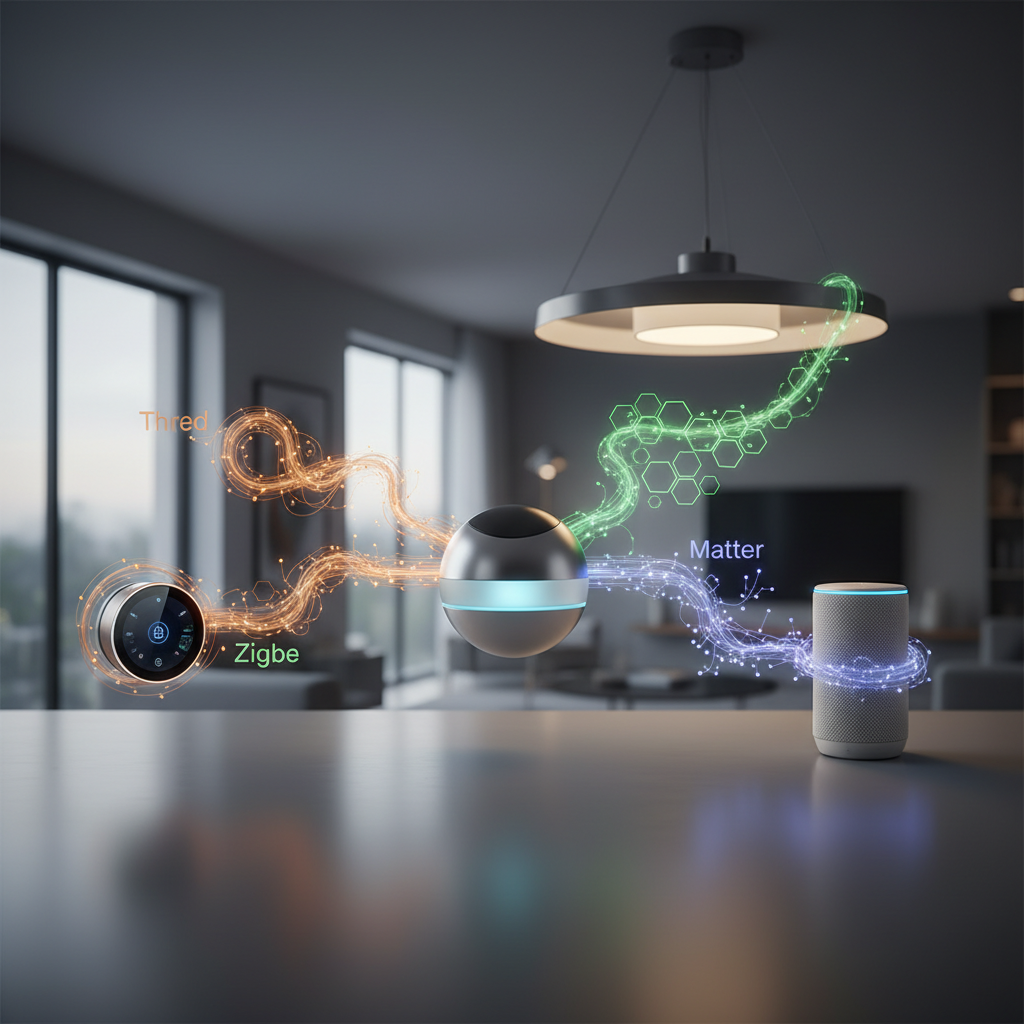
Smart home technology promises unparalleled convenience, but navigating the myriad of connectivity standards can often feel like learning a new language. You’ve likely seen terms like Thread, Zigbee, and Matter printed on product boxes or in online descriptions, and wondered how they all fit together. Understanding their distinct roles is key to building a truly seamless and efficient smart home ecosystem.
It’s crucial to understand that Matter is a connectivity protocol, essentially the universal language your smart devices speak. On the other hand, Thread and Zigbee are wireless protocols, acting as the networks that enable your devices to communicate. They work together, rather than competing, to create a smarter, more integrated home.
Thread: The Future-Forward Mesh for Small Devices
Thread represents a significant leap in smart home networking, designed for modern, IP-based communication. It creates a self-healing mesh network of low-power devices, allowing them to communicate more directly and efficiently. This results in faster response times and fewer frustrating disconnects compared to older protocols.
One of Thread’s major advantages is that it doesn’t require a dedicated central hub. Instead, devices with built-in Thread border routers work together to form the network, seamlessly bridging to your Wi-Fi. If one device in the mesh drops offline, traffic automatically reroutes through another, ensuring reliability.
Thread truly shines with numerous smaller, low-power devices. Think of motion, presence, and contact sensors, smart locks, lightbulbs, and switches. By connecting these devices through a single Thread network, you avoid congesting your main Wi-Fi and experience superior performance, especially with Matter over Thread.
Zigbee: The Established, Hub-Dependent Standard
Before Thread became widely available, Zigbee was a dominant force in smart home connectivity, known for its robust mesh networking capabilities. However, Zigbee networks are intrinsically hub-dependent, meaning you’ll need a dedicated hub to connect your devices to the internet and control them remotely. A prime example is Philips Hue lightbulbs, which often require a Hue Bridge for full remote functionality.
Once a Zigbee hub is set up and connected, it centralizes compatible devices, allowing them to communicate. While reliable, Zigbee is not IP-based, which can sometimes lead to slower response times compared to Thread. Users might also encounter more setup complexities and be more prone to brand lock-in due to the hub requirement.
Despite these considerations, Zigbee boasts a massive ecosystem of compatible smart bulbs, sensors, and plugs, thanks to its long history. You’ll find a wide array of both brand-specific and universal Zigbee hubs available on the market, offering plenty of choice for building a smart home.
Matter: The Universal Language for True Compatibility
Matter isn’t another network protocol; it’s the “language” that enables different brands of smart devices to understand each other and work together seamlessly. Its primary goal is to break down ecosystem barriers, allowing users to mix and match devices from Apple, Amazon, Google, Samsung, and more, all within a unified smart home experience. No more being locked into a single brand!
This interoperability is achieved because Matter is a software layer that can be added to devices, often through over-the-air updates. For instance, before Matter, a Google Nest Doorbell wouldn’t integrate with Apple HomeKit. Now, thanks to Matter, these devices can finally communicate, appearing and functioning within your preferred smart home app.
Matter is designed to work efficiently over existing network protocols, primarily Thread and Wi-Fi. This flexibility means you can optimize your smart home setup based on device needs.
- Matter over Thread: Ideal for low-power devices like smart sensors, locks, bulbs, and switches. This combination leverages Thread’s efficient mesh network and border routers, delivering swift, consistent responses without burdening your Wi-Fi. It’s the go-to for reliability and speed with numerous small accessories.
- Matter over Wi-Fi: Best suited for devices that require higher bandwidth, such as security cameras, video doorbells, smart speakers, and appliances. These devices connect directly to your Wi-Fi router, offering fast performance without the need for a Thread border router. However, be mindful that many such devices can quickly consume Wi-Fi bandwidth.
While the spotlight often falls on newer standards, Z-Wave remains a reliable, albeit older, smart home radio technology. Operating at a different frequency (900 MHz), it typically experiences less interference than 2.4GHz protocols like Zigbee and Thread. Like Zigbee, Z-Wave devices require a dedicated hub.
Z-Wave is particularly popular for local smart home setups and automations, especially within communities like Home Assistant users, as it often doesn’t rely on cloud services. However, it’s worth noting that Matter does not currently run on Z-Wave, and fewer new devices are being released compared to Thread and Matter-compatible options.
Source: ZDNet – AI
