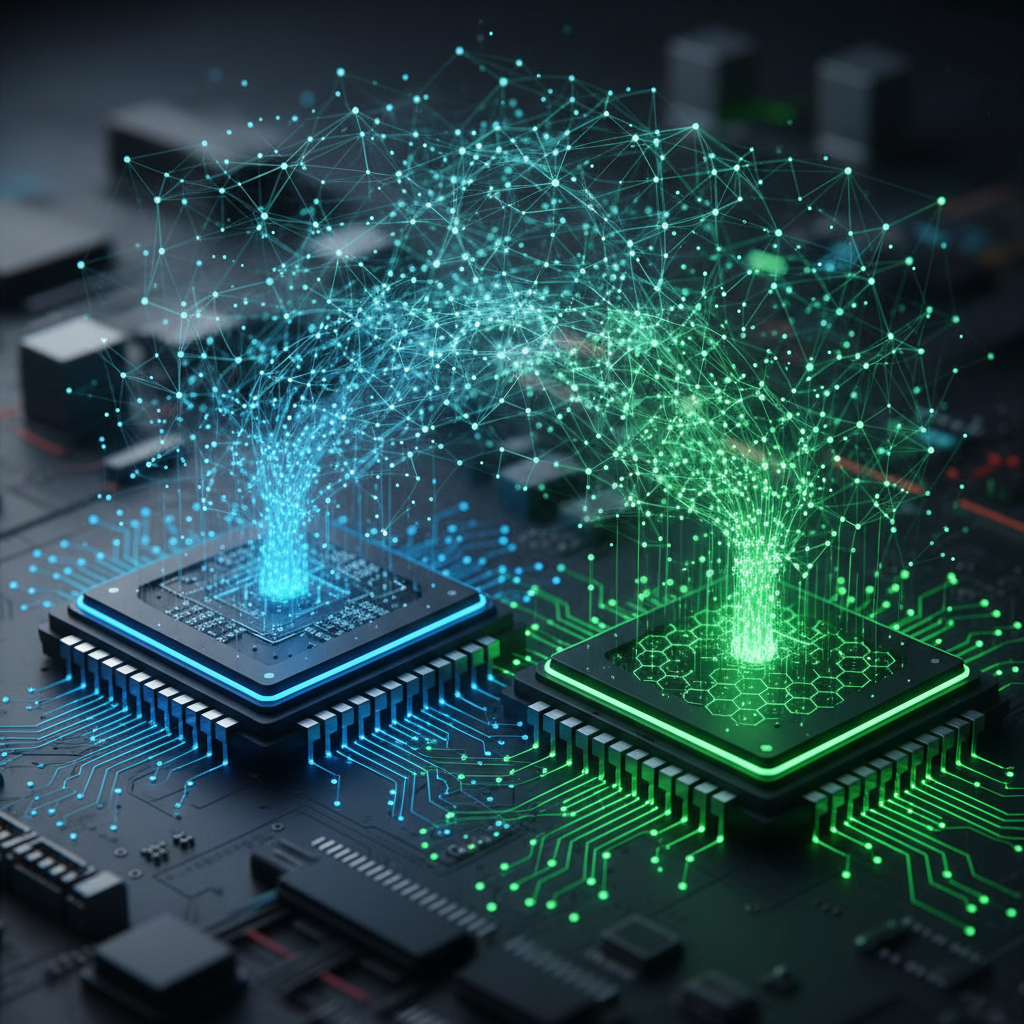
The artificial intelligence revolution continues to gather momentum, and at its heart are two undisputed giants: Google and Nvidia. As the tech world watches for the next big leap, market attention is keenly focused on these companies, whose innovations and performance are pivotal to the broader AI trade.
This period underscores the critical roles both companies play, albeit in different yet complementary spheres of the AI ecosystem. From the foundational hardware powering AI models to the sophisticated software making them useful, Google and Nvidia represent the dual engines driving this transformative technology forward.
Google’s AI Prowess and Cloud Dominance
Google has long been at the forefront of AI research, consistently pushing boundaries with its groundbreaking algorithms and machine learning advancements. Their recent strides with models like Gemini showcase their ambition to compete directly in the generative AI space, integrating advanced capabilities across their vast suite of products, from search to Workspace.
Beyond consumer-facing AI, Google Cloud Platform (GCP) is a powerhouse for enterprise AI solutions. It offers a comprehensive range of services, including AI platform tools, specialized hardware like Tensor Processing Units (TPUs), and powerful large language models (LLMs) available for businesses to build upon. This makes Google indispensable for companies looking to leverage AI at scale.
The company’s strategic investments in AI infrastructure and talent solidify its position as a holistic AI provider. Their ability to innovate across software, services, and custom silicon ensures they remain a central figure in the global AI landscape, continually shaping how businesses and consumers interact with intelligent systems.
Nvidia: The Hardware Backbone of AI
While Google excels in AI software and cloud services, Nvidia reigns supreme in the crucial realm of AI hardware. Their graphics processing units (GPUs) have become the de facto standard for training and deploying complex AI models, including the largest neural networks. The unparalleled parallel processing capabilities of Nvidia’s GPUs are essential for the compute-intensive tasks of modern AI.
Nvidia’s proprietary CUDA computing platform further locks in its dominance, providing developers with a powerful ecosystem of tools and libraries optimized for their hardware. This combination of superior hardware and a robust software platform makes Nvidia chips indispensable, creating a significant barrier to entry for competitors.
The explosive demand for AI computing power has propelled Nvidia to unprecedented heights, making it one of the most valuable companies globally. Its financial performance and strategic collaborations with major tech players highlight its essential role as the foundational provider of the digital infrastructure upon which the entire AI revolution is being built.
The Symbiotic Relationship Driving Innovation
The relationship between Google and Nvidia is a prime example of the interdependence within the AI ecosystem. Google, as a leading developer and deployer of advanced AI models, is a significant customer for Nvidia’s high-performance GPUs, utilizing them to train and run their cutting-edge algorithms across their data centers. Conversely, Nvidia benefits immensely from the continuous innovation in AI software by companies like Google, which drives the demand for more powerful and efficient hardware.
This synergistic dynamic ensures that advancements on one side rapidly accelerate progress on the other. As Google develops more complex AI, it necessitates more sophisticated hardware from Nvidia, which in turn enables Google to push the boundaries further. Investors closely monitor both companies, recognizing that their individual successes and challenges have profound ripple effects across the entire AI sector and the broader technology market.
- Google’s software and cloud services provide the intelligence and accessibility for AI.
- Nvidia’s GPUs and platforms provide the raw computational power required.
- Their collaboration, both direct and indirect, fuels the rapid pace of AI development.
Looking Ahead: Sustained Growth and Strategic Evolution
The future for both Google and Nvidia in the AI space appears incredibly promising, yet dynamic. Google will continue to invest heavily in refining its AI models, expanding its cloud AI offerings, and integrating AI deeply into all its products, aiming to maintain its competitive edge against other tech titans.
Nvidia, meanwhile, is set to further innovate its chip architectures, developing specialized hardware not just for training but also for efficient AI inference at the edge. The ongoing “AI gold rush” ensures that demand for their accelerators will remain robust, but competition from custom silicon by cloud providers (like Google’s TPUs) could also intensify, pushing both companies to innovate relentlessly.
As the AI trade evolves, monitoring the strategic moves and quarterly reports of these two giants will be crucial for understanding the direction and pace of the technological revolution. Their continued leadership is not just a testament to their past achievements but a beacon for future innovations that will undoubtedly reshape industries and daily life.
Source: Google News – AI Search
