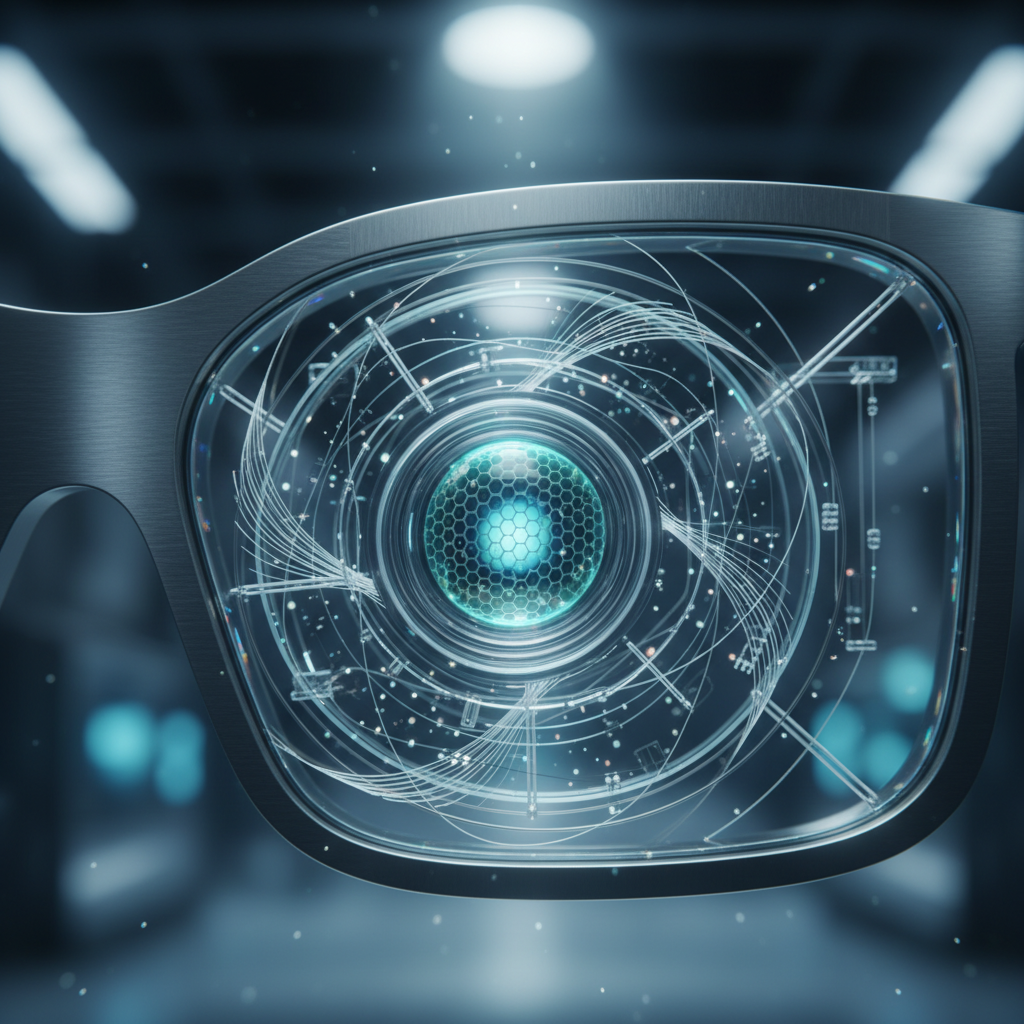
Imagine cruising down the highway on your motorcycle at high speed, and a glowing arrow materializes directly on the road ahead, guiding your next turn. No need to glance at a phone or dashboard; the directions are seamlessly integrated into your vision, courtesy of a lens no larger than your thumbnail. This isn’t science fiction, but a tangible reality already set to debut on European roads this year, offering a thrilling glimpse into the future of smart glasses.
Over the past few years, major tech companies have been making significant strides in the wearable AI space. Giants like Meta have been shipping AI-enabled Ray-Ban glasses since 2023, while Google is actively developing Android XR, and Apple is widely anticipated to enter this dynamic market. Reports even suggest Samsung is preparing to unveil its first AI-capable smart glasses, co-designed with Gentle Monster, at a July Galaxy Unpacked event.
The numbers speak volumes about this accelerating trend. Global AI glasses shipments exploded to 8.7 million units in 2025, marking an increase of over 300% from the previous year. Analysts at Omdia project this figure will surpass an impressive 15 million units this year, solidifying AI glasses as a rapidly expanding category in consumer electronics.
The Core Challenge of Wearable AI
As the market for AI-powered smart glasses booms, component makers and suppliers are strategically positioning themselves for what comes next. Among these innovators is LetinAR, a South Korean startup that has dedicated the last decade to perfecting the optical technology essential for truly wearable smart glasses. They’ve been meticulously building the intricate optical modules that bring digital information to life right before your eyes.
LetinAR doesn’t manufacture the complete glasses; instead, they craft the crucial optical module—a tiny lens component responsible for projecting images into your field of vision. According to CTO Jeonghun Ha, this component is the make-or-break element determining whether smart glasses feel like a cumbersome gadget or a comfortable, everyday accessory. The paramount engineering challenge lies in creating a module that is exceptionally light, thin, power-efficient, yet still delivers a crisp, clear image, all within the confines of a normal-looking frame.
CEO Jaehyeok Kim emphasizes their vision, stating, “We see AI glasses as that next platform.” He adds, “And the optical module is the hardest part to get right as AI glasses makers will need a lens that is thinner, lighter, and more power-efficient than what exists today.” This challenge is precisely what LetinAR is engineered to solve, aiming to be the go-to optics provider for the burgeoning AI glasses industry.
PinTILT: A Breakthrough in Optics
LetinAR’s proprietary technology is known as PinTILT, an ingenious method for arranging minuscule optical elements within a lens. Unlike traditional approaches, PinTILT precisely directs light solely where it needs to go—into the user’s eye—rather than scattering it inefficiently in all directions. This focused approach addresses a fundamental trade-off that has long plagued smart glass design.
Consider a television broadcasting light across an entire room, with only the light reaching your eyes truly mattering. Many existing smart lens technologies, particularly the prevalent waveguide approach, operate similarly, dispersing light across the full lens to generate a wide image. While this yields a thin lens, it’s inherently inefficient, discarding a significant amount of light before it ever reaches the eye. This inefficiency translates to dimmer images and, critically, rapid battery drain.
The alternative, a mirror-based birdbath design, delivers light more directly to the eye, resulting in brighter visuals. However, this structure is typically bulky, making it nearly impossible to integrate into frames resembling conventional eyeglasses. PinTILT ingeniously sidesteps this dilemma, as explained by Ha.
By meticulously focusing only on the light that can actually enter the eye and precisely engineering the angle of each tiny element within the lens, LetinAR claims its technology achieves a superior balance. PinTILT promises a brighter image within a thinner, lighter form factor, all while consuming significantly less power. In a product category where every gram and every hour of battery life is crucial, LetinAR’s innovation tackles the industry’s most persistent engineering hurdles.
Powering Innovation and Future Growth
LetinAR, backed by investors like LG Electronics (which has reportedly begun developing its own AI smart glasses, underscoring the category’s importance), recently secured an additional $18.5 million in funding. This latest round, led by Korea Development Bank and Lotte Ventures, brings their total raised capital to an impressive $41.7 million. The company has its sights set on a planned 2027 IPO in South Korea, signaling strong confidence in its future trajectory.
LetinAR’s optical modules are already making their way into products. They count significant customers such as Japan’s NTT QONOQ Devices and Dynabook (formerly Toshiba Client Solutions), demonstrating their capability for real-world manufacturing at scale. The company is also in discussions with various Big Tech firms for research and development of next-generation AI glasses, although specific names remain undisclosed.
One of LetinAR’s most compelling applications is with Aegis Rider, a Swiss deeptech firm spun out of ETH Zurich. Aegis Rider is developing an AI-powered augmented reality helmet for motorcyclists that projects navigation, speed, and safety alerts directly into the rider’s field of vision, anchored to the road itself. LetinAR’s module is at the heart of this innovative helmet, which is slated for launch in the EU and Swiss markets in 2026.
CEO Jaehyeok Kim states that the recent funding will be crucial for scaling up operations as the AI glasses market transitions from early adoption to mass production. He firmly believes that hardware devices like AI glasses represent the next vital layer for seamlessly integrating AI into our daily lives, transforming how we interact with technology and the world around us.
Source: TechCrunch – AI
