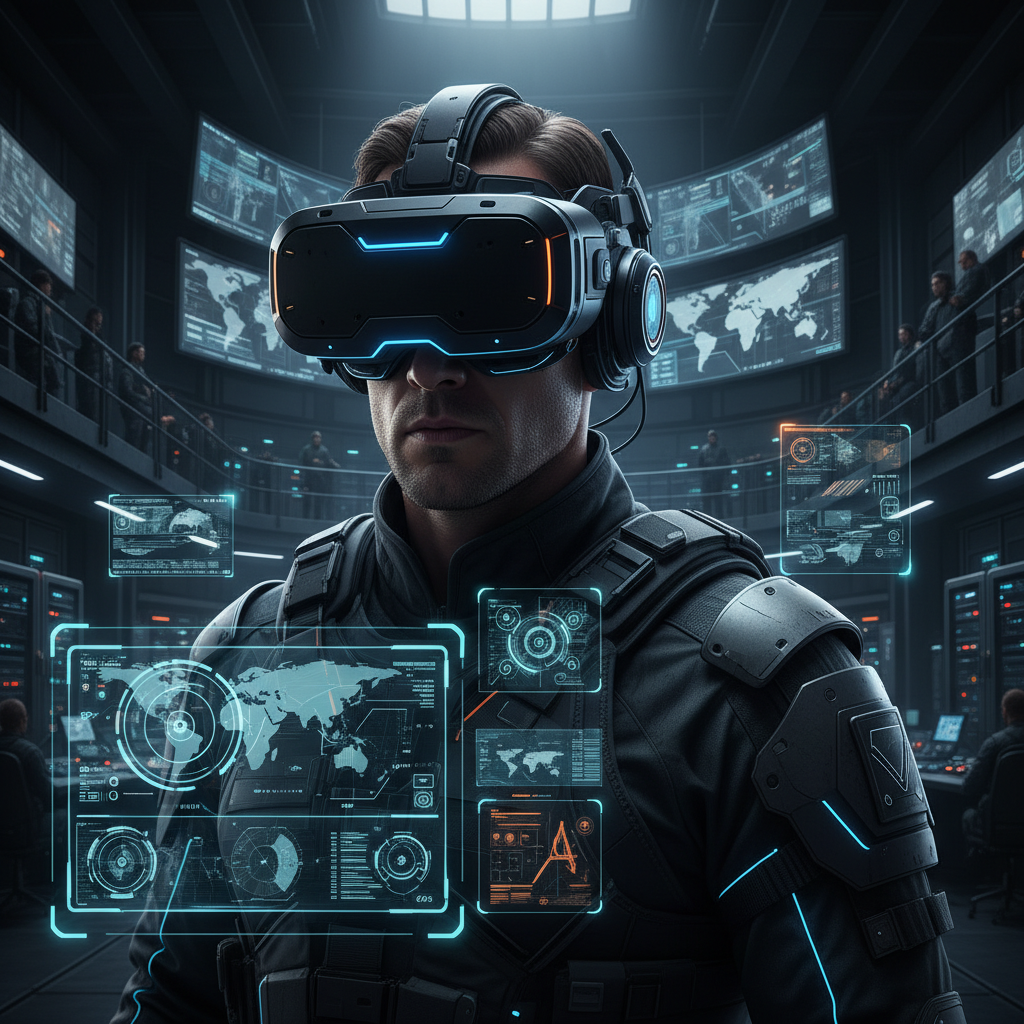
Imagine a soldier on the battlefield, not just equipped with a rifle, but with a futuristic visor that transforms their perception of combat. Defense-tech powerhouse Anduril, in collaboration with Meta, is making this vision a reality, developing augmented reality (AR) headsets designed to revolutionize military operations.
Their ambitious goal? To optimize “the human as a weapons system.” This isn’t just about better gear; it’s about seamlessly blending human intellect with cutting-edge technology, enabling soldiers to command drones, access critical intelligence, and even order strikes with nothing more than a glance or a spoken word.
Transforming the Soldier’s Perspective
Anduril is currently advancing two distinct but related projects. The first is for the U.S. Army’s Soldier Born Mission Command (SBMC) program, for which Anduril secured a $159 million prototyping contract last year.
This initiative focuses on developing AR glasses that can integrate directly with existing military helmets, leveraging Meta’s expertise in augmented reality. The second project, dubbed EagleEye, is a self-funded venture by Anduril to design an entirely new helmet and headset combination from the ground up, believing it will ultimately prove superior and be adopted by the military.
Both systems are still in their developmental stages, with widespread deployment years away. The Army, for instance, isn’t expected to move its top choice for the SBMC program into production until 2028, and that’s if it even selects a viable candidate after previous setbacks.
The core functionality of these AR glasses involves overlaying crucial information onto a soldier’s real-world view. This could range from a simple compass to detailed topographical maps, real-time drone locations, or even AI-powered recognition of targets like enemy vehicles.
Crucially, soldiers would interact with these systems using natural language. For example, they could verbally request an evacuation for an injured colleague or plot a route that automatically accounts for restricted zones. To facilitate this, Anduril is experimenting with various large language models (LLMs) including Google’s Gemini, Meta’s Llama, and Anthropic’s Claude, to translate spoken commands into actionable software instructions.
Powering this sophisticated network is Anduril’s proprietary Lattice software, which unifies data from diverse military hardware into a single, comprehensive operational picture. The Army has already committed a substantial $20 billion to integrate Lattice across its entire infrastructure, highlighting its importance to future command and control.
From Eye-Tracking to Drone Strikes: A New Era of Command
The vision extends to multi-step tasks, dramatically streamlining complex operations. A soldier might instruct a drone to survey an area and alert them upon detecting, say, an artillery unit.
The system would then propose immediate courses of action, such as dispatching a nearby drone for a strike, all while ensuring adherence to the normal chain of command for approval. In the future, these commands might not even require speech, potentially executed through precise eye-tracking and subtle physical gestures.
While early prototypes have shown promise in these advanced functionalities, they are not yet ready for large-scale Army testing. An important logistical hurdle has been establishing new supply chains that are compliant with federal military contracting rules, ensuring parts are sourced independently of Chinese companies – a requirement that differentiates these devices from Meta’s commercial smart glasses.
This cutting-edge integration also introduces new risks. While militaries have long used computer vision for object identification and chatbots for decision-making support, these AR systems bring AI directly to the frontline soldier for critical tasks like threat identification and strike recommendations. This close reliance on AI, even with human oversight, necessitates rigorous testing to mitigate the inherent risks of potential errors.
Navigating the Challenges of Battlefield Integration
The deployment of such advanced technology on the battlefield comes with significant challenges. As Jonathan Wong, a former U.S. Marine and senior policy researcher at RAND, points out, soldiers already grapple with information overload. The success of these smart glasses hinges on their ability to present only the most relevant information, at the right moment, without adding to a soldier’s cognitive burden.
Wong emphasizes the crucial question: “How much mental bandwidth do you have to be both aware of your surroundings and to operate this technology in a way that makes you and your whole unit better?” The technology must be seamless; otherwise, it risks being rejected by the very soldiers it aims to assist.
Anduril is also innovating in other areas, including a new system for digital night vision. This technology uses electronic sensors and algorithms, enhanced by both generative AI and traditional machine learning, to boost low light levels and produce clearer images, addressing long-standing issues with previous grainy and slow systems.
Interestingly, much of the core hardware, including displays and waveguides, is being built by Meta. This collaboration marks a notable turn, given that Anduril founder Palmer Luckey was famously ousted from Facebook (now Meta) in 2017. Their renewed partnership highlights a shifting landscape in both tech and defense industries.
Beyond the U.S. Army, Anduril plans to market its EagleEye system to foreign militaries, even if the domestic military opts for an alternative. However, the operational environment presents formidable obstacles: devices must withstand dust, explosions, and smoke, while also incorporating sufficient computing power and battery life without adding excessive weight to a soldier’s already heavy load.
Crucially, powerful AI and computer vision models will need to run locally on the devices, as ubiquitous 5G connections won’t be available in combat zones. The bar is exceptionally high for these systems to truly deliver on their promise and achieve widespread adoption.
Source: MIT Tech Review – AI
