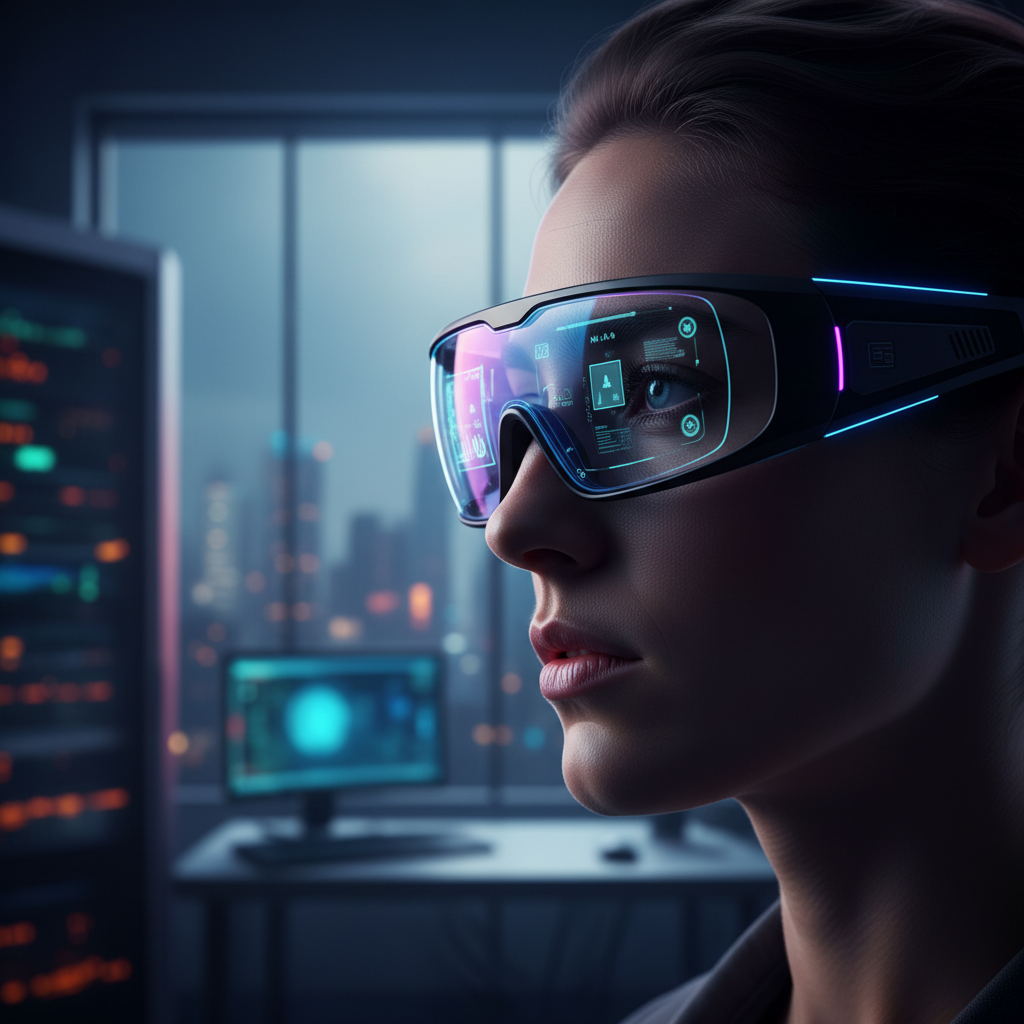
The promise of seamless augmented reality, woven directly into our perception, has long captivated the tech world. Google’s latest foray into AI-powered smart glasses brings us tantalizingly close to that future, offering a glimpse into a world where information and assistance are always just a glance away. We recently had the chance to go hands-on with a prototype of these innovative wearables, and while they’re not quite ready for prime time, their potential is undeniably revolutionary.
Stepping into a demo, the initial impression of Google’s AI glasses is one of cautious optimism. The design, while still prototype-level, shows a clear evolution towards subtlety compared to earlier iterations of smart eyewear. Sliding them on, the initial focus isn’t on the hardware itself, but on the discreet, almost magical layer of digital information that suddenly becomes part of your reality.
Stepping Into the Future: Key Features
One of the most impressive and immediately impactful features demonstrated was real-time language translation. Imagine conversing with someone speaking a different language, and seeing their words appear as captions right before your eyes, almost like subtitles for real life. This capability alone has profound implications for travel, international business, and connecting diverse communities.
Beyond translation, the glasses showcase powerful visual AI capabilities, offering instant information about the world around you. Point your gaze at a landmark, an unfamiliar plant, or even a product on a shelf, and the glasses can identify it, pulling up relevant facts, history, or reviews. This turns every interaction into a learning opportunity, providing context and knowledge on demand without ever breaking your stride.
The integration with Google’s broader ecosystem also shines through, offering hands-free navigation overlays that guide you precisely down city streets. Notifications from your phone appear subtly in your peripheral vision, allowing you to stay connected without constantly pulling out a device. Voice commands facilitate seamless interaction, making the glasses a truly intuitive personal AI assistant.
The “Almost There” Reality Check
Despite these incredible advancements, the “almost there” sentiment is palpable when considering the current prototype. The form factor, while improved, still feels a bit too substantial for all-day, everyday wear. Comfort and aesthetics are critical hurdles for mass adoption, and Google is clearly still refining the balance between necessary hardware and desirable design.
Performance, though impressive for a prototype, also presented occasional stutters or a slight lag in AI processing, particularly with complex visual tasks. Battery life, a perennial challenge for all wearable tech, remains a significant constraint, limiting the duration of seamless, continuous use. These are crucial areas where further optimization is needed to deliver a truly uninterrupted experience.
The display itself, while clear and vibrant, offers a relatively confined field of view for the augmented reality elements, feeling less like a full overlay and more like a smart heads-up display. User interface interactions, primarily voice-driven, are intuitive but still require precise commands, indicating room for growth towards more naturalistic, context-aware input methods.
The Road Ahead for Wearable AI
The demo of Google’s AI glasses leaves us with an overwhelming sense of excitement for what’s to come. This technology has the potential to fundamentally change how we interact with information, each other, and the world itself, dissolving digital barriers and augmenting human capability. From enhancing accessibility to transforming education, the applications are boundless.
Google faces the familiar challenge of turning groundbreaking technology into a refined, user-friendly product that people genuinely want to integrate into their daily lives. Overcoming the current limitations in design, performance, and battery efficiency will be key to unlocking the true potential of these smart glasses. The journey to a truly ubiquitous wearable AI experience is complex, but the initial steps are profoundly promising.
Ultimately, Google’s AI glasses, even in their current “almost there” state, offer a compelling vision of the future. They represent a significant leap forward in wearable artificial intelligence, proving that the dream of seamless, intelligent assistance woven into our visual world is no longer science fiction. We eagerly await the next iteration, confident that with continued innovation, these glasses will one day be an indispensable part of our connected lives.
Source: Google News – AI Search
