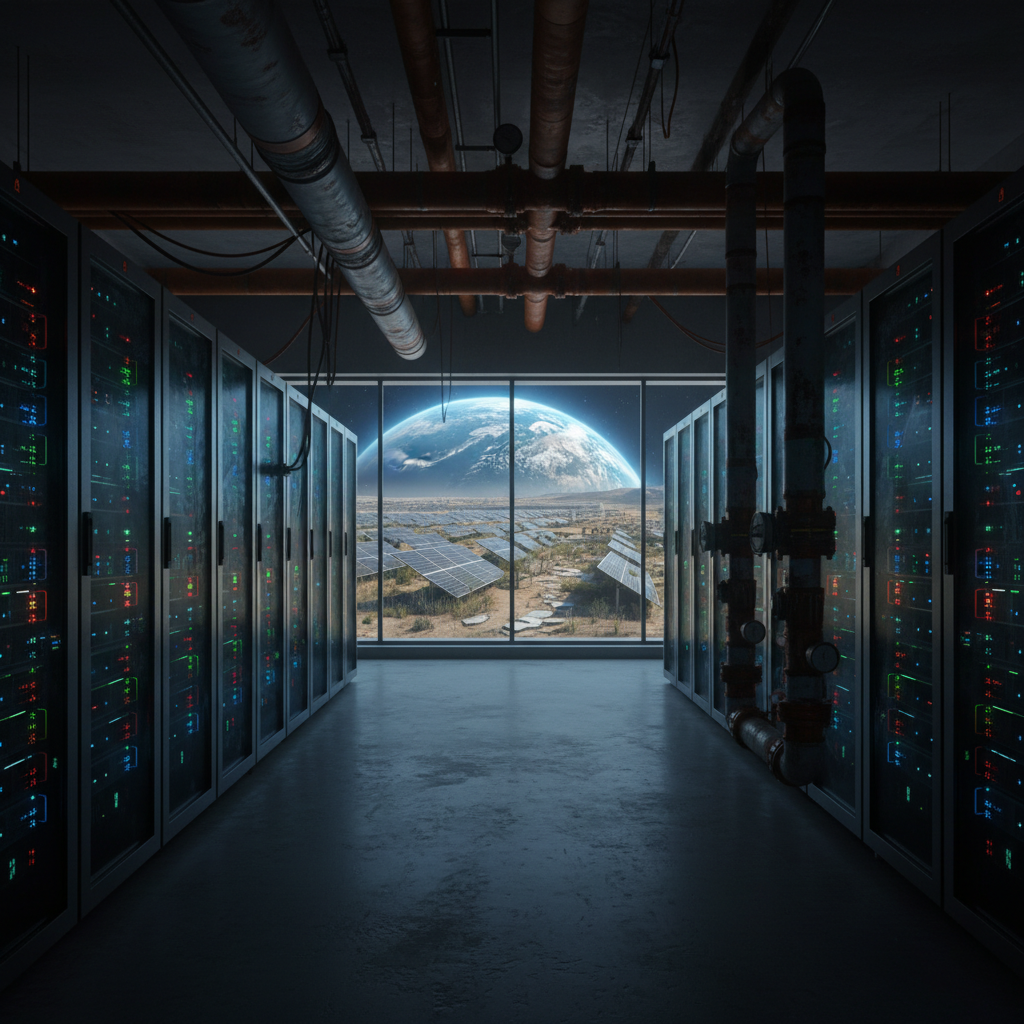
Elon Musk, a name synonymous with electric vehicles and sustainable energy, appears to be charting a surprising new course for his AI ventures. Recent revelations from the SpaceX IPO filing hint at a significant pivot, suggesting a potential departure from his long-held vision of a purely solar-electric economy, at least here on Earth.
For years, Musk’s Tesla Master Plans have championed the electrification of our economy, with the explicit goal of transitioning away from fossil fuels. His original ethos was clear: “the overarching purpose of Tesla motors…is to help expedite the move from a mine-and-burn hydrocarbon economy towards a solar electric economy.” This commitment has been a foundational pillar of his empire.
A Shifting Energy Strategy for xAI
However, a curious development has emerged within Musk’s burgeoning AI company, xAI. The company has reportedly embraced traditional fossil fuels, utilizing dozens of unregulated natural gas turbines to power its data centers.
Furthermore, xAI plans to invest an astonishing $2.8 billion more in these gas turbines, effectively cementing natural gas’s role in its AI operations. This strategy stands in stark contrast to the clean energy principles that built the Tesla brand and seems to contradict the spirit of inter-company synergy seen elsewhere.
Musk’s companies often cross-purchase: SpaceX famously spent $131 million on 1,279 Cybertrucks, and xAI itself has invested $697 million in Tesla Megapacks, its grid-scale battery storage systems. These Megapacks are intended for managing peak loads, yet, tellingly, xAI has not made any materially significant purchases of solar panels from Tesla to date.
The Lure of Space-Based Solar
While terrestrial solar power seems to be taking a backseat for xAI’s immediate energy needs, solar isn’t absent from Musk’s broader vision; it’s just been relocated. The SpaceX IPO filing prominently positions space-based solar power as the future for data center energy, highlighting its perceived superiority over Earth-bound alternatives.
SpaceX claims that solar arrays in orbit can generate “more than five-times the energy” of their terrestrial counterparts. This significant boost is attributed to the constant 24/7 illumination experienced outside Earth’s atmosphere, avoiding night cycles and weather interference.
This fascination with orbital energy sources aligns with a growing trend among Silicon Valley executives, particularly as AI data centers face increasing opposition and logistical challenges on Earth. The concept of placing massive server racks in space, perpetually powered by the sun, offers an enticing solution to these terrestrial constraints, including local resistance (NIMBYism).
However, the journey to space-based data centers is fraught with considerable challenges, making the economics “challenging at best.” Power prices for existing Starlink satellites are already multiples higher than what a typical terrestrial data center incurs.
Beyond energy costs, protecting sensitive computer chips from the harsh environment of space – with its radiation, extreme temperatures, and vacuum – presents significant engineering and financial hurdles. Moreover, it remains unclear whether AI training workloads can be efficiently distributed across multiple satellites, meaning a substantial portion of AI development may need to remain Earth-bound for the foreseeable future.
Extrapolating AI Demand and Terrestrial Reality
Musk likely views xAI’s current natural gas-powered data centers as temporary solutions, anticipating a future where SpaceX can launch “gigawatts worth of servers into orbit.” In his mind, this future might be just a few years away, rendering current terrestrial infrastructure, including those new natural gas turbines, obsolete.
This perspective is driven by Musk’s “first principles” thinking and his concern that AI’s computing demands will rapidly overwhelm Earth’s existing capabilities. The SEC filing is sprinkled with references to “terawatt-scale annual AI compute growth,” a staggering figure considering that all of the world’s data centers currently consume around 40 gigawatts annually.
Musk’s companies argue that “third-party estimates on data center demand are constrained by the practical supply limitations that exist in a terrestrial context.” They believe the impending power shortage for AI may be far greater than current research suggests, necessitating radical solutions like space-based infrastructure.
While it’s plausible that AI compute demand is entering a phase of exponential growth, such extreme extrapolations require careful consideration. Humanity currently uses approximately 35,000 terawatt-hours of energy annually, or about 4 terawatts on a continuous basis, for all its needs.
The practicalities of shipping solar panels via flatbed truck versus launching them into orbit also present a stark contrast in energy efficiency. Moreover, manufacturing space-ready solar panels at the unprecedented scale required for terawatt-level orbital data centers introduces immense logistical and production hurdles.
We’ve barely scratched the surface of solar’s immense potential here on Earth, with vast opportunities for improvement and expansion. The pursuit of ambitious space dreams should not necessarily negate the vital work of optimizing and deploying sustainable solutions right in front of us.
Just three years ago, Tesla’s “Master Plan Part 3” meticulously outlined a comprehensive “plan to eliminate fossil fuels.” It would be a strong, immediate step towards that vision to address the current energy strategy employed by xAI’s data centers.
Source: TechCrunch – AI
