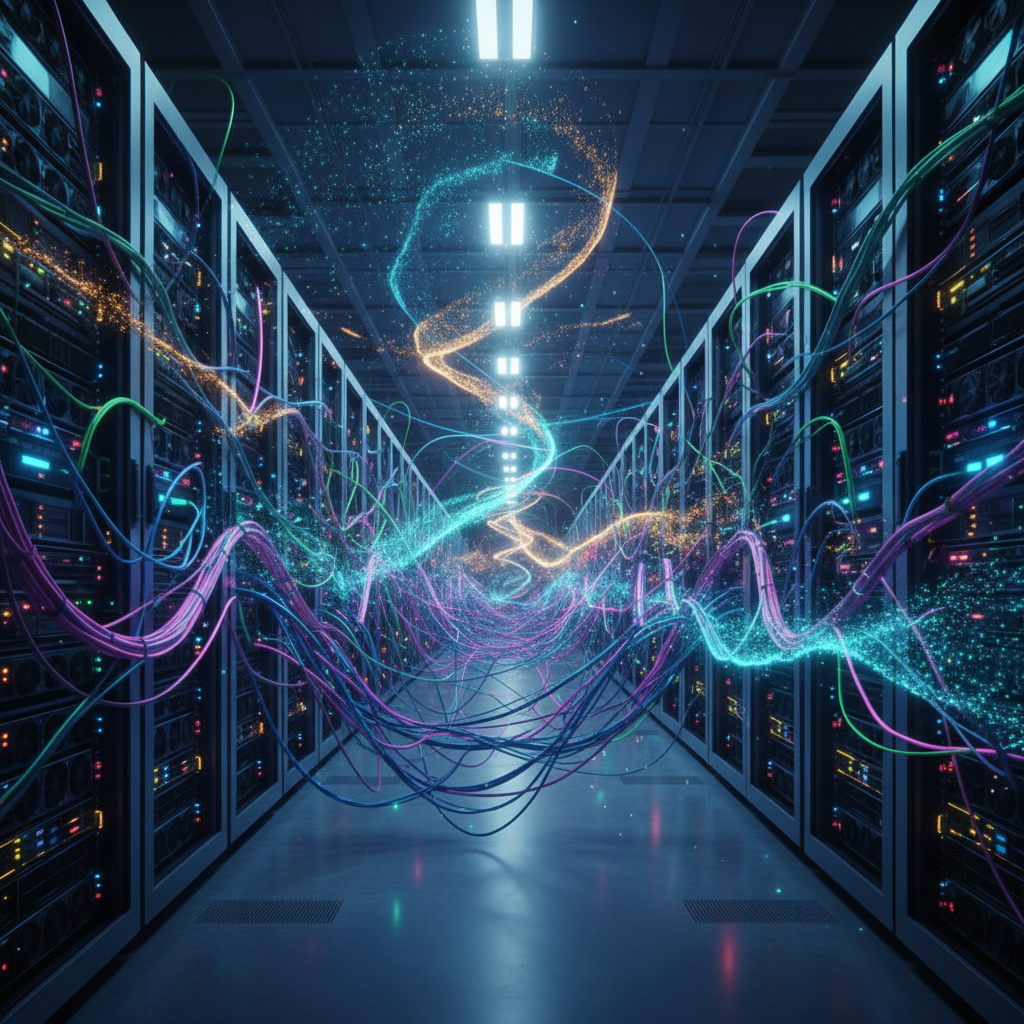
DeepMind, a leading artificial intelligence research lab, has consistently pushed the boundaries of what AI can achieve. From mastering complex games to accelerating scientific discovery, their innovative AI agents are redefining possibilities. But behind these groundbreaking achievements lies an immense engineering challenge: how do you scale sophisticated AI agents to operate efficiently and effectively within a global infrastructure like Google’s?
The journey from a laboratory prototype to a globally deployed AI system is fraught with computational hurdles and intricate logistical demands. This article explores the remarkable strategies and technologies DeepMind employs to run its powerful AI agents at an unparalleled scale, leveraging Google’s robust ecosystem. Discover how cutting-edge research seamlessly integrates with enterprise-level infrastructure, paving the way for the next generation of intelligent systems.
The Immense Challenge of AI Agent Scaling
Training and deploying advanced AI agents, particularly those based on reinforcement learning, demand colossal computational resources. Imagine an agent learning through millions of simulated interactions or processing petabytes of real-world data; this isn’t a task for a single server. Such agents require significant processing power for training, massive memory for storing experiences, and high-speed networks for data transfer.
Furthermore, the iterative nature of machine learning means experiments are constant, requiring rapid iteration cycles and efficient resource allocation. DeepMind’s agents often involve complex neural networks with billions of parameters, necessitating distributed training across thousands of processors. Managing this distributed workload while ensuring data consistency and experimental reproducibility presents a formidable engineering puzzle.
The scale of data involved is equally staggering, ranging from visual inputs and textual information to intricate reward signals. Efficient data pipelines are crucial to feed these agents continuously, preventing bottlenecks that could slow down learning or deployment. DeepMind’s ability to navigate these challenges is a testament to their innovative approach and the unparalleled support from Google’s infrastructure.
DeepMind’s Secret Sauce: Google’s Infrastructure and Custom Frameworks
One of DeepMind’s greatest assets is its integration within Google, granting it access to a computing environment unmatched by most research institutions. This synergy allows DeepMind to leverage Google’s vast data centers, powerful custom hardware, and highly optimized software frameworks. This includes an enormous fleet of Tensor Processing Units (TPUs), specifically designed for accelerating machine learning workloads.
TPUs are central to DeepMind’s ability to conduct large-scale experiments, enabling faster training times and the exploration of more complex models. Beyond hardware, DeepMind has developed and co-developed highly specialized frameworks and libraries that sit atop Google’s infrastructure. These tools are engineered to facilitate distributed training, asynchronous processing, and efficient resource management across thousands of machines.
For instance, their work often involves sophisticated distributed reinforcement learning architectures, where agents learn in parallel across many environments and processors. This requires robust orchestration systems capable of managing complex dependencies and ensuring optimal utilization of Google’s global computing grid. DeepMind’s mastery of these underlying systems is key to turning ambitious AI research into practical, scalable solutions.
Key Technologies and Methodologies for Scalability
DeepMind employs a suite of advanced technologies to manage and scale its AI agents effectively. Central to this is distributed training, where neural networks are broken down and trained across multiple compute units simultaneously. This significantly reduces the time required for model convergence and allows for the development of much larger, more capable agents than would otherwise be possible on single machines.
Another critical component is the development of custom machine learning frameworks and libraries, often built on top of TensorFlow or JAX. These frameworks are optimized for DeepMind’s specific research needs, enabling efficient data flow, gradient computation, and model updates in highly distributed settings. They also incorporate features for experiment tracking and reproducibility, essential for cutting-edge research.
- Asynchronous Architectures: Many DeepMind systems utilize asynchronous learning, allowing different parts of an agent (e.g., experience collection, policy updates) to operate independently, maximizing throughput.
- Optimized Data Pipelines: Robust and high-throughput data ingestion pipelines are crucial for feeding agents with vast amounts of training data, often involving sophisticated data compression and streaming techniques.
- Advanced Resource Schedulers: DeepMind leverages Google’s internal scheduling systems to dynamically allocate and manage compute resources (CPUs, GPUs, TPUs) efficiently across thousands of concurrent experiments.
- Cloud-Native Deployment: Their agents are designed for cloud environments, taking full advantage of Google Cloud’s elasticity and global reach for both training and eventual deployment.
The Impact and Future of Scaled AI Agents
The ability to run AI agents at Google’s scale has profound implications for the speed and scope of DeepMind’s research. It means they can tackle problems previously deemed intractable due to computational limits, accelerating breakthroughs in areas like protein folding with AlphaFold, or developing more generalized AI agents. This vast computational power allows for extensive hyperparameter tuning and exploring a broader range of architectural designs, leading to more robust and higher-performing models.
Furthermore, the experience gained from scaling these agents within Google’s infrastructure directly influences the development of new AI tools and methodologies that benefit the wider AI community. DeepMind’s contributions often lead to improvements in core machine learning frameworks and best practices for large-scale distributed training. As AI continues to evolve, the demand for even greater computational resources will only grow, making DeepMind’s expertise in scaling AI agents more vital than ever.
Looking ahead, the seamless integration of advanced AI research with industrial-grade infrastructure will continue to drive innovation. DeepMind’s work with Google’s scale doesn’t just push the boundaries of AI capabilities; it also sets new standards for how complex intelligent systems can be developed, deployed, and managed efficiently. Their journey offers a compelling blueprint for the future of AI development, where immense computational power meets groundbreaking algorithmic design.
Source: Google News – AI Search
