At ZDNET, our commitment is to provide you with honest, thoroughly researched, and dependable tech recommendations. We believe in transparency and dedicate countless hours to independent testing, ensuring that our advice is always grounded in fact and real-world performance.
Our “ZDNET Recommends” process involves comprehensive testing, in-depth research, and meticulous comparison shopping. We meticulously gather data from reputable sources, including official vendor information, detailed retailer listings, and a wide array of relevant, independent review sites. Crucially, we also pore over customer reviews to truly understand what matters to real users who interact with these products and services daily.
When you navigate from our site to a retailer and make a purchase, we might earn an affiliate commission. This financial model plays a vital role in supporting our extensive work, allowing us to continue delivering high-quality content. Rest assured, this never influences our editorial coverage, the products we choose to review, or the price you pay.
Our editorial team writes for you, our valued reader, with the singular goal of empowering you to make smarter buying decisions across a vast range of tech gear and services. Every article undergoes rigorous review and fact-checking to uphold the highest editorial standards. Should we ever make an error, we are committed to promptly correcting or clarifying the information, and we encourage you to report any inaccuracies you spot.
The Allure of a 1,000W Charger
Being a professional tech reviewer often brings some truly “interesting” products across my desk. While these aren’t Bugatti supercars or jewel-encrusted Fabergé eggs, they can certainly spark curiosity, sometimes with a concerning undertone of potential fire hazards. More often than not, I delve in, and I’m glad I did with my most recent submission.
The device in question was a charger making an astonishing claim: a full 1,000W of power distributed across ten ports. Specifically, it boasted four 140W USB-C ports, four 100W USB-C ports, and two 20W USB-A ports. Such specifications promise an unparalleled charging experience for a multitude of devices simultaneously.
However, the person who initially purchased this charger reported a worrying experience. They plugged it in, used it to charge their phone for only “a few minutes,” and quickly became concerned when it grew “a little hot,” prompting them to unplug it immediately. This initial report immediately raised red flags about the product’s safety and performance.
My own first impressions didn’t alleviate these concerns; the unit felt suspiciously light and plasticky, particularly for a device claiming to house a robust 1,000W power supply. For context, a legitimate 500W charger like Ugreen’s Nexode weighs nearly 5 pounds, making this featherlight impostor highly suspect. There was also a faint, tell-tale whiff of melty plastic, suggesting the initial overheating incident was more severe than “a little hot.”
Testing the “Too Good to Be True” Device
A gut feeling told me that the only way this charger would genuinely push out 1,000W was if it burst into flames. Clearly, talk is cheap when it comes to such ambitious claims, so it was time to put this charger through its paces with proper testing. Objective data was needed to confirm my strong suspicions.
I plugged the charger in, switched it on, and began my test protocol. Within a mere couple of minutes of activation, several alarming signs emerged: flickering lights, unsettling noises, and erratic power delivery. And then, with a dramatic and definitive “POP!”, the charger simply gave up the ghost.
Inside the Hazard: A Dangerous Teardown
With the unit now defunct, it was time for a teardown to understand its internal flaws. Shockingly, for a device that connects directly to mains power, it was astonishingly easy to pry open. A single, flimsy sheet of plastic was the only barrier separating curious hands from potentially lethal live AC power, an egregious safety oversight.
Even unplugged and visibly broken, the unit retained enough charge in some capacitors to deliver a significant zap. This highlights a terrifying safety flaw: if the case were to inadvertently open while still connected to an outlet, the consequences could easily be deadly. Such a design choice is simply unacceptable for a consumer electronic device.
Inside, I discovered a familiar grey goo, a thermal paste I’d encountered in other disappointing chargers. While intended to dissipate heat, here it was trapped within a sealed plastic box with no effective heatsink, rendering it utterly useless. In fact, this paste would likely create a thermal mass, slowly heating up and retaining dangerous temperatures.
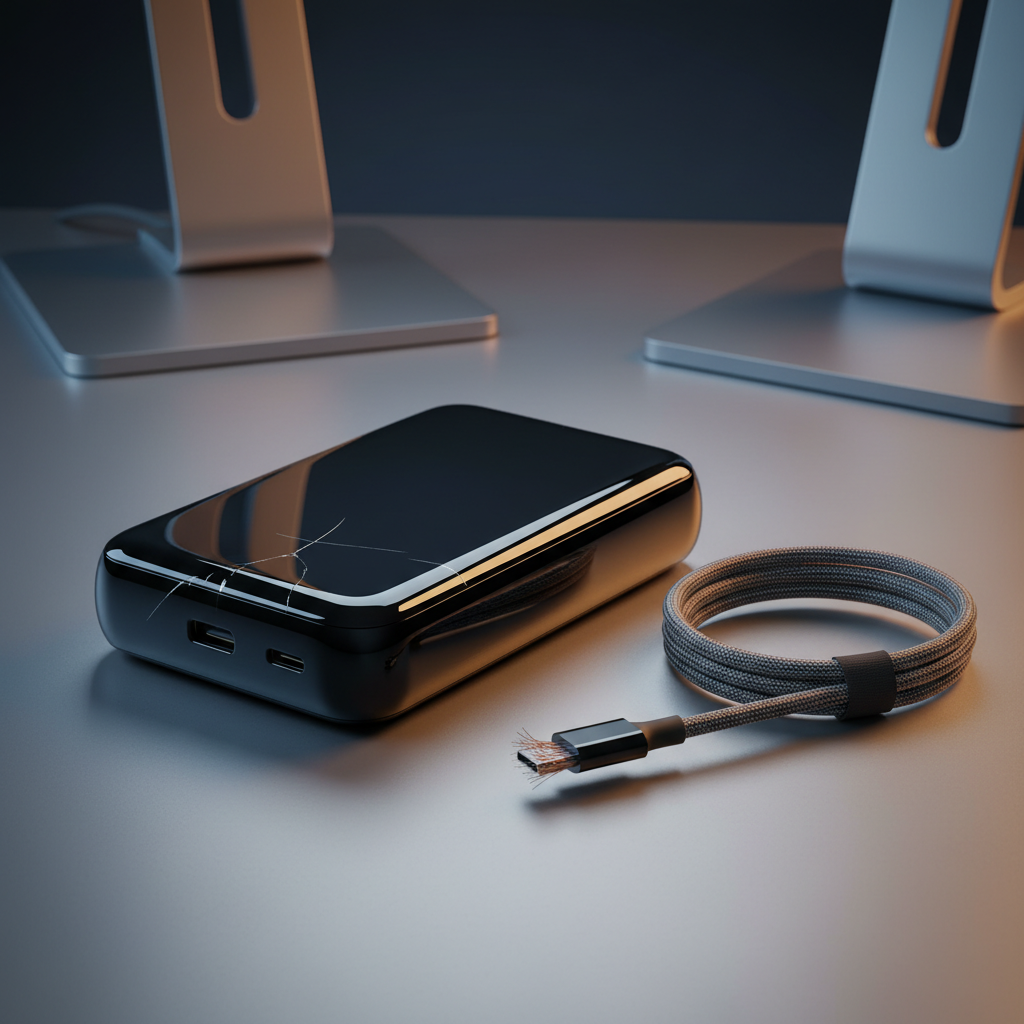
The primary cause of the failure was clear: a bank of capacitors, the black cylinders visible inside, had overheated, with three showing obvious signs of bulging. Furthermore, two crucial bridge rectifiers, responsible for converting AC mains power to DC, were poorly affixed at an angle, making only partial contact with a small metal heatsink. This inadequate cooling design was a recipe for disaster.
The “Scalewashing” Trap and Safer Alternatives
This charger is yet another cautionary tale of a “too good to be true” device biting the dust. It vividly illustrates how some manufacturers engage in “scalewashing,” using impressive, often exaggerated, numbers like 1,000W and a multitude of ports to mask fundamentally poor-quality products. It’s a marketing tactic designed to entice unsuspecting buyers with seemingly incredible value.
A product like this might be halfway decent if engineered for a much more modest 100W output, but that segment of the market is already fiercely competitive. Instead, slapping “1,000W” on the casing and sprinkling in a few dubious, scripted reviews suddenly makes it appear “interesting” and “exciting”—right up until it fails spectacularly. It’s a deceptive practice that puts consumers at risk.
Currently, I am unaware of any legitimate 1,000W USB-C charger available to consumers. The highest-power charger I have rigorously tested and confirmed as reliable is the Ugreen Nexode 500W charger, which comes with a legitimate price tag of around $250. This premium price reflects its robust construction and comprehensive safety features, including ingenious tip-over protection that cuts power if the unit is knocked over to prevent heat buildup.
The moral of the story is clear: true high-wattage power requires sophisticated engineering, quality components, and a significant investment in safety. If you genuinely need 1,000W of reliable power today, your safest and most effective solution would be to purchase two legitimate 500W chargers and utilize them together, rather than trusting a single, cheap, and potentially hazardous “1,000W” unit.
Source: ZDNet – AI
