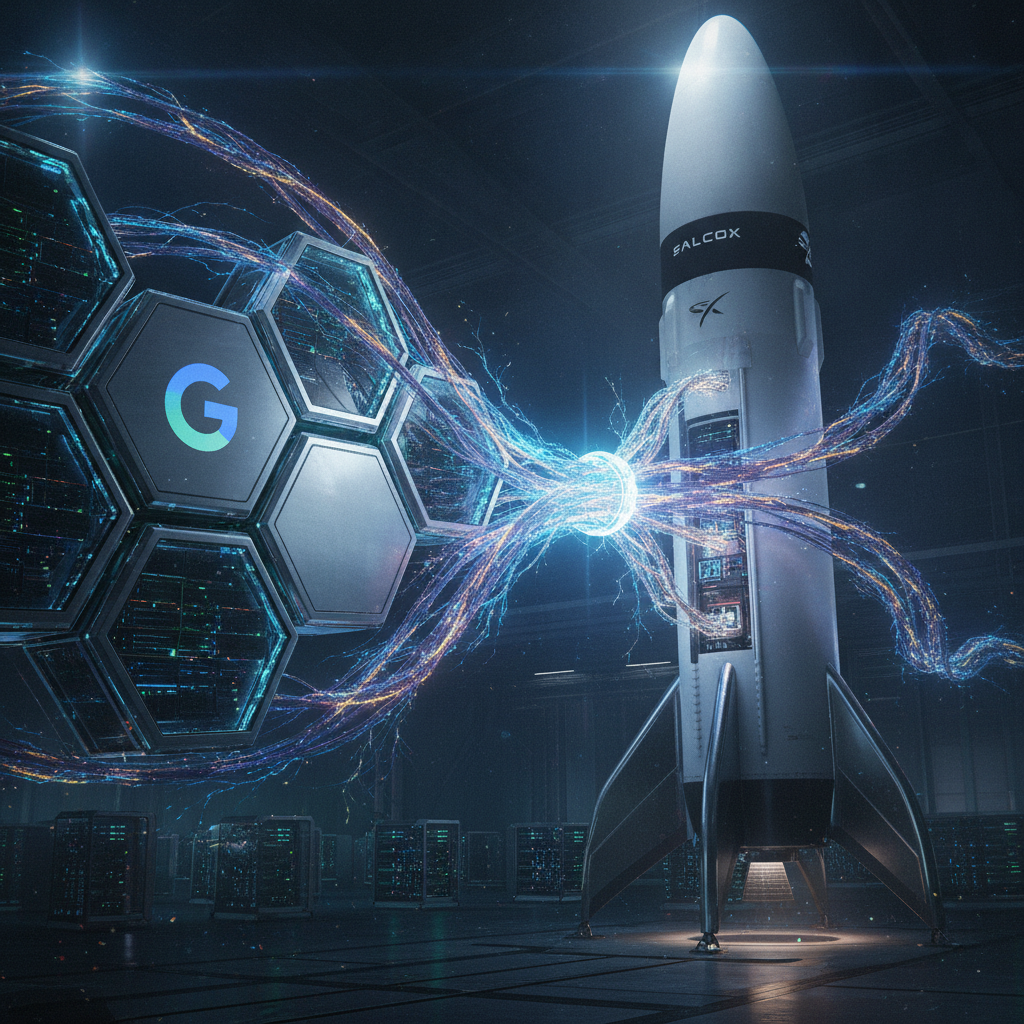
In a groundbreaking development that has sent ripples across the technology landscape, aerospace giant SpaceX has reportedly secured a monumental deal with Google for its artificial intelligence compute services. This unprecedented partnership highlights the escalating demand for robust computational power in the rapidly evolving world of AI.
The collaboration signifies a profound convergence of cutting-edge space technology and advanced machine learning capabilities. It’s a testament to the immense infrastructure required to fuel the next generation of artificial intelligence and innovation.
A Colossal Investment in AI Compute
At the heart of this landmark agreement lies a staggering financial commitment. Reports indicate that Google is set to invest an astounding ₹8,735 Crore per month into SpaceX’s AI compute resources. This figure, translating to over a billion US dollars monthly, underscores the sheer scale of operations Google is undertaking to advance its AI initiatives.
Such a substantial monthly expenditure positions this deal as one of the most significant technology infrastructure contracts in recent history. It reflects Google’s strategic imperative to maintain its leadership position in AI development, requiring an unparalleled dedication of computational muscle.
This unprecedented monthly investment is not just about raw processing power; it’s about securing a dedicated, high-performance environment tailored for the most demanding AI tasks. This could involve highly specialized GPU clusters, custom AI accelerators, or a combination designed to optimize Google’s proprietary machine learning frameworks and large language models.
The specifics of the compute services involved are expected to encompass high-performance processing for complex machine learning models. This could include training neural networks, processing vast datasets, and running intricate AI simulations, all critical for Google’s ambitious AI research and product development.
Why SpaceX? The Power of Distributed Intelligence
The choice of SpaceX as a partner for such a critical infrastructure deal is particularly intriguing and strategic. While not traditionally known as a conventional cloud computing provider, SpaceX’s growing Starlink satellite constellation offers a unique and potentially revolutionary platform for distributed computing.
The infrastructure provided by SpaceX, likely leveraging its advanced Starlink satellite constellation, offers unique capabilities that differentiate it from conventional cloud providers. This could include unparalleled geographic flexibility, allowing Google to run AI operations in locations previously constrained by terrestrial fiber optic networks, crucial for global data processing and real-time AI applications.
One primary advantage could be geographical redundancy and resilience, especially for operations requiring data processing in remote or underserved areas. Leveraging Starlink’s global reach could enable Google to deploy AI workloads with unprecedented flexibility and speed, bypassing traditional terrestrial limitations.
Furthermore, SpaceX’s expertise in large-scale infrastructure deployment and its rapidly expanding network could provide a bespoke, high-bandwidth environment. This might offer Google dedicated resources that are less prone to the congestion or shared resource limitations sometimes experienced in public cloud environments.
Such a partnership hints at a future where computing infrastructure isn’t just ground-based but extends into a truly global, distributed network spanning both terrestrial and orbital domains. This innovative approach could dramatically enhance the resilience and availability of critical AI resources, mitigating risks associated with localized outages or geopolitical factors.
The partnership could also hint at future innovations, potentially exploring edge computing capabilities directly within the Starlink network. Imagine AI models being trained or inference tasks performed closer to the data source, even in space, leading to lower latency and enhanced efficiency for specialized applications.
- Global Reach: Utilizing Starlink’s low-latency, high-bandwidth satellite internet for distributed AI workloads.
- Dedicated Resources: Potential for customized, high-performance compute environments designed for specific AI tasks.
- Strategic Resilience: Enhancing data processing capabilities in diverse and potentially remote locations, independent of terrestrial infrastructure.
- Future Innovations: Exploring advanced edge computing and AI processing closer to the data source, including potential applications beyond Earth.
Implications for the Future of AI and Tech Partnerships
This massive compute deal between SpaceX and Google is far more than a simple transaction; it’s a powerful indicator of future trends in technology. It demonstrates that the demand for AI compute is not just growing, but is exploding to scales previously unimaginable, requiring novel infrastructure solutions.
For Google, securing such extensive and potentially specialized compute capacity provides a formidable competitive advantage. It ensures the company can continue to innovate at an aggressive pace, translating cutting-edge research into practical applications that redefine user experiences and enterprise solutions across its vast ecosystem.
For SpaceX, this deal represents a significant diversification of its revenue streams beyond launch services and Starlink subscriptions. It validates the potential of its network as a foundational infrastructure for advanced computing, opening doors to new business models and applications for its satellite technology and engineering prowess.
This strategic alliance also underscores a broader industry trend: the increasing vertical integration of technology companies and their suppliers. As AI becomes more central to business operations, companies are seeking more direct control or bespoke access to the foundational compute infrastructure that powers their innovation engines.
The collaboration also sets a precedent for how major tech players might forge unconventional alliances to meet their strategic needs. As technology advances, we can expect to see more cross-industry partnerships that leverage unique capabilities to solve complex challenges, pushing the boundaries of what’s possible in the digital and physical realms.
The reported ₹8,735 Crore per month AI compute deal between SpaceX and Google is a monumental agreement with far-reaching implications. It underscores the insatiable appetite for computational power in the age of AI and showcases the innovative ways companies are forging alliances to meet these demands.
As both companies continue to push the frontiers of their respective fields, this partnership could very well define the next era of AI development and high-performance computing, both on Earth and potentially beyond. It’s a bold step into a future where the sky is no longer the limit for technological ambition.
Source: Google News – AI Search
