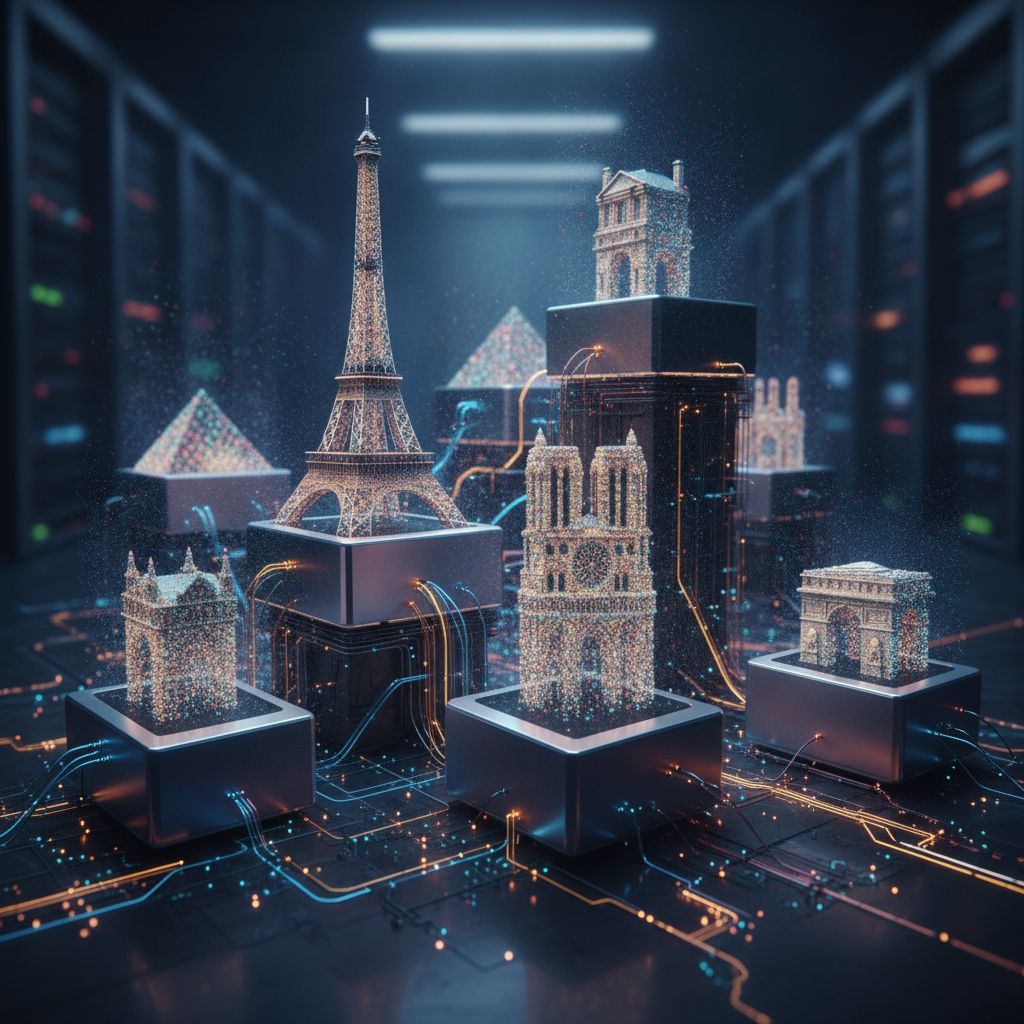
Imagine creating a stunning 3D gallery showcasing the iconic monuments of Paris, complete with intricate Gaussian splats, without ever opening an image generator or touching a 3D reconstruction tool yourself. This isn’t a futuristic dream; it’s a reality made possible by AI agents and a groundbreaking shift in how we build multimedia software. We recently witnessed an AI agent craft such a gallery by simply calling two specific Hugging Face Spaces, then seamlessly wiring their outputs into a captivating cinematic viewer.
This remarkable feat highlights a pivotal moment in technology. It’s a preview of how a significant portion of multimedia software will be constructed moving forward, emphasizing modularity and autonomous assembly. The traditional complexities of asset generation and integration are being transformed by intelligent agents orchestrating specialized AI components.
The Building Block Economy Comes for AI
Mitchell Hashimoto eloquently described a phenomenon he calls the “building block economy,” where the most effective path to software isn’t through monolithic applications but via small, well-documented components. These components are then intelligently assembled by others, increasingly by AI agents. His core insight is profound: while AI can attempt to build everything from scratch, it truly excels at connecting proven, modular pieces.
While this thesis has largely been applied to code libraries, these same forces are now dramatically impacting multimedia AI. Historically, the most challenging aspect of leveraging state-of-the-art models for images, video, text-to-speech, or 3D reconstruction wasn’t the model itself. The real hurdle was the intricate integration—dealing with SDKs, managing weights, allocating GPUs, and conforming to various input/output formats.
What if each cutting-edge model could instead function as a documented, callable building block? An AI agent could then effortlessly glue these specialized blocks together, much like a developer combines npm packages today. This vision is precisely what Hugging Face Spaces are quietly, yet powerfully, becoming.
Hugging Face Spaces: Your New AI Primitives
The Hugging Face Hub hosts thousands of state-of-the-art models, many of which are open-weights and deployed as interactive Spaces. Crucially, every Gradio Space now also exposes a plain-text agents.md file, providing an agent with explicit instructions on how to interact with it. This means an agent can understand everything it needs in one shot.
A simple curl command, for instance, to https://huggingface.co/spaces/VAST-AI/TripoSplat/agents.md will return the full API schema URL, call and poll templates, file upload instructions, and authentication hints. There’s no need for complex client libraries or hardcoded integrations; an agent simply reads this documentation and can drive the Space end-to-end, often just needing an HF_TOKEN for authentication.
The true power lies in chaining these Spaces together. The output from one Space can seamlessly become the input for the next, creating sophisticated, multi-stage pipelines. This transformative capability—for example, a prompt leading to an image, then that image transforming into a 3D asset—forms the entire backbone of the Parisian gallery project.
A Parisian Showcase: From Prompt to 3D Splat
For our 3D Paris gallery, the AI agent skillfully chained two specific Hugging Face Spaces. It began by using ideogram-ai/ideogram4 for image generation, crafting six distinct images of Parisian monuments, all isolated on black backgrounds. These perfectly prepared images were then ready for the next stage: single-image 3D reconstruction.
Next, the agent fed these generated images into VAST-AI/TripoSplat, a Space designed for 3D Gaussian splatting. But the agent’s work didn’t stop there; it also handled all the crucial “glue” work. It noticed the TripoSplat outputs were Y-down and automatically flipped them upright, intelligently auto-framed each monument, and compressed the generated .ply files into much smaller .ksplat files for faster loading.
Finally, the agent constructed a bespoke Three.js viewer complete with a scroll-to-switch and drag-to-rotate user interface, then deployed the entire interactive experience as a static Space. Human input was minimal, mostly confined to taste-level adjustments like “make it zoomed out,” “replace the obelisk with something better for splatting,” or “the transition lingers too long.” This iterative, conversational approach, where the agent reacts to real-world outcomes (e.g., a wide glass pyramid splatting poorly), embodies the “outsourced R&D, fast iteration” loop that the building-block economy predicts.
The Future is Composable: Why This Matters
This paradigm shift offers profound implications for AI development and multimedia creation:
- Models become effortlessly composable: Imagine chaining a state-of-the-art splat model from one organization with a cutting-edge image model from another, all with zero integration code. The Hugging Face Hub transforms into a dynamic library of callable multimedia primitives.
- Agents gravitate towards accessibility: Agents naturally prefer tools that are well-documented and easily reachable. The
agents.mdfile makes a Space trivially accessible, ensuring agents will choose it over models requiring manual setup. This mirrors the dynamic Mitchell Hashimoto identified for open-source code libraries. - The integration barrier crumbles: What used to be a daunting, multi-week project—like turning a text prompt into a rotating 3D monument—now becomes a straightforward step within a larger pipeline. The technical overhead that once slowed innovation is largely eliminated.
We encourage you to experience this powerful new approach yourself. Point your own coding agent (such as Claude Code) at a Space’s agents.md and watch it create. You can explore image generation with curl https://huggingface.co/spaces/ideogram-ai/ideogram4/agents.md or delve into single-image to 3D Gaussian splatting via curl https://huggingface.co/spaces/VAST-AI/TripoSplat/agents.md.
Simply paste either link into your agent, set your HF_TOKEN, and challenge it to build something innovative. The complete, reproducible pipeline that created our Parisian gallery, including the scripts that accessed these agents.md endpoints, is readily available in the Space repo. The essential building blocks are waiting on the Hub, and your agents are ready to connect them.
Source: Hugging Face Blog
