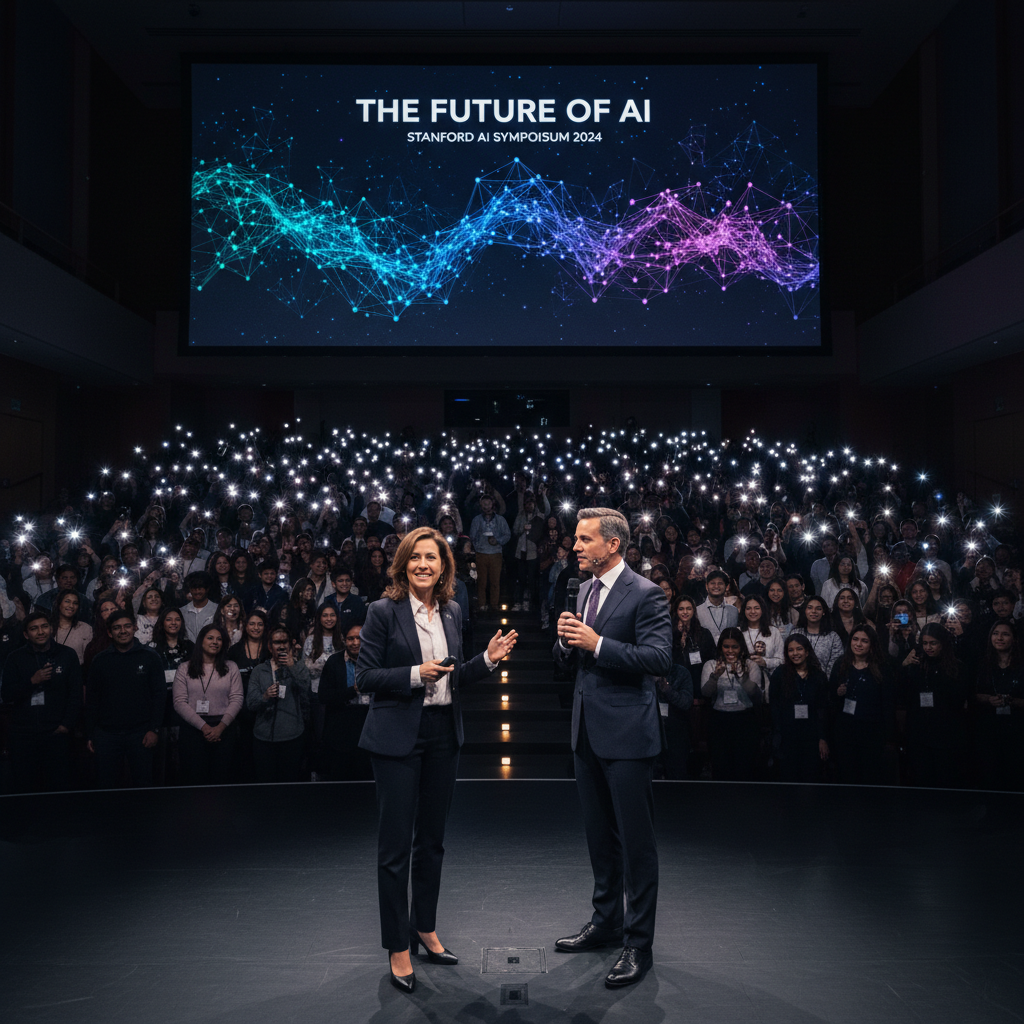
While thousands of music lovers flocked to Southern California for the annual Coachella Music Festival, a different kind of “AI Coachella” was making waves a few hundred miles north in Palo Alto. This unique program, Stanford’s CS 153, has become one of the university’s most sought-after courses this semester. It features an impressive lineup of “celebrities”—not pop artists, but some of the biggest names in Big Tech.
The course is co-taught by Anjney Midha, a former Andreessen Horowitz general partner, and Michael Abbott, Apple’s former VP of engineering for cloud services. Their guest lecturer list reads like a who’s who of the tech world, boasting figures such as OpenAI CEO Sam Altman, Nvidia CEO Jensen Huang, and Microsoft CEO Satya Nadella. Other prominent speakers include AMD CEO Lisa Su, Anthropic philosopher Amanda Askell, and White House Senior Policy Advisor for AI Sriram Krishnan.
The Hottest Ticket in Silicon Valley Education
This is the fourth year Midha and Abbott have taught a version of this class, and its popularity is undeniable. The 500 available seats were snapped up almost instantly when registration opened, leaving dozens on the waitlist and thousands more tuning in via YouTube lectures. Stanford’s appeal has long included unparalleled access to Silicon Valley’s elite, with its campus a stone’s throw from legendary venture capital firms on Sand Hill Road.
CS 153 exemplifies this blend of education and insider access, which has also sparked a lively debate. After a screenshot of the guest lecturer lineup went viral, some critics questioned whether students were truly getting an education or just attending an expensive live podcast. On campus, there’s been talk of other professors expressing discomfort with what some perceive as a celebration of raw corporate power.
Jesse Mu, a researcher at Anthropic, notably quipped on X, “Protip for Stanford undergrads: beware the classes with guest speaker lineups that read like AI coachella. You’re basically paying $5k to listen to a live podcast series.” Another Stanford research fellow, Luke Heeney, humorously contrasted the packed CS 153 with a sparsely attended functional analysis class, urging students to “Remember to eat your veggies.”
“AI Coachella”: A Feature, Not a Bug
Anjney Midha, however, has embraced the “AI Coachella” moniker. He’s even ordered 500 T-shirts for his students, emblazoned with “I took CS 153 and all I got was AI coachella.” Midha views the criticism as “red teaming” his system, stating, “I was like, huh, AI Coachella? Is that a feature or a bug? That’s totally a feature. That’s product market fit.”
Midha and Abbott recently launched their own venture firm, AMP, which aims to provide AI startups with both capital and computing capacity. Midha transparently shared with the class that he has invested in several companies led by guest lecturers, including Black Forest Labs, Mistral, Sesame, and Periodic Labs. This direct connection, while raising eyebrows for some, is precisely what makes the class so compelling to others.
So, what exactly do students learn in this highly sought-after course? CS 153 delves into frontier AI systems, a topic often only briefly touched upon in traditional undergraduate computer science curricula. Midha’s inaugural lecture, for instance, focused on the computing infrastructure vital for AI models, arguing that AI chips are not commoditizing. He even shared internal charts from AMP to illustrate the recent increase in Nvidia H100 prices.
More Than Just Tech Insights
Midha, a Stanford alumnus himself, sees the class as providing students with a “cheat code” to insider knowledge. “I have so much inside access and information,” he explains. “I was like, okay, this is obvious to me. I should just give the students a chance to learn, instead of the VCs hoarding all the knowledge.”
Students like sophomore Mahi Jariwala and junior Darrow Hartman confirm the class’s value. Jariwala appreciates the opportunity to engage directly with successful investors and entrepreneurs, asking questions that offer real-world insights. Hartman notes that CS 153 provides a valuable high-level overview of the startup world and helps him connect with like-minded peers. Both students acknowledge it’s their “fun class” alongside their more rigorous academic commitments.
Surprisingly, Midha also integrates lessons on navigating life amidst the AI boom. Early in his opening lecture, visibly emotional, he spoke about “Anj’s life scaling laws,” emphasizing the importance of investing in personal relationships alongside professional pursuits. He candidly shared how he had been too busy for the real Coachella, but met his wife and future co-founders at Stanford, highlighting the importance of the university’s social fabric.
Midha recounts starting the class during a personally challenging period, finding purpose and enjoyment in teaching with Abbott. He’s genuinely surprised by the number of high-profile entrepreneurs who agree to speak, believing they share his motivation: finding renewed meaning and nostalgia in mentoring the next generation of innovators. While “AI Coachella” encapsulates the current moment in Silicon Valley, its blend of insider access and practical wisdom undeniably enhances Stanford’s educational appeal, especially in an era where the value of traditional college education is constantly re-evaluated.
Source: Wired – AI
