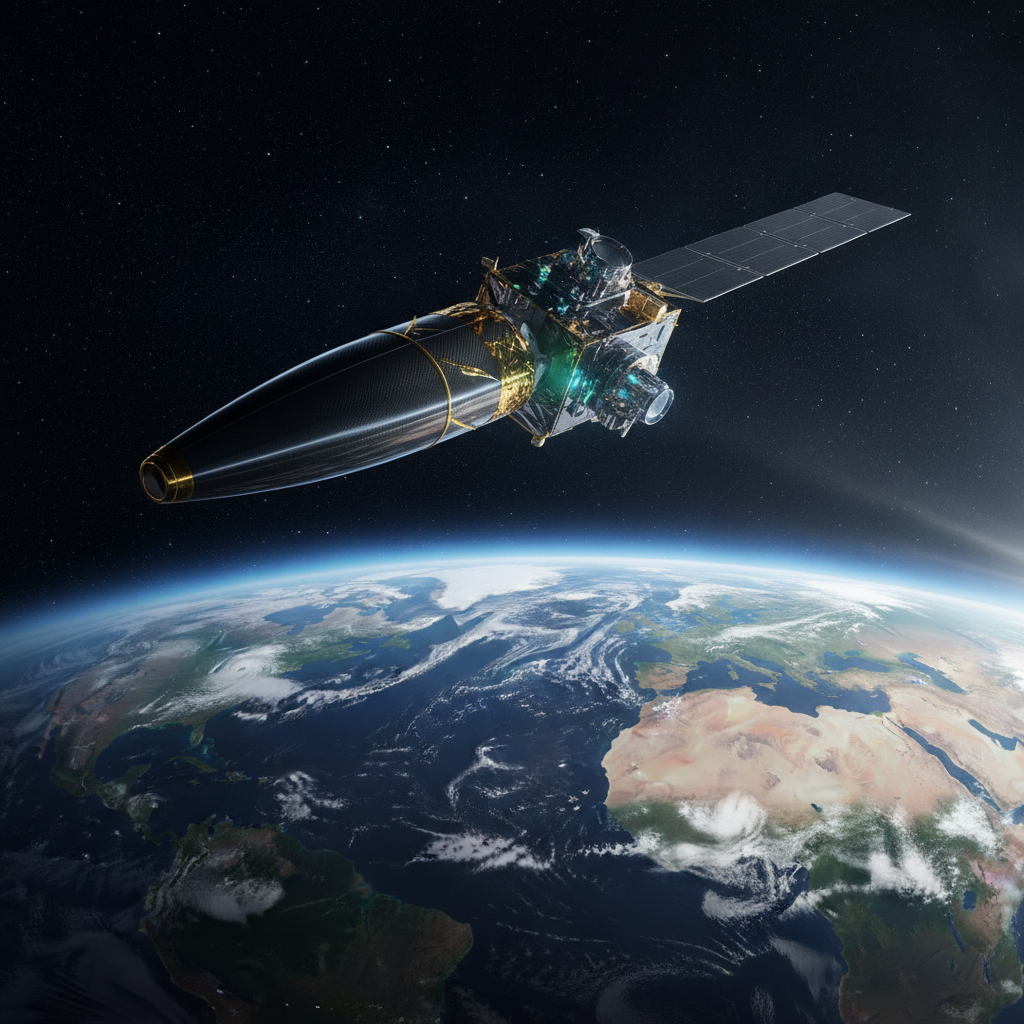
A groundbreaking moment recently unfolded in orbit, as an Earth observation satellite accomplished an unprecedented feat: it independently identified what it was looking for, without any human intervention on the ground. This remarkable milestone, achieved in April, marks the first reported use of a vision-language model (VLM) in space, signaling a paradigm shift for satellite capabilities. It offers a compelling glimpse into how artificial intelligence is poised to fundamentally redefine the utility and value of space-based sensors.
Historically, satellites captured vast amounts of raw data, which was then downloaded to Earth for human analysts or ground-based machine learning algorithms to sift through. This traditional approach often led to a deluge of information that required significant time and resources to process and interpret. However, the recent demonstration aboard Yam-9, a spacecraft built by space infrastructure company Loft Orbital, has introduced a revolutionary alternative.
Onboard Yam-9, a specialized software package developed by NASA’s Jet Propulsion Laboratory (JPL) took center stage. This innovative system successfully identified areas of interest directly in response to natural language queries. Powering this impressive capability was Google DeepMind’s Gemma 3, a vision-language model specifically engineered for “edge” applications.
Gemma 3 is purpose-built to run efficiently on limited hardware, far removed from traditional data centers, making it ideal for the confines of space. This VLM deftly combines the nuanced contextual understanding of large language models with the critical ability to analyze complex imagery. Researchers challenged the model with tasks like classifying areas where natural environments meet human development and identifying infrastructure around railway hubs—and it performed flawlessly.
The On-Orbit AI Breakthrough: Smarter Satellites
This groundbreaking demonstration holds immense significance for the immediate future of space technology. In the near term, it promises to make space sensors exponentially more useful by performing initial data triage directly in orbit. This on-board processing capability dramatically reduces the overwhelming flood of raw data that analysts currently contend with, streamlining workflows and accelerating insights.
Looking further ahead, this achievement serves as a powerful proof point for the eventual deployment of larger-scale AI infrastructure throughout space. Paul Lasserre, Loft Orbital’s head of AI, highlighted its potential, stating it “opens the door to always-on, patrol layers in space.” He envisions a future where users can interact with satellites, asking them to “monitor this border for me, and let me know when something is suspicious.”
Loft Orbital designs its spacecraft as versatile platforms for third-party customers, operating on an “infrastructure-as-a-service” model rather than just manufacturing satellites. Yam-9 itself was launched in the fall of 2025 as a pathfinder for the company’s ambitious orbital AI projects. Crucially, it houses an Nvidia Jetson Orrin AGX GPU, a leading chip for space computing, enabling its advanced AI operations.
The core intelligence facilitating this achievement was NAVI-Orbital, a sophisticated software package spearheaded by Juan Delfa Victoria, a technical leader in NASA JPL’s AI group. While Gemma 3 is an off-the-shelf VLM, JPL engineers meticulously streamlined the software. Their efforts focused on drastically reducing the required libraries and memory, ensuring optimal performance within the stringent constraints of orbital hardware.
Pioneering the Future of Space Intelligence
While this marks the inaugural reported instance of a VLM operating in orbit, the industry is quickly moving in this direction. Companies like Planet Labs already deploy satellites equipped with Jetson Orin processors. Although currently used for simpler object detection, a spokesperson confirmed that extensive research is underway into other advanced AI applications, including vision-language models.
Kepler Communications, known for operating the largest constellation of GPUs in space, remained tight-lipped about their specific VLM deployments due to partner confidentiality. However, they hinted at significant progress, noting “several undisclosed use cases of our compute environment” since their latest spacecraft launched in January. This suggests a broader trend towards advanced on-orbit processing.
Loft Orbital’s Lasserre emphasized, “Now that we’ve proven the concept, that’s really the direction of travel.” The ultimate goal is to expand the constellation to achieve real-time coverage across the entire Earth. This ambitious vision would necessitate a network of approximately 50 to 100 satellites similar to Yam-9, building upon Loft’s current operational fleet of 12 spacecraft.
The invaluable lessons gleaned from deploying these smaller, yet powerful, AI models in orbit will be critical. These insights will directly inform how companies approach the challenges of implementing even larger-scale compute infrastructure in space. Key areas of focus include the prosaic-but-vital aspects of efficient power and memory management, crucial for sustainable long-term operations.
Beyond Earth Observation: AI for Astronauts
This leap in orbital AI also has the potential to unlock entirely new scientific tools, extending its impact far beyond Earth observation. The initial spark for NAVI-Space, the broader project of which NAVI-Orbital is a part, came from JPL Researcher Taran Cyriac John. His vision centered on developing advanced digital assistants to support astronauts exploring distant worlds like the Moon or Mars.
Delfa Victoria elaborated on this profound potential, noting the challenges astronauts face with bulky pressurized suits that impede keyboard use. He explained, “So, how about we provide an assistant, like in video games and in movies, where you see an AI which is interactive?” This human-like interaction could revolutionize how astronauts perform complex tasks and manage missions in extreme environments.
Source: TechCrunch – AI
