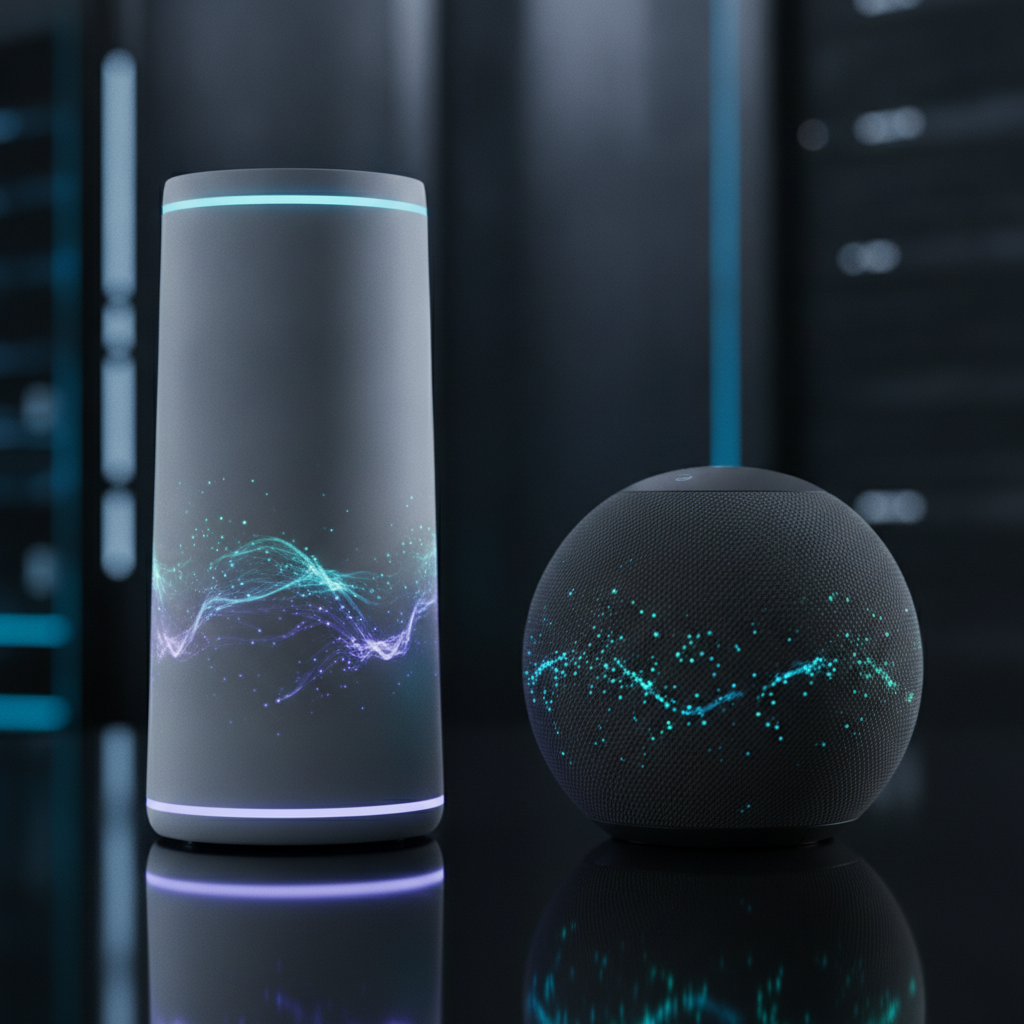
The world of smart home technology is buzzing with excitement as Google unveils its latest innovation: the new Google Home Speaker. Set to hit shelves on June 25, this $100 device promises to redefine smart living with its built-in generative AI, Gemini for Home, immersive 360-degree sound, and robust smart home hub capabilities.
Directly in its sights is the formidable Amazon Echo Dot Max, also priced at $100 (though often on sale), which features its own generative AI assistant, Alexa+. Both speakers are designed to handle complex tasks, answer your questions with unprecedented depth, and even generate content, marking a significant leap from traditional voice commands.
With similar price points and an array of advanced features, the inevitable question arises: which smart speaker reigns supreme? While the Google Home Speaker is still under wraps until its official release, we can dive deep into a specification-based comparison to help you make an informed decision today.
The Brains Behind the Smart Speaker: Gemini vs. Alexa+
A crucial factor in choosing your next smart speaker lies in its artificial intelligence, which has evolved dramatically. Both the Google Home Speaker, powered by Gemini for Home, and the Amazon Echo Dot Max, with Alexa+, represent a new era of AI-driven virtual assistants, moving far beyond the simple command-and-response interactions of previous generations.
From initial impressions, Google’s extensive investment in generative AI technologies gives Gemini for Home a noticeable edge. It demonstrates a more conversational style, often providing richer, more complete answers to general inquiries and making fewer mistakes in complex interactions.
Gemini excels at understanding corrections mid-sentence and can swiftly reason through multiple pieces of information to answer multi-step questions. While Alexa+ is undeniably capable and a powerful assistant in its own right, Gemini’s ability to handle intricate requests and engage in more fluid dialogue is a distinct advantage for those prioritizing advanced conversational AI.
Sound Quality: Who Delivers the Best Tunes?
For many, a smart speaker isn’t just about intelligence; it’s also about audio performance. Both the Amazon Echo Dot Max and the Google Home Speaker promise redesigned audio experiences that surpass their predecessors, yet their philosophies on sound appear to diverge.
Amazon traditionally places a strong emphasis on acoustic quality, and the Echo Dot Max is no exception. It boasts enhanced audio with a dual-speaker design and stronger bass, engineered to deliver a booming, room-filling sound that elevates your music and podcasts.
In contrast, Google’s specifications for the Home Speaker are more concise regarding audio, simply stating it offers “balanced 360-degree audio for podcasts and music.” While we’ll need to conduct side-by-side tests to confirm, the Echo Dot Max seems poised to win the battle for superior sound output based on its detailed audio engineering.
Smart Home Integration: Your Connected Ecosystem
When it comes to seamlessly integrating with your smart home, both new speakers offer impressive capabilities. Making a choice based solely on whether you’re a Google or Amazon user would be too simplistic, as both devices now function as universal Matter hubs.
This means that regardless of brand, you can connect a wide array of previously incompatible smart home devices to either speaker. The Google Home Speaker takes this a step further by also doubling as a Thread border router, allowing it to support Matter over Thread connectivity, which can improve local network efficiency and add a resilient node to your smart home’s Thread network.
For home security, the Google Home Speaker integrates effortlessly with Nest cameras, allowing you to ask Gemini for home summaries or review camera history. Similarly, the Echo Dot Max works with Ring cameras. It’s worth noting that advanced features for both systems typically require a subscription to your respective home security service.
Home Entertainment: Beyond Just a Smart Speaker
Many users leverage smart speakers to enhance their home entertainment setups, and here, the differences between the two devices become more pronounced. The Google Home Speaker works with a Google TV Streamer, allowing it to act as an external speaker for your television and create a stereo pair with two Home Speakers.
However, the Amazon Echo Dot Max offers significantly more extensive home theater integration options. Amazon has developed a comprehensive ecosystem for pairing Echo speakers, enabling various configurations:
- A stereo pair for enhanced audio.
- 2.1 audio when combined with an Echo Sub.
- A full wireless home theater setup.
- Dolby Atmos-capable audio with compatible Echo devices.
Amazon’s wider range of Echo speaker tiers, including the dedicated Echo Sub for robust bass and integration with Fire TV sound bars, positions the Echo Dot Max as a more versatile choice for dedicated home entertainment enthusiasts.
Ultimately, a definitive verdict on which smart speaker is superior will require hands-on testing of the Google Home Speaker. Based on current specifications and what we already know, the Google Home Speaker appears to be a strong contender for those prioritizing advanced AI interactions and robust smart home control.
Conversely, the Amazon Echo Dot Max seems tailored for users who value superior audio performance and extensive home theater integration. Your ideal choice will likely come down to whether you prioritize the “brains” or the “sound” in your smart speaker experience.
Source: ZDNet – AI
