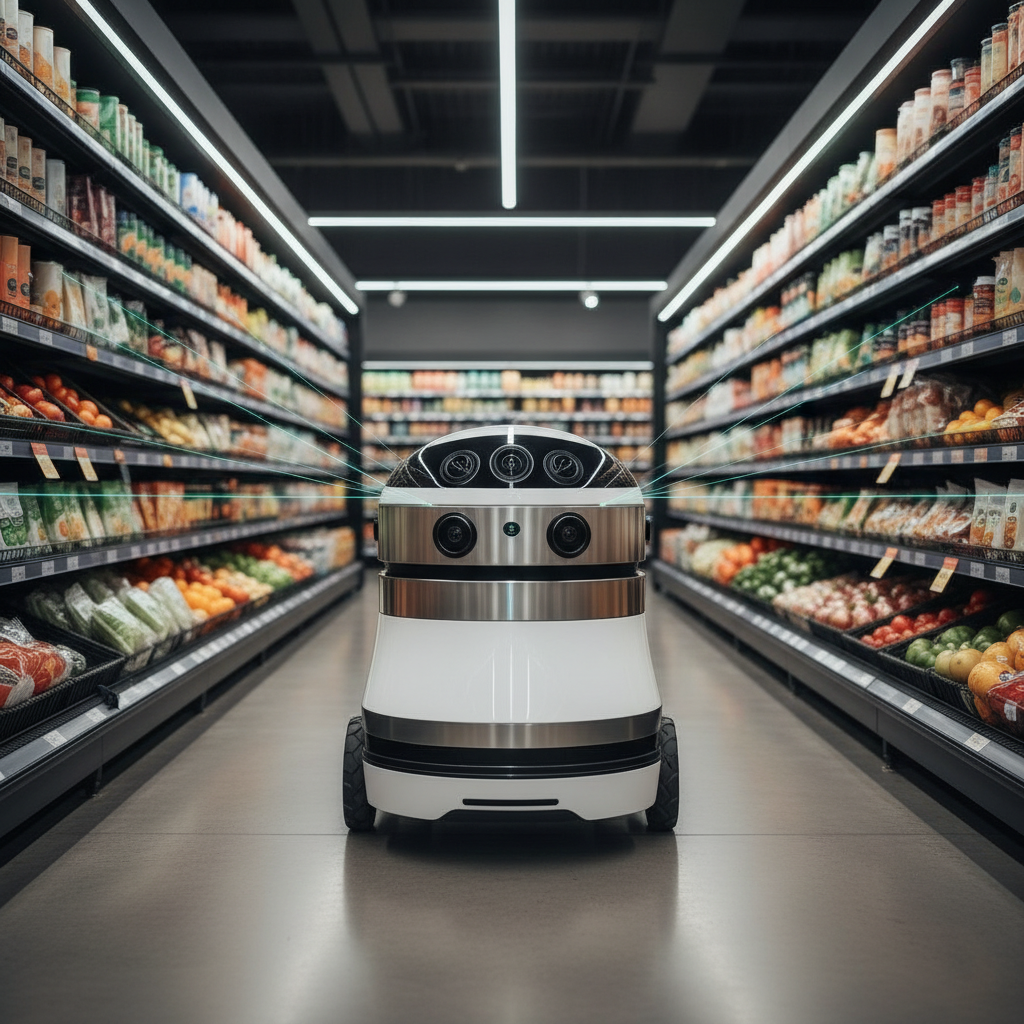
Retailers are increasingly turning to computer vision technology to safeguard their shrinking profit margins. By automating the laborious task of tracking physical shelves, businesses are directly tackling persistent in-store execution failures that continue to drain billions from the industry each year. This strategic hardware deployment is becoming a vital weapon in the fight against operational inefficiencies.
A recent study by Coresight Research, in collaboration with technology providers Simbe and RELEX Solutions, sheds light on the staggering cost of these shortcomings. It found that inefficiencies devour a substantial 6.4 percent of gross sales across the retail sector. Disturbingly, hardware, mass merchandise, and grocery categories alone are projected to lose an astronomical $196.4 billion to these operational failures by 2026.
This deficit represents a sharp 21 percent increase over the previous year’s losses, vastly outpacing the modest three percent projected sales growth for the entire sector. With nine out of ten retailers admitting to difficulties managing their shop floors, the impact of empty shelves and incorrect pricing structures directly suppresses operating margins, exceeding five percent for nearly 90 percent of businesses.
Retailers Embrace Smart Store Technology
The good news is that retailers are actively adopting solutions. Full-scale deployments of store intelligence platforms now span 60 percent of enterprise footprints, marking an impressive 18-percentage-point increase year-over-year. While experimental pilot programs account for only 18 percent of current market activity, the adoption curve clearly favors top-tier enterprises.
A striking 73 percent of retail companies generating over $5 billion in annual revenue maintain fully scaled deployments. Unfortunately, mid-market operators are lagging, with only 42 percent of sub-$1 billion companies achieving similar deployment maturity. These investments primarily target critical areas such as out-of-stock tracking, automated pricing, planogram verification, and assortment planning.
BJ’s Wholesale Club offers a compelling case study in shelf digitization. The company deployed Simbe robotics platforms to meticulously monitor inventory and price accuracy across its locations, creating “digital twins” of individual warehouse clubs. This innovative application established real-time visibility systems that were previously absent from their physical operations, enabling better decision-making.
Using these digital models, BJ’s improved route planning for online orders and curbside fulfillment, leading to a remarkable 40 percent year-over-year improvement in picking efficiency. CEO Bob Eddy highlighted how this technology also helped the company elevate quality standards within its fresh merchandise categories. Similarly, grocery giant Albertsons is leveraging AI to automate complex retail operations, aiming for an ambitious $1.5 billion in productivity gains over three fiscal years.
The Critical Sequence: Why Hardware Comes First
Despite the clear benefits, many organizations inadvertently create downstream data failures by prioritizing software over foundational sensor infrastructure. A significant 43 percent of surveyed technology leaders direct their capital toward pricing optimization software, while only 33 percent invest in the crucial shelf digitization hardware needed to feed accurate data into those models. This includes the cameras and sensors essential for verifying physical stock availability.
Store intelligence deployments demand strict sequencing to function properly: retailers must first digitize the shelf, then deploy data analytics, install inventory tracking software, and finally, execute pricing automation. When this “technology stack” is inverted, markdown algorithms process outdated inventory counts, and mispricing rates climb, hitting 13 percent in 2026—a four-point increase since 2024. As Kim Anderson, VP of Store Operations at Schnucks Markets, emphasizes, accurate shelf data must precede all other implementations.
Another excellent example comes from Lowe’s, which demonstrated the financial impact of automating associate workflows through its ‘Perpetual Productivity Improvement’ initiative. Executive VP of Stores Joseph McFarland oversaw the deployment of workforce management tools and inventory solutions, successfully eliminating redundant associate tasks. This rollout saved an impressive 80 non-productive labor hours per store on a weekly basis.
Lowe’s further advanced the initiative by deploying full shelf replenishment technologies powered by AI to track stock depletion in real-time. The company even distributed financial bonuses to its workforce, including $5,000 to associate store managers and varied payouts to hourly staff, based on these documented productivity enhancements. This success aligns with broader industry data, showing that intelligence applications drive a 14 percent average reduction in time spent on manual store tasks, with 86 percent of organizations reporting defined decreases.
Realizing Tangible Benefits and a Competitive Edge
The strategic deployment of store intelligence technologies extends far beyond mere cost savings. It fundamentally transforms the customer experience and builds lasting loyalty. Proper deployments are shown to increase customer lifetime value by 11 percent across the sector, while conversion rates improve for 50 percent of operators implementing physical automation frameworks.
Furthermore, 48 percent of companies record increased enrollment in their loyalty programs following system integration. Accurate pricing and consistent stock availability significantly elevate online review metrics for 47 percent of surveyed operators. These results underscore how integrated, properly sequenced hardware and software capabilities create a distinct market advantage.
Retailers are now recognizing that store intelligence technologies function as an interconnected ecosystem rather than standalone fixes for isolated problems. Investing in operational efficiency remains the primary objective, closely followed by the unification of store data. Many leaders, 40 percent to be precise, also seek to establish alternative revenue streams like retail media networks through these advanced tools.
Ultimately, establishing real-time, shelf-level visibility is strictly necessary before attempting to scale any downstream software. Pricing automation, supplier collaboration platforms, and inventory forecasting applications all require verified physical data to generate accurate and actionable outputs. Those who build upon this stable foundation will thrive, while those who accumulate disconnected applications risk building on unstable ground.
Source: AI News
