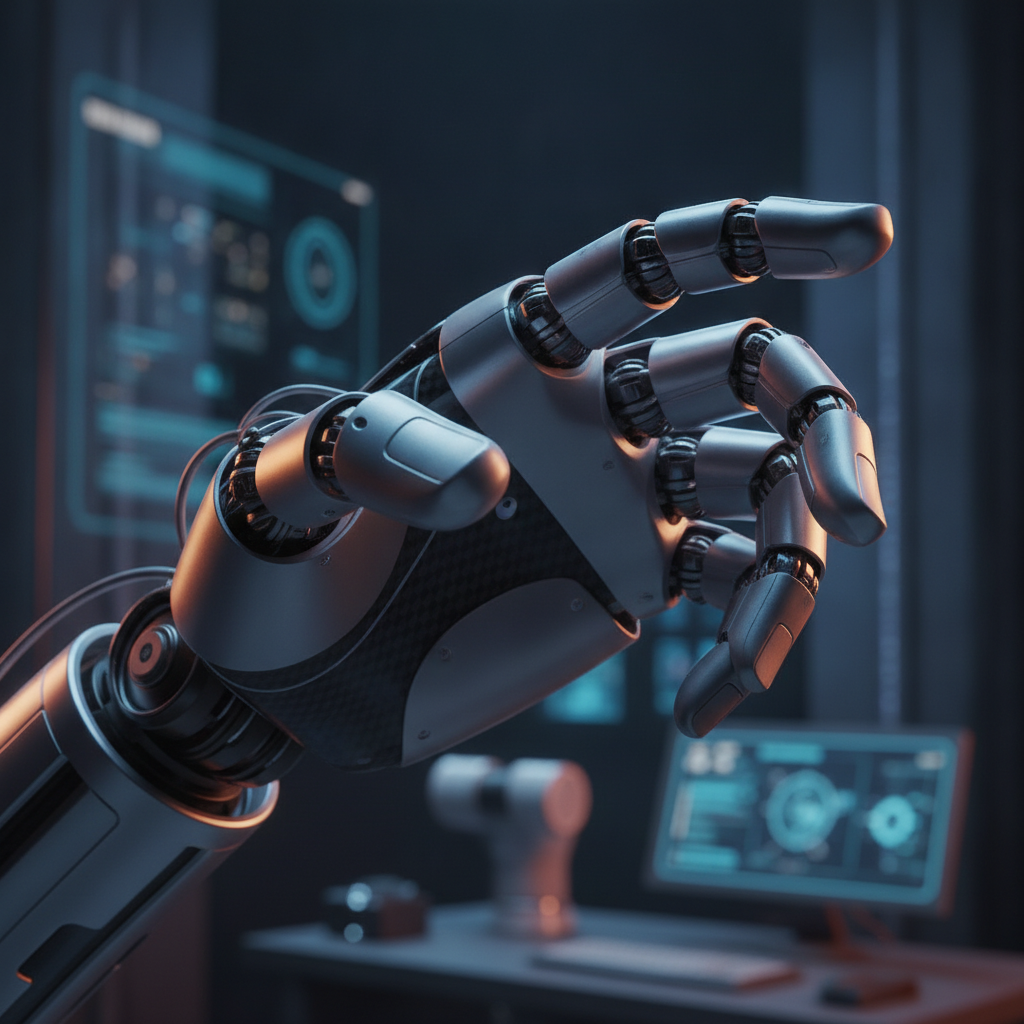
After navigating a high-stakes legal battle with electric vehicle giant Tesla, robotics startup Proception is not just breathing a sigh of relief — it’s launching into an exciting new phase. The company, founded by a former technical lead on Tesla’s Optimus humanoid robot program, has announced a significant funding round and begun shipping its first product. This pivotal moment marks a new chapter for Proception, solidifying its mission to revolutionize robotic dexterity.
Jay Li, the visionary behind Proception, openly admits that being sued by Tesla isn’t exactly a recommended growth strategy for a fledgling startup. Yet, he believes the experience ultimately forged a stronger, more resilient company. “I think it’s kind of like a resilience test, or pressure test,” Li told TechCrunch, echoing the sentiment that what doesn’t kill you often makes you stronger.
From Lawsuit to Liftoff: Proception’s Ascent
Last year, Li faced accusations from his former employer, Tesla, of absconding with trade secrets to establish Proception. This led to months of intense legal sparring, a challenging period for any entrepreneur, let alone one building a cutting-edge robotics firm. However, earlier this month, the dispute finally concluded with a settlement, and Tesla dismissed its lawsuit.
With the legal entanglements behind him, Li is now fully focused on what he describes as an even tougher problem: engineering robotic hands that truly emulate human dexterity. This complex challenge is at the heart of Proception’s innovation and future growth. The settlement has cleared the path for the company to accelerate its ambitious plans.
In a major announcement this week, Proception revealed it has successfully closed an $11 million seed round of funding. This impressive capital injection was led by First Round Capital, with significant contributions from Y Combinator and early-stage fund BoxGroup, signaling strong investor confidence in Proception’s vision and technology.
Beyond the funding, Proception also announced it is already shipping the inaugural batch of its “high-dexterity robotic hand” to leading researchers and robotics companies. The company aims to become the premier supplier of advanced robotic hands, allowing other firms to integrate superior manipulation capabilities without dedicating extensive resources to developing this complex technology in-house.
Unlocking Human-Like Dexterity: Robotics’ “Last Mile”
Despite a flood of investment and attention pouring into the broader robotics industry, Jay Li contends that the crucial area of robotic hands mimicking human capabilities has been underserved. True dexterous manipulation remains one of the most significant hurdles in making humanoid robots practical and versatile. This challenge is so profound that even industry titans recognize its difficulty.
Interestingly, one of the loudest voices highlighting this engineering puzzle has been Li’s former boss, Elon Musk. The Tesla CEO has frequently emphasized that perfecting robot hands is among the biggest unsolved engineering problems in robotics today. This shared understanding underscores the magnitude of the task Proception has undertaken.
While Musk has suggested that Optimus robots could be deployed in factories within a few years, the broader consensus among robotics experts indicates that achieving human-level robotic hand dexterity is still many years away. For instance, Kevin Lynch, director of Northwestern University’s Center for Robotics and Biosystems, estimated it could take a decade for such hands to become truly “functional and useful.” However, Li believes Proception can significantly accelerate this timeline.
Proception’s Innovative Data-Driven Approach
Proception’s strategy to expedite robotic hand development hinges on a revolutionary approach to data collection. Most companies currently train humanoid robots using teleoperators, where a human in a VR headset controls a robot and provides commands for learning. This method, however, suffers from key drawbacks.
According to Li, a major limitation of teleoperation is the lack of haptic feedback for the human operator, meaning they don’t feel what the robot touches. Additionally, this method scales poorly, as it’s restricted by the number of robots available for training at any given moment. These factors create bottlenecks in the data acquisition process.
Proception’s ingenious solution involves a specialized glove packed with an array of sensors. Human testers wear these gloves—and a headset—enabling the company and its clients to capture crucial “human hand interaction data without requiring a robot in the loop.” This allows for far more efficient and scalable data acquisition.
Crucially, this same glove technology forms the “skin” of Proception’s advanced robotic hand, acting as its primary sensor interface. The hand itself boasts an impressive 22 degrees of freedom and multiple joints per finger, facilitating an extensive range of dexterous motions. This sophisticated hardware, combined with its unique data collection method, is a game-changer.
Li emphasizes that this integrated approach allows Proception to gather finer, more task-specific data, leading to robotic hands that more accurately mimic human capabilities. He believes this dual focus on highly dexterous hardware and highly scalable data collection is the “key combination to solve this problem,” giving Proception a significant edge over competitors focused solely on hardware or non-scalable data.
Investor Confidence and a Confident Vision
Bill Trenchard, a partner at First Round Capital who led the investment in Proception, wholeheartedly endorsed Li’s vision and methodology. He praised Proception’s potential, stating, “We think they will have the best hand in the market, maybe the most sophisticated hand today, and the underlying data and models to support that.” Trenchard underscored the critical role of dexterous manipulation, calling it “the last mile” for truly performant humanoid robots.
Trenchard also commended Jay Li’s remarkable composure and leadership throughout the challenging period of litigation with Tesla. He noted Li’s transparency with investors and the team’s ability to remain focused under immense pressure. This resilience, coupled with technical prowess, solidified First Round’s confidence in Proception.
Jay Li, having faced down Tesla’s “hardcore litigation department,” is remarkably optimistic about Proception’s trajectory. He even speculated that as Proception continues to grow and innovate, his former employer might one day come knocking for assistance. “I think it will happen,” he confidently stated, painting a bold picture for the future of robotic hands.
Source: TechCrunch – AI
