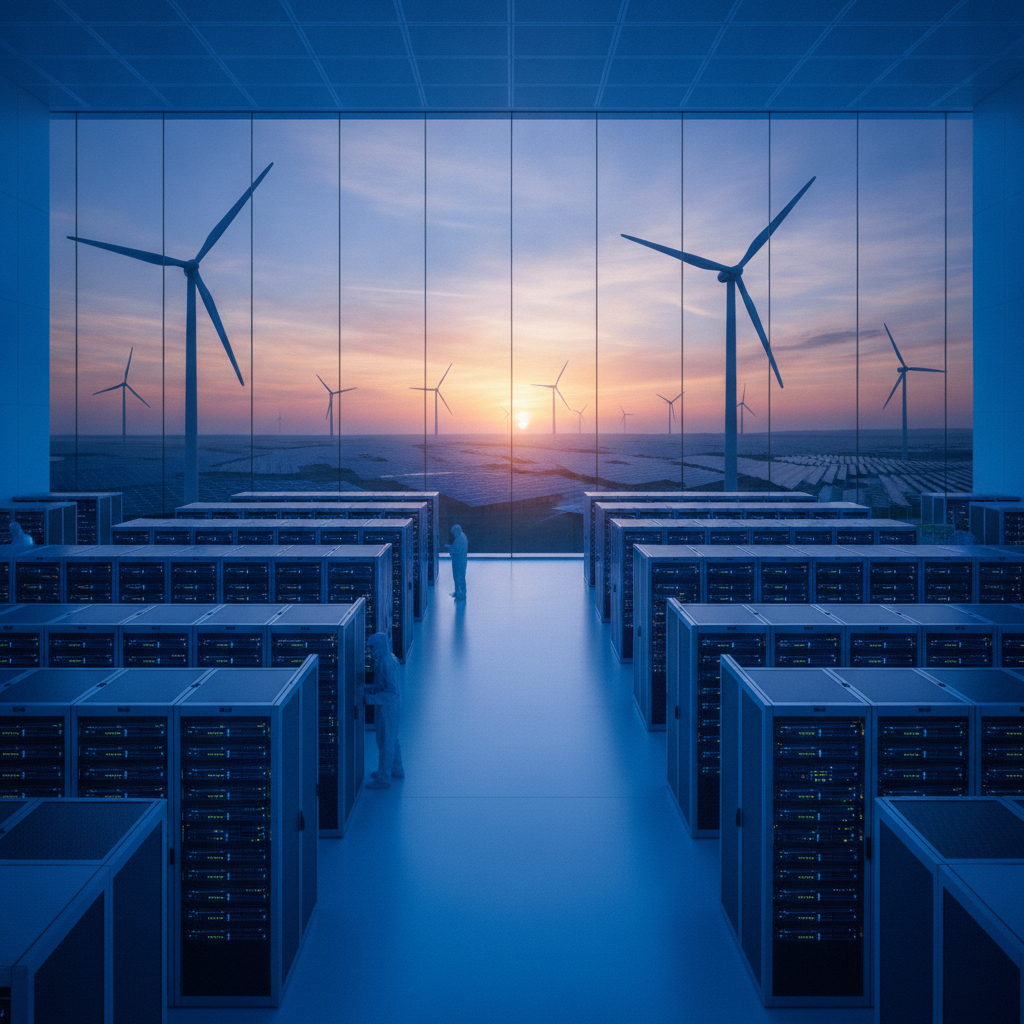
We’re thrilled to share insights from our 11th Environmental Report, a comprehensive look at our sustainability journey and performance, particularly in 2025. This report details our ongoing commitment to responsibly managing our environmental footprint, scaling abundant and affordable clean energy, and harnessing the power of AI to drive down emissions globally.
Despite significant growth in our operations, we’ve made remarkable strides. In 2025 alone, we signed agreements for over 12 gigawatts (GW) of net-new clean energy, which is roughly enough to power a country the size of Greece for a year once operational. Simultaneously, we managed to reduce our operational emissions by 2%, even as our electricity demand continued to climb.
Powering Progress with Clean Energy and Efficiency
Our commitment to a sustainable future is unwavering, even as we navigate the exciting tension between rapid growth and environmental stewardship. Google stands as one of the world’s largest corporate purchasers of clean energy, consistently expanding the global supply of renewable power.
From 2010 to 2025, we’ve executed over 240 agreements to purchase nearly 35 GW of net-new clean energy. This cumulative effort adds enough new capacity to power over 28 million U.S. homes, or roughly every household in New York, Texas, and Pennsylvania combined. Paired with our industry-leading data center infrastructure, which uses 83% less overhead energy than the industry average, we’re ensuring every megawatt is used with maximum efficiency.
Despite facing our largest load growth in history—a 37% annual increase in electricity demand—we successfully reduced our operational emissions by 2% year-over-year. This remarkable achievement was made possible while matching 100% of our electricity consumption with renewable energy purchases for the ninth consecutive year. These milestones are clear proof that rapid operational growth can indeed be decoupled from our carbon footprint.
To achieve this, we strategically invest in reliable, clean capacity directly on the local grids that support our data centers. We’re actively catalyzing advanced energy sources like nuclear and enhanced geothermal, alongside making long-term investments in breakthrough technologies such as fusion. Our responsible growth strategy ensures our expansion doesn’t burden local communities or other utility customers, as we structure our energy deals to cover 100% of our power costs, thus expanding access to affordable, reliable, and clean energy for everyone.
Through advancements in machine hardware, software, and compute efficiencies, combined with our robust clean energy procurement, we collectively avoided over 58 million metric tons of carbon dioxide equivalent (tCO2e) in 2025 alone. Without these crucial interventions, we estimate our ambition-based carbon footprint in 2025 would have been five times larger. This significant magnitude of avoided emissions demonstrates that our decarbonization tools are highly effective, even at hyperscale.
Our drive for efficiency extends beyond energy to all aspects of our operations and value chain. In 2025, our water stewardship projects successfully replenished approximately 7.7 billion gallons of water, which is roughly 78% of our freshwater consumption for the year. This marks substantial progress towards our ambitious goal to replenish more water than we consume by 2030.
AI for a Sustainable Future: Beyond Our Operations
Our impact reaches far beyond just operating Google more sustainably; it’s also about leveraging our technology to build a better future for everyone. Our data centers power AI products used by billions, driving progress in science, health, the economy, and many other critical areas.
We see, and are actively seizing, an immense opportunity for AI to drive progress on environmental issues specifically. In 2025, nine of our innovative AI solutions enabled individuals, cities, and partners to collectively reduce an estimated 41 million tCO2e. This figure is roughly three times Google’s own emissions, showcasing the expansive potential of AI.
We’re helping others mitigate emissions through enhanced efficiencies in high-impact sectors like energy and transportation. For instance, Google Earth optimizes layouts for solar and wind developers, significantly accelerating project siting. Nest thermostats use machine learning to automate home energy savings, while fuel-efficient routing in Google Maps analyzes factors like traffic and terrain to suggest lower-emission routes for drivers.
Beyond emissions, we’re supporting communities in staying safe during extreme events and natural disasters. Building on our longstanding efforts, we’ve advanced AI breakthroughs that enable forecasting and early detection of wildfires, floods, earthquakes, and extreme weather, providing timely information to protect people in harm’s way.
We’re also actively working to protect the planet’s biodiversity through powerful AI tools. Examples include Perch, a bioacoustic embedding model for analyzing massive bioacoustic datasets, and SpeciesNet, an Earth AI model that can recognize over 2,000 animal species in images from motion-triggered wildlife cameras with over 94% accuracy. These tools make nature protection more accessible, affordable, and profoundly effective.
Ultimately, as we develop new AI solutions to meet global challenges, our fundamental task is to maximize the immense good AI can do for the planet while conscientiously minimizing its resource intensity.
Navigating Challenges and Doubling Down on Innovation
At the start of this decade, we set ambitious net-zero and 24/7 carbon-free energy moonshots, designed to push the very frontiers of what’s possible in energy systems and data center operations. We were clear from the outset that these were intentionally aspirational goals, requiring significant innovation in both technology and policy.
Over the past few years, the rapid rise of AI has reshaped global infrastructure and placed new demands on the grid. Our moonshots have pushed us to meet this moment, and the scale of our impact has grown accordingly. In 2025, we contracted for eight times more clean energy than we did in 2019, and the emissions we successfully avoided were seven times larger than our 2019 ambition-based carbon footprint, which serves as our moonshot baseline.
While our commitment to sustainability remains deep, reaching our climate moonshots is undoubtedly becoming harder. It takes substantial energy and resources to support the growing demand for AI, which powers businesses and the essential tools we use every day. Like many in our industry, we experienced a surge in electricity demand last year, with our AI infrastructure buildout accelerating faster than the grid is decarbonizing.
External factors continue to present significant hurdles, including long waits for grid connections, fragmented energy markets, persistent supply chain delays, and regulatory bottlenecks that slow the deployment of new carbon-free energy. We are operating within energy systems that are simply not yet clean or flexible enough to keep pace with innovation.
Furthermore, while we successfully decreased our direct operational emissions, our supply chain emissions grew by 25% year-over-year. This increase reflects not only the sheer scale of our new AI infrastructure but also the operations within Asia-Pacific supply chains that rely on grids still undersupplied with carbon-free energy. This challenge is compounded by land constraints, high construction costs, and complex policy and regulatory hurdles in those regions.
We continue to evolve our approach in tandem with the technology we build, regularly assessing our strategy while maintaining steady execution. Our focus remains on balancing our bold climate ambition with real-world impact. We will continue to prioritize AI stack efficiencies, clean energy procurement, and groundbreaking innovation to ensure our efforts leverage the transformative potential of AI to enhance lives globally.
Source: Google Blog (The Keyword)
