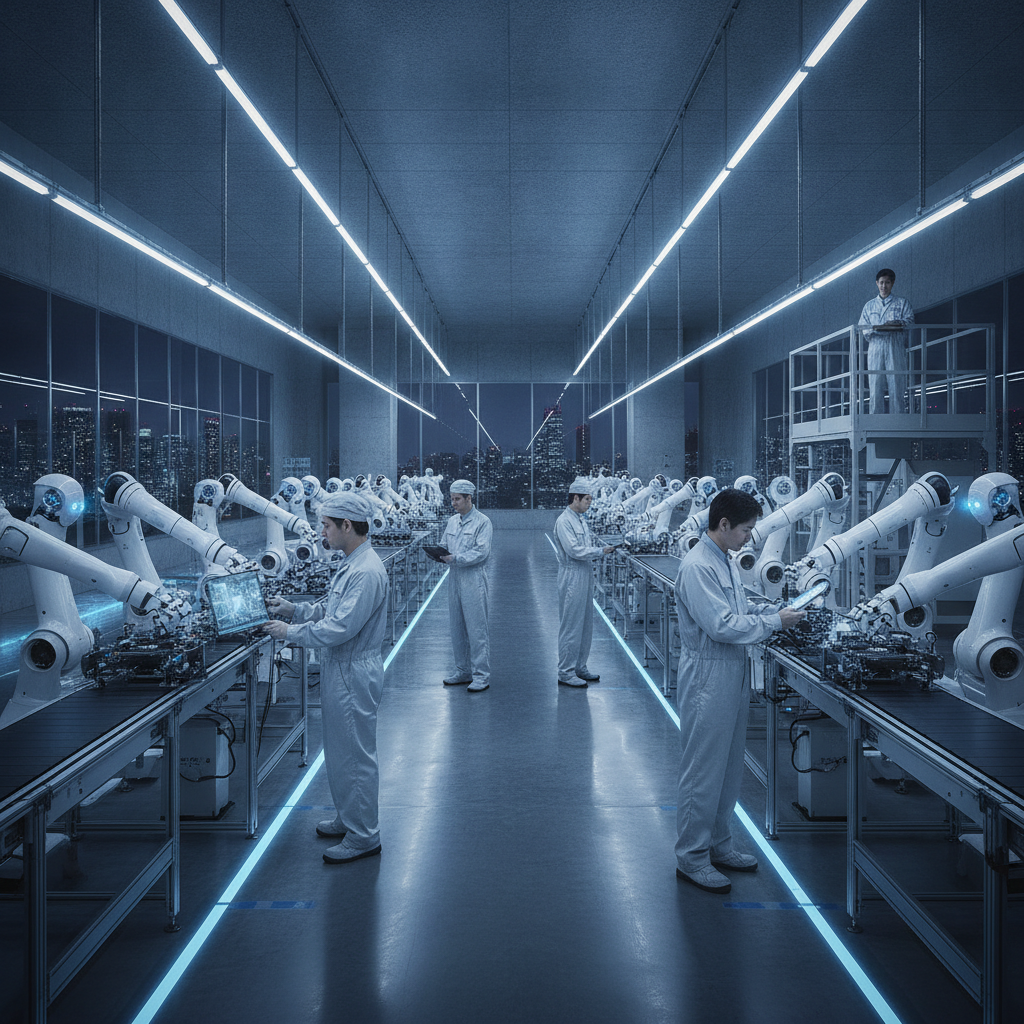
Japan’s vision for the future of work and industry has taken a monumental leap, transitioning from ambitious discussions to a concrete national strategy. The government has formally confirmed its transformative plan: to deploy an astonishing 10 million AI-powered robots across 18 diverse industries by 2040. This monumental initiative will be backed by substantial public funding, earmarking up to one trillion yen (approximately US$6.1 billion) over the next five years.
What sets this announcement apart is that it’s far more than a policy aspiration; it’s a fully commissioned project with specific deliverables. The Japanese government has formally tasked a unique collaboration, bringing together established research and industry players to build the technological backbone for this robotic revolution. This ensures accountability and a clear path forward for an undertaking of this magnitude.
Japan’s Bold Leap into AI Robotics
The Ministry of Economy, Trade and Industry (METI) and the New Energy and Industrial Technology Development Organization (NEDO), Japan’s key innovation agency, are spearheading this ambitious endeavor. They have officially commissioned Noetra, a consortium of leading Japanese firms, and AIST, the country’s national research lab, to develop what they term a “physical AI” model. This pivotal push is slated to run from fiscal 2026 to 2030, with early milestones expected even sooner.
While the trillion-yen figure grabs headlines, it’s crucial to understand the funding structure. The current fiscal year’s commission alone is reportedly worth around US$2.3 billion, drawn from a 387.3 billion yen allocation funded through GX Economy Transition Bonds. However, only the first two years of funding are guaranteed, with subsequent allocations subject to annual review via a rigorous stage-gate process.
This critical detail means the trillion-yen figure represents a ceiling, not an automatic guarantee; Tokyo retains the flexibility to adjust or even withdraw funding if Noetra fails to meet its pre-defined milestones. Such a mechanism underscores the government’s commitment to tangible progress and fiscal responsibility for a project of this scale.
Pioneering “Physical AI” for a Smarter Future
At the heart of this strategy lies the development of a cutting-edge multimodal foundation model, the very essence of “physical AI.” Unlike traditional robots that follow pre-programmed instructions, this advanced AI aims to equip robots with true contextual awareness. It will enable them to interpret and integrate diverse data streams, including language, images, video, and various sensor inputs, allowing them to truly understand an environment and act intelligently within it.
Imagine a robot that can not only move through a room but also comprehend its layout, identify objects, understand spoken commands, and adapt its actions in real-time. This sophisticated capability promises to unlock unprecedented levels of autonomy and flexibility for robotic applications across industries. An initial version of this groundbreaking model is expected as early as this fiscal year, with continuous annual upgrades planned thereafter.
The development effort will be powered by a collaborative ecosystem, leveraging valuable data volunteered by participating manufacturers and other key companies. Noetra itself is a powerful consortium, majority-owned by industry titans such as SoftBank, NEC, Sony Group, and Honda, with Fujitsu and Rakuten reportedly considering joining. SoftBank engineers are already working in close partnership with researchers from Preferred Networks and AIST, combining top-tier talent for this national endeavor.
A Consortium Approach to a National Challenge
Japan’s strategic choice to assemble a consortium reflects a familiar and effective industrial push. Rather than tasking a single company with the monumental effort of developing a frontier AI model, the state has united firms that already possess the essential hardware and technological expertise. This collaboration seamlessly integrates Honda’s advanced robotics, Sony’s cutting-edge imaging sensors, and other partners’ specialized knowledge, creating a formidable collective.
Industry minister Ryosei Akazawa has been explicit about the driving force behind this initiative: to “vigorously promote social implementation” across vital sectors like restaurants, food manufacturing, and medical care. This ambitious push directly addresses Japan’s looming demographic crisis, where an aging population combined with stringent migration policies has left significant parts of its economy facing severe labor shortages with no easy solution in sight.
It’s important to note that Japan isn’t starting from scratch in the robotics field. The nation boasts a long history of expertise, having spent years developing advanced robotics for elder care, disaster response, high-precision manufacturing, and even the challenging cleanup efforts at Fukushima Daiichi. This current project aims to elevate that invaluable domestic experience into something truly exportable, positioning Japan as a global leader in intelligent robotics.
Global Race and the Road Ahead
The timing of Japan’s formal announcement is no mere coincidence. South Korea unveiled its own national robotics initiative within a day of Japan’s confirmation, highlighting a rapidly intensifying global competition. Both governments are clearly framing “physical AI” as the next crucial frontier, extending beyond the current dominance of chatbots and cloud computing into the tangible world of intelligent machines.
For Japan’s ambitious plan, the ultimate test won’t solely be the far-off 2040 deployment target, but rather the more immediate hurdle of the first stage-gate review. If Noetra successfully hits its early milestones and delivers a usable model this fiscal year, it’s highly probable that the investor list will expand significantly beyond its current four core members. Conversely, if early targets are missed, the conditional funding structure provides Tokyo with a clear and quiet exit strategy, preventing the government from propping up a stalled national project.
Source: AI News
