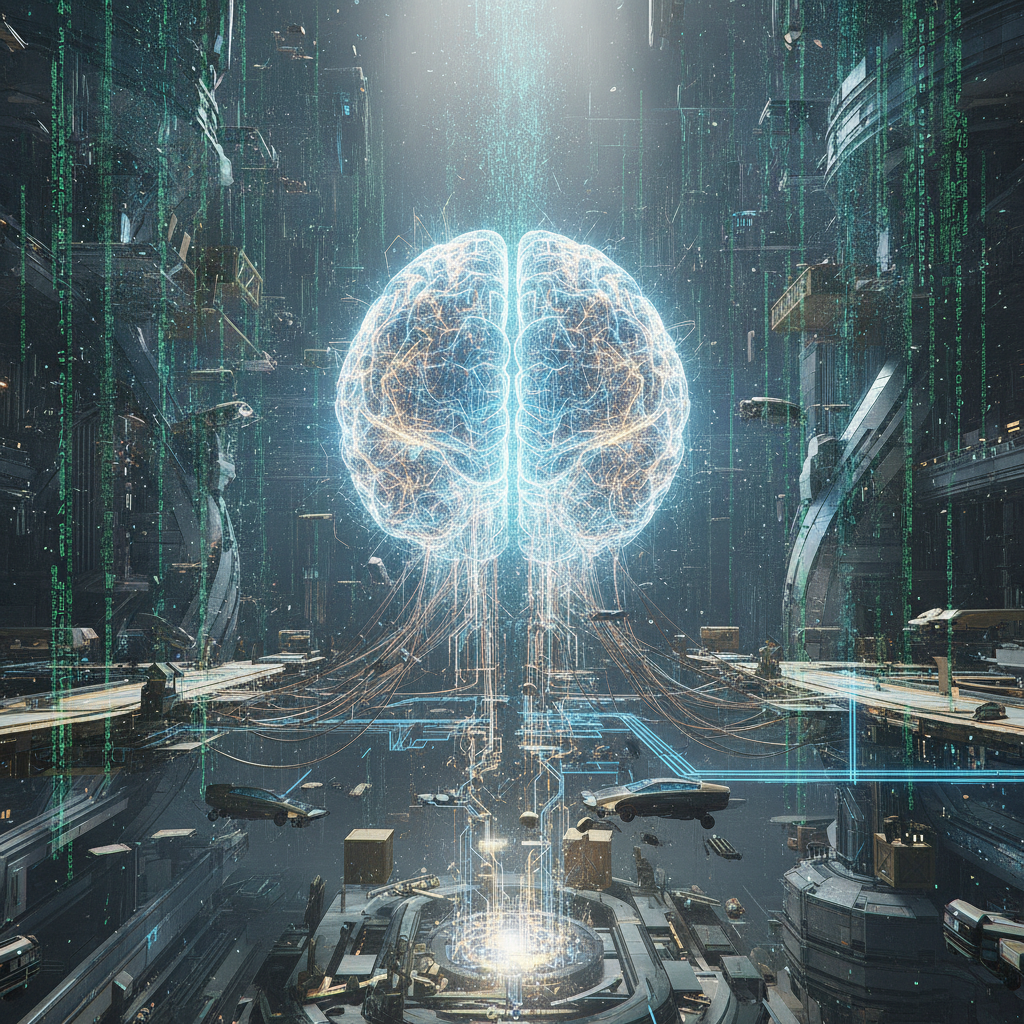
The quest for Artificial General Intelligence (AGI), a truly versatile and human-like AI, often seems like a distant dream. While Large Language Models (LLMs) such as ChatGPT and Claude have showcased incredible linguistic abilities, they frequently fall short in understanding the fundamental mechanics of our physical world. This crucial gap—the ability to grasp how objects move and interact through space and time—is proving to be a significant hurdle on the path to generalized intelligence.
However, a groundbreaking approach is emerging, suggesting that the intricate, dynamic worlds of video games might offer a superior training ground for advanced AI. This innovative strategy is at the heart of General Intuition, a burgeoning New York-based startup, which believes that synthetic gaming environments hold the key to unlocking the next generation of AI capabilities. Their bold vision is already attracting serious attention and substantial investment from industry titans.
Beyond Text: The AGI Challenge
Current LLMs are undeniably impressive, capable of generating coherent text, answering complex questions, and even writing creative content. Yet, their intelligence often remains confined to the linguistic domain, struggling to build robust “world models” that mirror physical reality. These models lack a deep, intuitive understanding of causality, object permanence, and how actions unfold in a three-dimensional space over time.
Developing an AI that can truly generalize, adapting to novel situations and understanding the world akin to a human, requires more than just processing vast amounts of internet text. It necessitates an AI that can simulate and predict interactions within a dynamic environment. This critical deficiency in spatial and temporal reasoning is precisely where traditional internet data, primarily composed of static text and images, proves inadequate for achieving true AGI.
Why Gaming Data is the Ultimate Training Ground
Enter the rich, interactive tapestry of video games. Unlike the static snapshots of the internet, games offer highly structured, physics-driven environments where agents can learn through continuous interaction, observation, and experimentation. They provide an endless stream of real-time sensory data, complete with consistent rules, predictable physics engines, and the immediate consequences of actions.
This dynamic learning environment allows AI models to develop an intuitive grasp of how objects behave, how actions lead to reactions, and how complex scenarios unfold over time. Pim de Witte, CEO of General Intuition, champions this perspective, arguing that gaming data can imbue AI with the essential “common sense” understanding of the physical world that LLMs currently lack. The company itself impressively spun out of Medal TV, a popular gaming platform, giving it a unique advantage in leveraging this powerful data source.
General Intuition’s innovative approach has resonated deeply with the investment community, underscoring its potential to revolutionize AI development. The startup recently closed a substantial $320 million funding round, bringing its valuation to an impressive $2.3 billion. This significant backing comes from a roster of prestigious investors including Coatue, Eric Schmidt, and leading researchers from MIT and Google DeepMind, alongside earlier support from Jeff Bezos himself.
Shaping the Future of Physical AI
The implications of AI models trained on such rich gaming data are profound, especially for the field of physical AI. Imagine robots that can seamlessly navigate complex, unstructured environments, or autonomous systems that understand and react to unforeseen circumstances with human-like intuition. This could unlock breakthroughs in robotics, virtual reality, scientific simulation, and countless real-world applications requiring nuanced physical interaction.
However, with great power comes great responsibility. As General Intuition explores the vast potential of these advanced world models, the ethical considerations of their deployment are paramount. The CEO acknowledges the necessity of establishing clear “red lines,” particularly concerning potential applications in sensitive areas like defense, emphasizing the importance of responsible development and thoughtful governance for this transformative technology.
General Intuition’s journey, as detailed by Pim de Witte on TechCrunch’s Equity podcast, marks a pivotal moment in the pursuit of AGI. By tapping into the structured complexity of virtual worlds, they are forging a new path to create AI that doesn’t just process information, but truly comprehends and interacts with the physical reality around us. This innovative approach promises to deliver intelligent systems far more capable and intuitive than anything we’ve seen before.
Source: TechCrunch – AI
