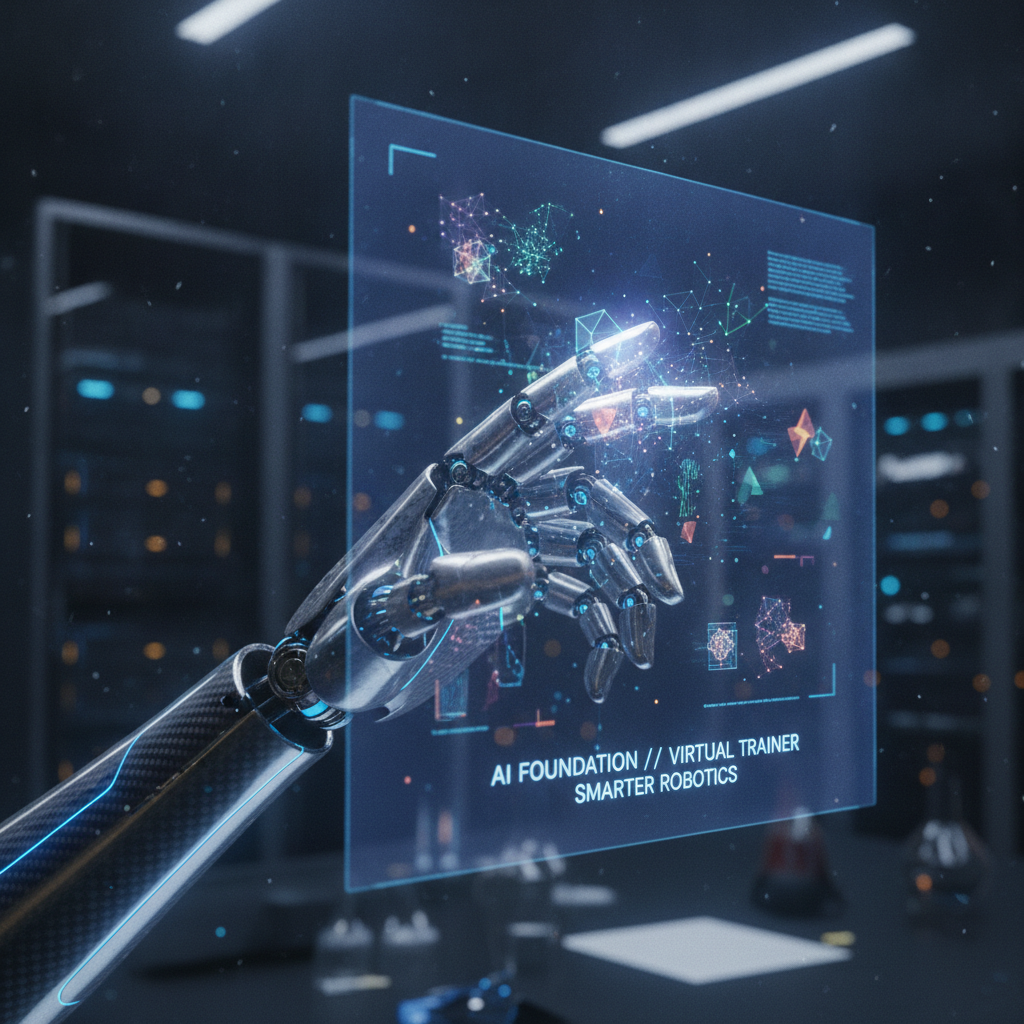
Imagine a moment that completely reshapes an entire industry, much like OpenAI’s GPT-3 irrevocably changed natural language processing. That’s precisely the kind of revolution startup General Intuition believes is on the horizon for robotics. They’re making a bold claim: the era of specialized robot models, painstakingly built from the ground up, is nearing its end.
In the past, developing sophisticated AI meant collecting vast, task-specific datasets to train models for individual applications. But just as NLP shifted from bespoke creations to powerful, general-purpose foundation models like GPT-4 or Claude, General Intuition argues that physical AI is poised for a similar transformation. This paradigm shift could dramatically accelerate innovation in how robots learn and interact with our world.
Pim de Witte, CEO of General Intuition, is at the forefront of this movement. He believes the focus should move from sheer quantity of real-world data to the quality of datasets that can instill a fundamental “intuition” for movement and interaction. This shift, he suggests, will soon render much of the current specialized robotics work redundant.
The AI Paradigm Shift for Robotics
Before the advent of powerful foundation models in natural language processing, companies dedicated immense resources to building specialized AI for every distinct text-based task. Each model required its own extensive, domain-specific training data, often making development slow and incredibly expensive. Today, most organizations start with a robust, general-purpose model, fine-tuning or prompting it to meet their unique needs.
Robotics, however, largely remains in this “pre-foundation model” era. Companies are still engaged in what de Witte describes as “lots of specialized work focused on individual embodiments, individual environments, and individual robots.” This approach often necessitates collecting hundreds of thousands, if not millions, of hours of real-world data for each new application, making progress incrementally slow.
General Intuition proposes a radical departure from this method. Their core thesis is that a strong, generalized foundation model can significantly reduce the need for such exhaustive real-world data collection. De Witte confidently states, “the reality is, you only need a few minutes” of targeted fine-tuning once a truly intuitive base model is established. The ability for a model to reason about space and time generally, he argues, is the ultimate product.
Training Intuition: A Novel Approach
So, how does one build a general model capable of intuitive spatial-temporal reasoning? General Intuition took an unconventional path, training its foundation model on **millions of hours of video game data**. Crucially, this dataset included not just visual information but also details on human controller inputs, providing a rich understanding of actions and reactions within a virtual environment.
Lead investor Vinod Khosla echoes de Witte’s conviction that this action-oriented data is the key to developing human-like intuition for physical interaction. This bold thesis, backed by impressive demonstrations, recently attracted significant investor confidence. Last month, General Intuition successfully raised an astounding **$320 million**, pushing its valuation to an impressive **$2.3 billion**.
The company has already demonstrated the power of its current model. It’s capable of seamlessly playing video games for extended periods, a testament to its learned virtual intuition. More remarkably, after fine-tuning with just **eight minutes of real-world robotics data**, the same model was able to power a quadrupedal robot, enabling it to navigate physical spaces.
De Witte recounted his surprise at the robot’s capabilities: “The fact that [the robot] was actually able to zero-shot on just the front camera, with no other sensors, in the office with dynamic objects being introduced and people walking by was a very big surprise to us.” This suggests a profound level of generalized understanding, hinting at the transformative potential of their approach.
Empowering the Future of Physical AI
General Intuition isn’t aiming to become a robot manufacturer itself; their ambition is far broader. Their ultimate goal is to establish themselves as the foundational AI layer for all physical robotics. They envision their models serving as the core intelligence that other companies can leverage to build an incredible array of specialized machines and applications.
This approach promises to democratize advanced robotics, making the development of complex systems significantly more accessible and efficient. As de Witte articulates, “We’re not gonna build a self-driving car company. We’re gonna make it 10 times easier for the next person to build a self-driving car company.” This vision could unlock an unprecedented era of innovation in everything from automated logistics to smart manufacturing and personal assistance robots.
By providing a general-purpose, intuitive foundation, General Intuition is poised to drastically lower the barrier to entry for developing sophisticated embodied AI. If their predictions hold true, the “ChatGPT moment” for robotics is not just coming – it’s already being built, promising to redefine how we interact with and utilize intelligent machines across every industry imaginable.
Source: TechCrunch – AI
