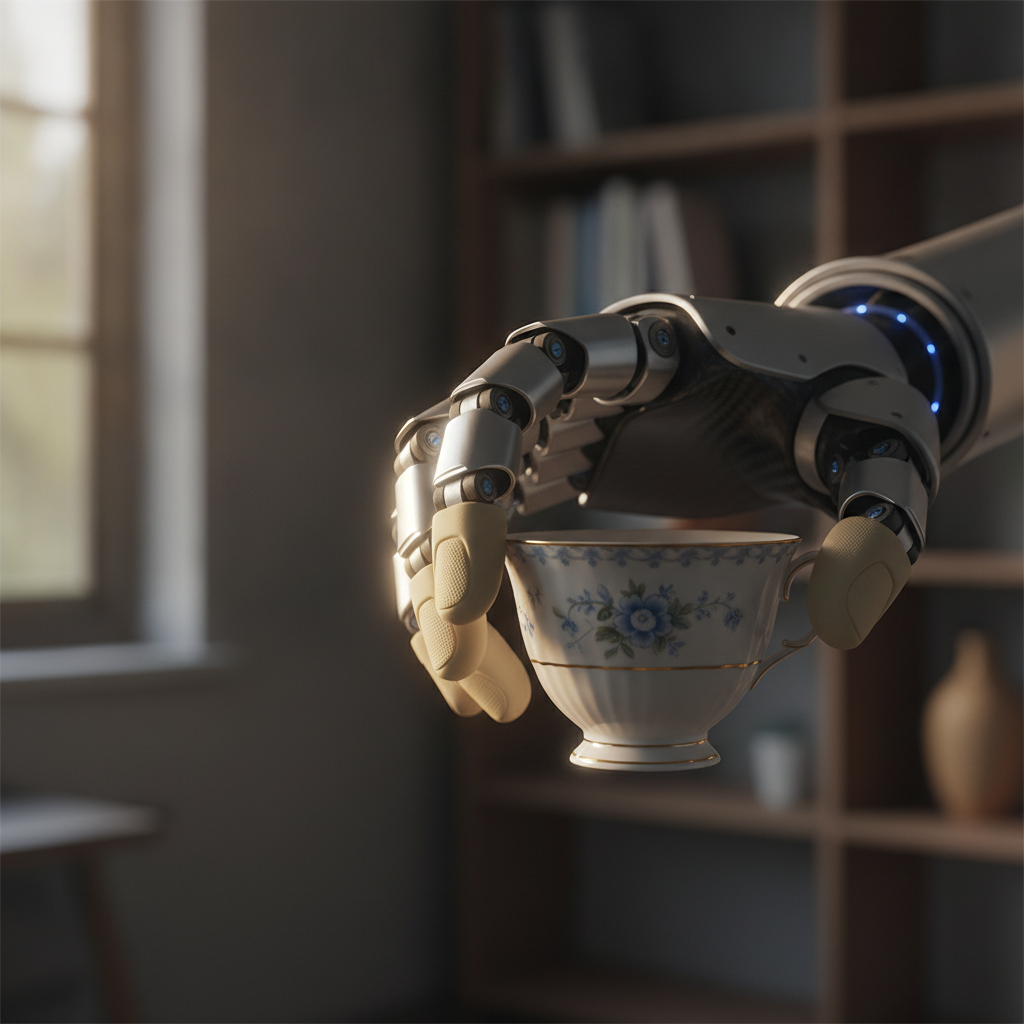
For decades, the idea of friendly home robots has captivated our imaginations, a staple of science fiction. We dream of docile, helpful machines that effortlessly handle chores like laundry, taking out the trash, or even whipping up dinner and tidying afterward. But for these futuristic helpers to truly integrate into our daily lives, they’ll undoubtedly need highly capable hands to perform such a diverse array of tasks.
Enter 1X, a Norwegian-American robotics company that recently unveiled fascinating details about the advanced five-finger hands equipping its soft, approachable robot companion, Neo. These hands represent a significant leap forward in making domestic robots a practical reality, bridging the gap between sci-fi dreams and real-world utility.
The Human Touch: Engineering Neo’s Dexterous Hands
Neo’s innovative hands are engineered with actuators designed to mimic the intricate tendon movements that control human hands. This sophisticated design grants Neo’s hands an impressive 25 degrees of freedom of movement, remarkably close to the 27 degrees typically found in human hands. Coupled with on-board cameras and advanced AI, the robot can discern the broader context of what its fingers are attempting to grasp, enabling truly nuanced interactions.
This dexterous combination allows the Neo bot a broad and versatile range of motion. 1X states that its hands can securely grip uniquely shaped objects and even detect when something begins to slip from its hold. Furthermore, the fingers can move with remarkable speed and even hyperextend in directions beyond human capability, offering enhanced functionality.
Adding to their practicality, Neo’s hands boast an IP68 waterproof rating, meaning the robot can easily wash its own hands – or perhaps even handle wet tasks around the house. Jonathan Terfurth, 1X’s director of actuators and hands, emphasizes that the engineers meticulously dialed in this range of motion to align with, and potentially even surpass, human abilities. This enables Neo to perform actions like opening doors, lifting heavy items, and even plugging itself in to recharge its battery.
“You want to be able to operate with a human who has never worked or interfaced with a robot, and you still want it to be safe and compliant and soft,” Terfurth explains. He notes that while the range of motion can be extreme, the design aims to be very close to what humans can do, ensuring the robot integrates seamlessly into our world. This advancement marks a significant “ChatGPT-esque moment” for robotics, transforming bots from clumsy manipulators into capable handlers ready for delicate objects and everyday chores.
Designing a Companion, Not a Terminator
In a humanoid robot market often dominated by tough, industrial-looking machines built for specialized or defense contracts, 1X is taking a distinctly different path with Neo. This isn’t a hulking Terminator-like creation; instead, Neo is designed as a soft, supple robot, enveloped in a protective 3D lattice shell. Its friendly aesthetic is openly inspired by beloved characters such as Baymax, the affable robot from Disney’s “Big Hero 6.”
1X aims for Neo to be a comforting presence, fostering a sense of ease and safety in a human environment. Dar Sleeper, 1X’s vice president of product and design, articulates this vision: “We love this idea that a robot can be this peaceful and fun and goofy safe presence in a life.” He stresses the importance of Neo feeling comfortable and soft, both inside and out, making it a natural fit rather than something alien or intimidating.
For those eager to welcome Neo into their homes, early access pricing is available. You can secure your own robot for a lump sum of $20,000, which prioritizes delivery for 2026, or opt for a monthly subscription of $500 per month. This pricing strategy reflects the advanced technology and aspirational nature of a personal robot companion.
Teleoperation, Privacy, and Performance
While the ultimate goal for Neo is full autonomy, the robot is currently partially teleoperated, a feature 1X calls “Expert Mode.” This means human operators can remotely control Neo, viewing its surroundings through its integrated cameras, to assist with more complex tasks. This “human-in-the-loop” approach is designed to enhance Neo’s utility in situations requiring nuanced judgment or problem-solving.
However, the concept of remote human operators peering into your home raises significant privacy questions. 1X assures users that human “experts” can only connect to Neo when explicitly requested by the homeowner. Furthermore, users can monitor the video stream being captured via a mobile app, and a distinct ring light around Neo’s “ear” illuminates blue to indicate an active human connection, giving users the power to disconnect the expert at any time.
Despite these safeguards, 1X has not yet publicly addressed how the company plans to prevent potential bad actors or hackers from gaining unauthorized control of the robot. This remains a crucial concern as personal robots become more integrated into smart home environments. Adding to the intrigue, 1X’s marketing for Neo’s new hands features distinctly sensual imagery, with soft jazz and warm lighting accompanying the robot’s fingers gracefully curling around a wine glass, unzipping a jacket, and gently touching grapes.
While one might appreciate the robot’s dexterity, this marketing approach, especially given the teleoperation feature, has raised eyebrows. When questioned about whether their promotional videos showcased automated or remotely controlled actions, a 1X representative clarified that “some of the videos are machine-articulated while some are operated to show the upper limit of the hardware capabilities.” This nuance highlights the ongoing development in achieving full autonomous performance.
During a Zoom call with WIRED, an automated Neo robot demonstrated its capabilities live behind Jonathan Terfurth and Dar Sleeper. Sleeper prompted it to showcase its finger speed, and Neo began by raising and lowering individual fingers slowly. The robot then rapidly accelerated, its fingers drumming so fast they blurred on screen, continuing until Sleeper commanded it to stop. Later, the impressive robot even flashed a peace sign, underscoring its potential for engaging human interaction.
Source: Wired – AI
