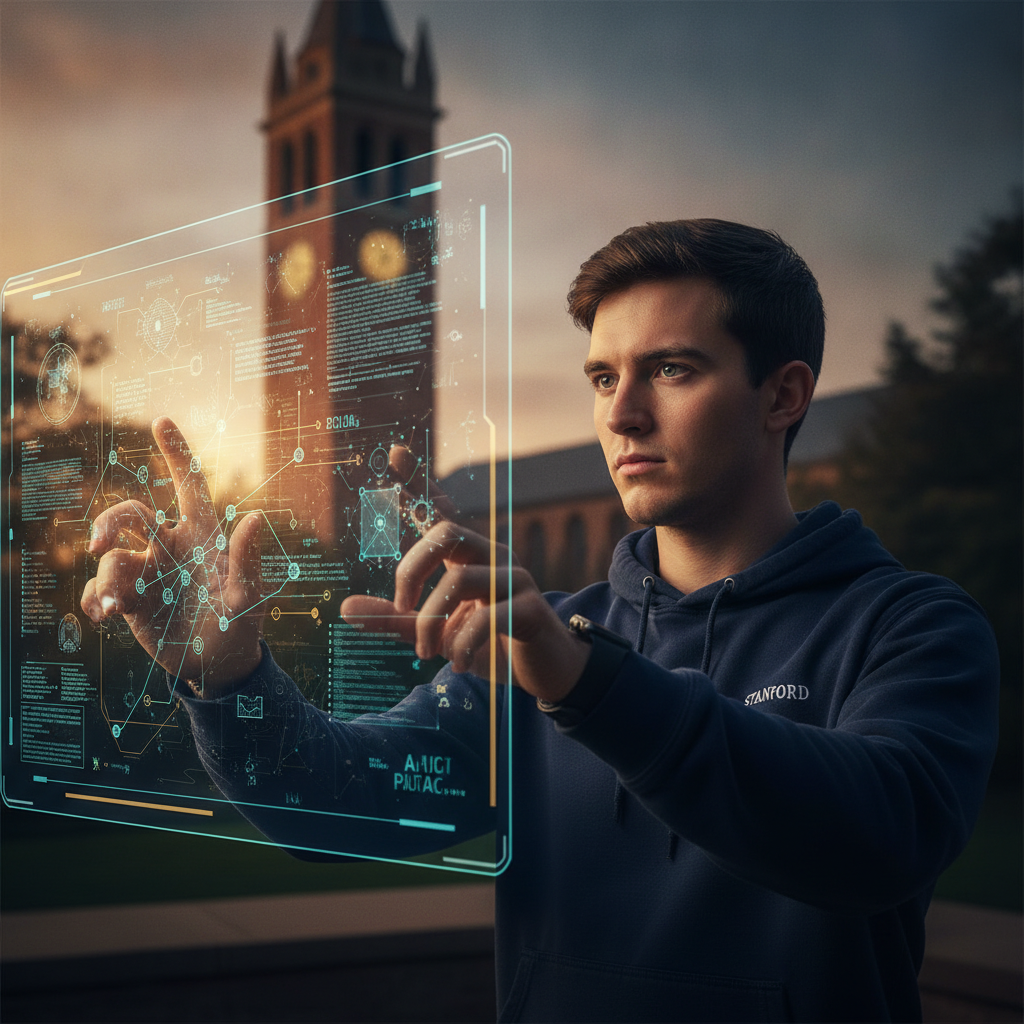
For countless aspiring minds, acceptance to Stanford University represents the ultimate golden ticket. It’s a gateway to innovation, a hub of world-class education, and a launchpad for future leaders. Yet, as the halls of this prestigious institution buzz with brilliant students, a new, powerful force is reshaping their academic journey and future prospects: artificial intelligence.
The rise of AI tools, from advanced language models to sophisticated data analytics platforms, presents a fascinating paradox. On one hand, these technologies offer unprecedented opportunities to enhance learning, streamline research, and unlock creative potential. On the other, they introduce complex questions about academic integrity, skill development, and the very nature of human achievement.
The core question facing Stanford students and educators alike isn’t whether AI will integrate into academia, but how. Can AI genuinely help students achieve more, or does it pose an inherent risk to their educational foundations and future careers? Navigating this intricate balance is now a central challenge for one of the world’s leading universities.
AI: A Catalyst for Enhanced Learning and Innovation
Students at Stanford, inherently at the forefront of technological adoption, are quickly discovering the manifold ways AI can augment their academic experience. Many view AI not as a replacement for human intellect, but as a powerful co-pilot. It’s helping them to navigate vast amounts of information, refine complex arguments, and even spark new ideas with greater efficiency.
For instance, AI-powered tools can significantly speed up research, summarizing lengthy academic papers or highlighting key data points from extensive datasets. This efficiency allows students to dedicate more time to critical thinking and analysis, rather than slogging through laborious foundational tasks. The shift means a deeper, more engaged interaction with the subject matter.
Furthermore, AI is proving invaluable in personalized learning environments. Imagine an AI tutor providing instant feedback on essays, offering tailored practice problems, or even suggesting relevant supplementary materials based on a student’s individual learning style and pace. This level of customized support was once unimaginable, but it’s now becoming a tangible reality for Stanford students exploring AI integration.
Beyond traditional academics, AI is a fertile ground for entrepreneurial spirit within the Stanford community. Students are leveraging AI development kits to prototype innovative solutions, from advanced healthcare diagnostics to sustainable energy management. The campus is a vibrant ecosystem where theoretical knowledge quickly translates into practical, world-changing applications, often with AI at its core.
This innovative use of AI extends to collaborative projects, where AI can help organize team efforts, track progress, and even identify potential bottlenecks. By automating routine organizational tasks, AI frees up valuable human capital for creative problem-solving and strategic planning. This enhances the overall productivity and learning outcomes for aspiring innovators.
Navigating the Ethical Maze and Academic Integrity
While the benefits are clear, the integration of AI into academic life at institutions like Stanford also presents significant challenges, particularly concerning ethics and academic integrity. The ease with which AI can generate coherent text raises thorny questions about authorship and authentic learning outcomes. Educators are grappling with how to assess student understanding when AI can complete assignments.
The fundamental concern revolves around ensuring that students are genuinely acquiring knowledge and critical thinking skills, rather than merely outsourcing their intellectual heavy lifting to an algorithm. Policies on AI usage are rapidly evolving, with some courses embracing AI as a tool, while others strictly prohibit its use in certain contexts. This creates a complex landscape for students to navigate, balancing efficiency with ethical responsibility.
Discussions around AI plagiarism are prevalent across campus. Is it plagiarism if an AI writes an essay based on a student’s detailed prompts? Or is it a form of sophisticated research assistance? These are not trivial questions, and they demand careful consideration from faculty and students alike as the university develops clear guidelines that support learning while upholding academic standards.
Moreover, the potential for AI to introduce bias or misinformation into academic work is another serious consideration. Training data for AI models can reflect existing societal biases, and relying solely on AI outputs without critical human review can perpetuate these inaccuracies. Developing critical AI literacy is becoming as crucial as traditional research skills for future generations.
The AI-Shaped Future of Work and Skill Development
Perhaps the most profound impact of AI for Stanford students lies in its implications for the future job market. While AI promises to create new roles, it also has the potential to automate many existing tasks, leading to anxieties about job displacement. Students are keenly aware that their ‘golden ticket’ education must now equip them with skills that are AI-proof or, even better, AI-enhanced.
The focus is shifting from rote memorization and procedural tasks to competencies that AI currently struggles with: creativity, emotional intelligence, complex problem-solving, and critical ethical reasoning. Universities like Stanford are adapting curricula to emphasize these uniquely human attributes, ensuring graduates are not just technically proficient but also intellectually agile and resilient.
Students are actively seeking opportunities to specialize in AI development, machine learning engineering, data science, and AI ethics. They recognize that being fluent in the language and application of AI will be a distinct advantage in nearly every field, from medicine and law to finance and the arts. The competitive edge is now firmly linked to AI fluency and adaptation.
The university encourages students to engage with AI technology not just as users, but as creators and ethical stewards. This involves understanding the underlying algorithms, contributing to open-source AI projects, and actively participating in conversations about responsible AI development. The goal is to produce graduates who can confidently shape the future of AI, rather than simply reacting to its advancements.
Charting a Course in the AI Era
Ultimately, the relationship between Stanford’s ambitious students and the pervasive power of AI is a dynamic and evolving one. It’s a journey marked by both immense promise and significant challenges that require continuous adaptation.
While AI certainly offers powerful tools to enhance learning and innovation, it also demands a renewed focus on academic integrity, critical thinking, and uniquely human skills. For those walking the hallowed grounds of Stanford, navigating this AI-driven landscape is not just an academic exercise; it’s a fundamental part of preparing for a future that will undoubtedly be shaped by artificial intelligence, ensuring their golden ticket remains valuable.
Source: Google News – AI Search
