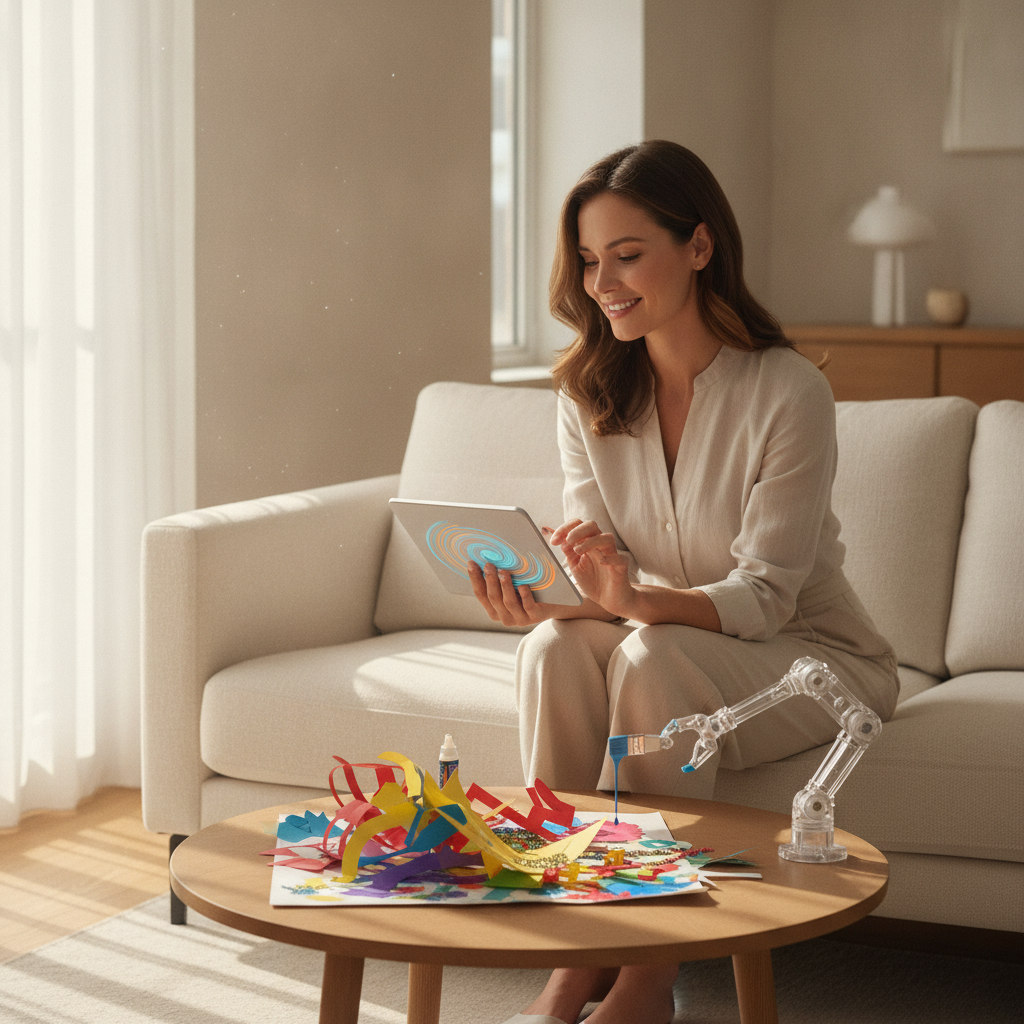
Lilian Schmidt was at her wit’s end. Night after night, she wrestled with the impossible task of getting her daughter to sleep. Despite countless expert tips—white noise, blackout curtains, even massages—nothing seemed to work for the bleary-eyed brand consultant from Zurich.
“Every single day, it took like two to three hours to put her to bed,” Schmidt recalls. The nightly struggle involved screams and fights, leaving everyone in the family exhausted and frustrated by the day’s end. It was a seemingly endless cycle of parental despair.
Then, when her daughter was three and a half, a desperate Schmidt turned to an unexpected, and frankly controversial, source: ChatGPT. The AI’s advice completely defied conventional wisdom, suggesting her daughter needed more stimulation, like chewing gum or jumping on a trampoline before bed. To Schmidt’s utter astonishment, it worked.
Within five minutes, her daughter snuggled up and drifted off to sleep. “I was freaking out,” Schmidt admits, realizing a profound shift had just occurred. “Nobody was able to help me except ChatGPT.”
AI Steps In: A New Era of Parenting Support
From that pivotal moment, Schmidt, who also parents a 14-year-old stepson, became an ardent AI evangelist. Her journey took a public turn in June 2025, when she posted a TikTok video proclaiming, “I Turned ChatGPT into my coparent,” which quickly went viral, swelling her follower count to 27,000 in just three weeks. This success led her to create her own custom GPT, “Coparent,” offering access to other parents for $37 on her website.
Schmidt embodies a rising trend: a new breed of “momfluencer.” Unlike those who romanticize the daily grind of motherhood with aesthetically pleasing imagery, these influencers challenge whether all that labor is even necessary. Their content, featuring titles like “The AI Assistant That’s Basically My Mom Brain Now” or “How to Use AI as a Mom,” champions the use of customized prompts and handbooks.
They promise moms a “coparent who never forgets the sunscreen or asks you to write things down,” as Schmidt cleverly puts it. This movement taps into a deep-seated desire among mothers to reclaim their time and sanity, transforming mundane tasks through technology.
The Mental Load & The AI Gender Gap
Interestingly, Schmidt’s online content often shows her undertaking the bulk of parenting tasks—meal prep, grocery shopping, arts and crafts—with her partner notably absent. This portrayal reflects a stark reality: moms continue to bear the overwhelming majority of physical and mental labor in households. A 2022 Department of Labor survey highlighted this, finding employed mothers spend an additional 13.5 hours per week on chores and 12.5 hours on childcare, a staggering 40 percent increase since 1975.
While Pew data indicates fathers now dedicate more than twice the time to household duties and childcare compared to 50 years ago, women still disproportionately shoulder the burden. Schmidt herself notes, “It’s not that my partner isn’t helping, because he is.” Yet, she emphasizes the “invisible labor” that largely falls on women, which detracts from quality time with their children.
Moms have flocked to her platform, drawn by the promise of using AI “to actually be more present with my kids and to be more emotionally regulated, so I can be a cool mom and a happy mom and not a stressed-out one.” However, a significant “AI gender gap” exists; women are over 20 percent less likely to use generative AI in their daily lives than men, according to a 2025 study. Stephanie Leblanc-Godfrey, founder of Mother AI, describes the issue as generative AI tools suffering from a “PMS” problem: “pale, male, and stale.”
Leblanc-Godfrey points out that AI companies often lack diversity, failing to reflect the society they serve or the specific needs of mothers, who are often heads of households. Erin Grau, cofounder of Charter, suggests “mom guilt” may play a role, making women view reliance on AI as “cheating.” Recognizing this disparity, prominent figures like Mel Robbins, in partnership with Microsoft Copilot, and Reese Witherspoon have publicly advocated for women to embrace AI, framing it as a tool for empowerment and a way to avoid being “left behind.”
Beyond the Hype: Challenges and Realities
The rise of AI momfluencers isn’t without its critics. Schmidt and Dooley frequently face backlash from those concerned about generative AI’s substantial environmental impact and its potential to displace nearly 15 percent of the workforce. There are also valid anxieties surrounding AI’s effect on children’s development and mental health.
Even some within the AI-for-moms movement share these concerns. Leblanc-Godfrey cautions against framing AI as “radical feminism” or “productivity porn,” suggesting such approaches miss the broader picture. She believes exploiting women’s insecurities to push AI as a feminist tool is misguided, rejecting the notion of “toxic efficiency.”
Despite these important considerations, many AI momfluencers position AI literacy as a form of liberation from household drudgery, akin to the societal impact of the vacuum cleaner or washing machine in the mid-20th century. Schmidt argues that adding another reservation about using this tool would be counterproductive, given that “women already have so many reservations about using this tool.”
Is AI the Answer? The Unseen Burden
Yet, fundamental questions persist: why does the onus fall on women to master AI for household efficiency, and where are the dads in this conversation? Schmidt notes that while 95 percent of her audience is female, she does receive private messages from fathers looking to ease their partners’ workloads. However, these inquiries are far less frequent than those from women, and are often kept out of public view.
When pressed on this discrepancy, Schmidt offers a semi-joking, yet telling, explanation: “the patriarchy.” She asserts that “mental load is still considered a female problem,” with many men simply unaware of what the concept even entails. This systemic issue remains largely unaddressed by technology.
Even trying out chatbot parenting can be daunting. The author’s personal attempt to use AI for daily mom tasks—entering endless lines of text to delineate household mundanities—elicited a sense of “existential dread.” Seeing the sheer volume of quotidian responsibilities laid out collectively felt overwhelming. Rather than simplifying life, AI, much like previous household inventions, seemed merely a flashier means of tethering women to the home.
This experience underscored a deeper frustration: the continued expectation that women shoulder the majority of these responsibilities. While the author’s husband readily uses AI for stock market research or architectural tasks, it wouldn’t occur to him to delegate tracking birthday parties or doctor’s appointments to a chatbot. Ultimately, while technology can offer some relief, it doesn’t eliminate the fact that women are still primarily responsible for this significant mental load. As Leblanc-Godfrey aptly states, “These tools were built for people with spare time. And guess what? Moms don’t have any.”
Source: Wired – AI
