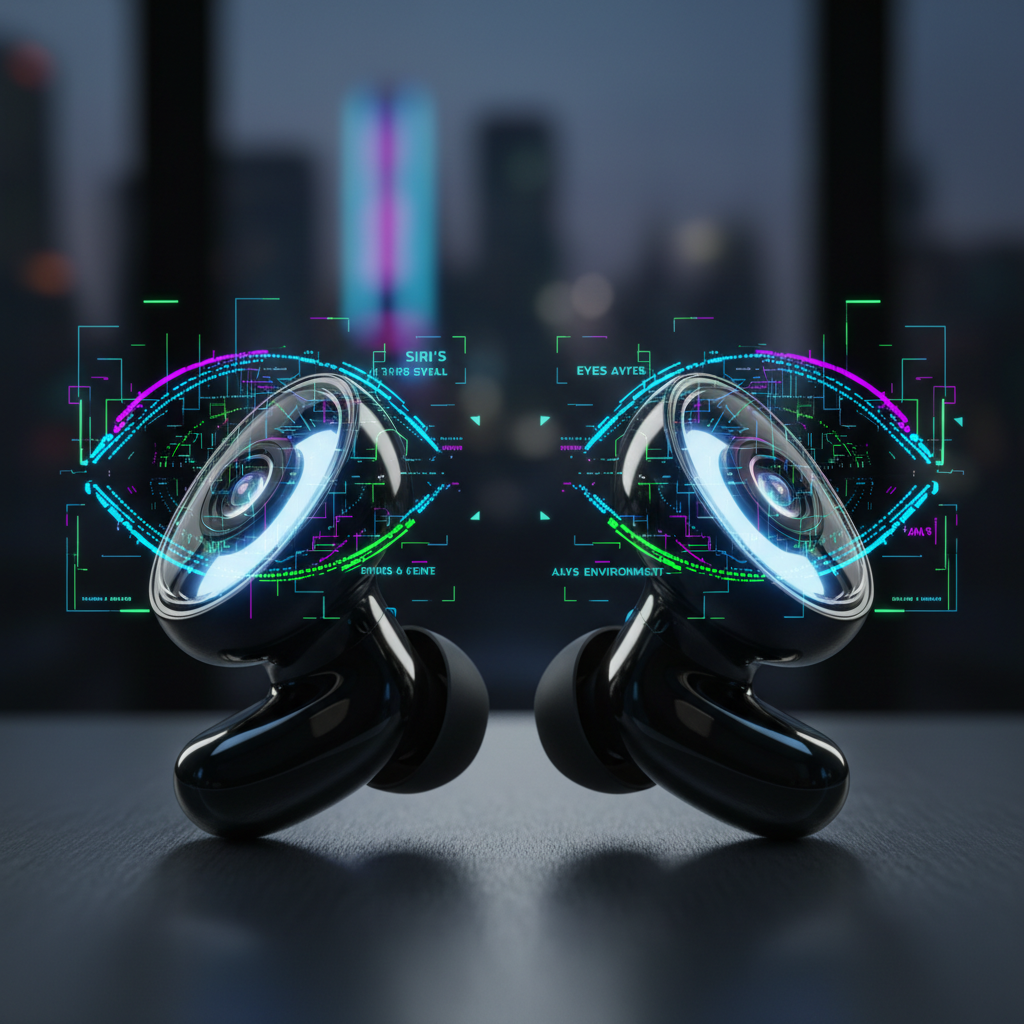
Imagine your everyday AirPods, subtly equipped with a camera. This intriguing, and for some, unsettling, concept is reportedly in advanced testing at Apple. While the idea of ubiquitous earbuds recording might raise privacy eyebrows, these aren’t for casual video capture, but rather to give Siri a new superpower: the ability to “see” the world.
However, the journey to bringing camera-equipped AirPods to market seems complex. Industry sources suggest Apple might delay their release, despite ready hardware. The primary hold-ups include Siri’s visual intelligence not being mature, and Apple executives grappling with significant privacy concerns without truly compelling use cases.
Siri’s New Vision: What’s the Idea?
Bloomberg’s Mark Gurman reported that Apple has designed AirPods with low-resolution cameras, currently undergoing late-stage testing. These sensors, housed in slightly larger stems, are intended as Siri’s eyes, providing visual context for spoken requests rather than high-resolution photos.
Potential uses include landmark-based navigation and identifying groceries. Anshel Sag, principal analyst, emphasizes vision-based location for rectifying GPS data, hinting at a passive user experience.
Beyond Navigation: The Potential of Visual AI
An “all-seeing” Siri has implications beyond simple directions. Analysts envision an AI assistant combining visual data with input from other Apple devices. For instance, Siri could suggest dinner recipes based on fridge contents, or understand your urgency in a busy train station to defer calls.
Beyond convenience, camera-equipped AirPods could offer significant accessibility enhancements. Features like Apple’s Image Explorer and Voice Over for visually impaired users could be dramatically improved with real-time visual input, providing a richer, context-aware understanding of their environment.
This integration of visual data is also crucial for Apple’s broader AI ambitions. As AI models move beyond text, real-world visual and acoustic data become invaluable for training new systems, potentially enabling Apple to develop its own foundational AI models or enhance existing partnerships.
The Privacy Tightrope and Practical Hurdles
Introducing cameras into such a ubiquitous device challenges Apple, especially given its strong stance on user privacy. Consumers are wary of casual surveillance, and Apple must justify the privacy risk with compelling use cases. A small LED light would reportedly indicate when visual data is uploaded to the cloud.
To honor its privacy policies, Apple would need rigorous anonymization and “radical cleaning” of personal data. Alternatively, processing contextual cues on-device or on the user’s iPhone could mitigate risks. Apple’s Private Cloud Compute offers a secure, server-based solution with end-to-end encryption for heavier AI requests.
Practical hurdles also exist. AirPods are known for their compact size, but cameras demand more internal space and significantly impact battery life. Early research found cameras halved AirPods’ battery life to just over three hours. Physical issues, like long hair, could also easily obstruct the cameras.
Glimpse into Apple’s Spatial Computing Future?
Despite these challenges, Apple’s camera-enabled AirPods exploration is likely strategic. Many see it as an “entry-level” device for multimodal AI, preparing users for future products like the long-rumored Apple Glasses. This positions AirPods as one end of Apple’s comprehensive spatial computing strategy, alongside the premium Vision Pro.
Qiran Ju, a senior analyst, views camera AirPods as a logical step, seeing them as “more context-aware than a phone, but potentially lighter and more familiar than glasses.” This aligns with enabling first-person immersive image and video capture for spatial content.
While some Chinese companies already explore camera-enabled earbuds, the biggest mystery remains what will truly materialize from Apple’s ambitious AI push. This venture highlights a broader industry shift towards wearables that offer deeper, context-aware interaction, shaping the future of post-smartphone consumer tech.
Source: Wired – AI
