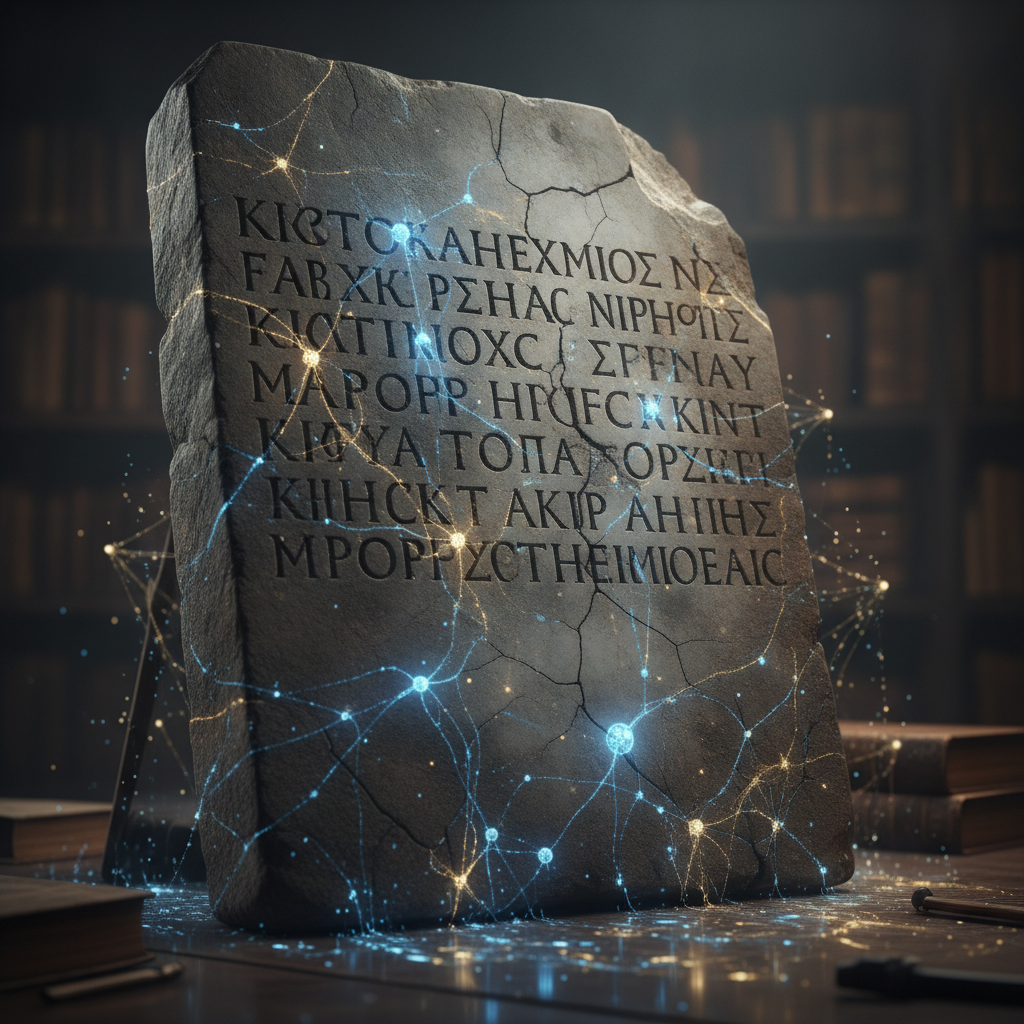
A groundbreaking stride in digital humanities is set to transform how we understand the ancient world. Google DeepMind has unveiled an advanced AI skill specifically designed to assist historians and classicists in their meticulous work with ancient inscriptions. This revolutionary tool promises to accelerate the deciphering, restoration, and analysis of damaged or fragmented texts, opening new avenues for historical research.
For centuries, the study of ancient inscriptions—a field known as epigraphy—has been a cornerstone of understanding past civilizations. Now, with the power of artificial intelligence, researchers are gaining an unprecedented ally in piecing together the puzzles left behind by our ancestors, from legal decrees to personal dedications etched in stone.
Unlocking the Past: The Challenge of Ancient Inscriptions
Working with ancient inscriptions is an incredibly complex and time-consuming endeavor. Historians and archaeologists often grapple with fragments of text, eroded surfaces, and inscriptions written in archaic languages or scripts that have long fallen out of use. Many precious historical records are incomplete, damaged by time, weather, or human activity.
The sheer volume of material, combined with the delicate nature of its preservation, means that progress in epigraphy can be painstakingly slow. Deciphering a single line can take weeks or months of dedicated research, cross-referencing, and comparative analysis. This intensive human effort often requires deep linguistic knowledge, archaeological context, and keen pattern recognition skills.
Such challenges underscore the immense value of any tool that can streamline this process. The ability to quickly and accurately suggest missing text or contextual information is nothing short of a game-changer for scholars dedicated to resurrecting voices from antiquity.
How AI is Revolutionizing Historical Research
Google DeepMind’s new AI skill is engineered to tackle these formidable challenges head-on. Trained on a vast dataset of hundreds of thousands of documented ancient Greek inscriptions, the AI can recognize patterns, linguistic nuances, and historical contexts that even expert human eyes might miss or take much longer to identify. It leverages deep learning to make informed predictions about lost text and provide crucial insights.
This sophisticated AI doesn’t just fill in blanks; it offers a comprehensive suite of analytical capabilities. It can propose multiple restoration options, assign probabilities to different interpretations, and even suggest potential dates and geographical origins for inscriptions based on stylistic and linguistic cues. This helps historians narrow down their research and focus on the most promising leads.
By automating the initial, most laborious stages of textual analysis, the AI skill empowers historians to dedicate more time to critical interpretation and synthesizing new knowledge. It acts as an intelligent research assistant, performing tasks that would traditionally demand extensive manual cross-referencing and expert intuition.
Key capabilities of this AI skill include:
- Restoration: Accurately proposing missing characters or entire words in damaged texts.
- Dating: Estimating the creation period of an inscription, often with impressive precision.
- Provenance: Suggesting the likely geographical origin, aiding in archaeological contextualization.
- Cross-referencing: Identifying parallels and connections with other known inscriptions and historical documents.
A Powerful Ally, Not a Replacement
It’s crucial to understand that this AI is designed to be a collaborative tool, an assistant to human experts, not a replacement. Historians will always retain the ultimate authority in interpreting and validating the AI’s suggestions. The tool provides hypotheses and probabilities, which then require expert human scrutiny, validation, and contextualization within broader historical narratives.
The AI excels at identifying patterns and making statistically informed guesses, but it lacks the nuanced understanding of human intent, cultural context, and the ability to critically evaluate historical narratives that a seasoned historian possesses. Its role is to augment human intelligence, allowing researchers to explore more possibilities and work through data at an accelerated pace.
This synergistic approach ensures that while the efficiency of research dramatically improves, the integrity and depth of historical scholarship remain paramount. Historians can now devote more energy to the interpretive work that truly defines their field, rather than being bogged down by the initial data reconstruction.
The Future of Digital Humanities
The launch of Google DeepMind’s AI skill marks a significant milestone in the field of digital humanities. It showcases the immense potential of artificial intelligence to revolutionize academic research, particularly in areas dealing with vast and complex datasets like ancient history. This technology not only preserves cultural heritage but also makes it more accessible to a wider audience.
Looking ahead, we can anticipate this technology expanding its reach to other ancient languages and scripts, from Egyptian hieroglyphs to Mesopotamian cuneiform. Such advancements promise to democratize access to historical knowledge, allowing more scholars and enthusiasts to engage directly with the primary sources of human civilization.
Ultimately, by bridging the gap between cutting-edge AI and ancient history, Google DeepMind is helping us illuminate the past with unprecedented clarity, bringing the voices and stories of antiquity to life for new generations.
Source: Google News – AI Search
