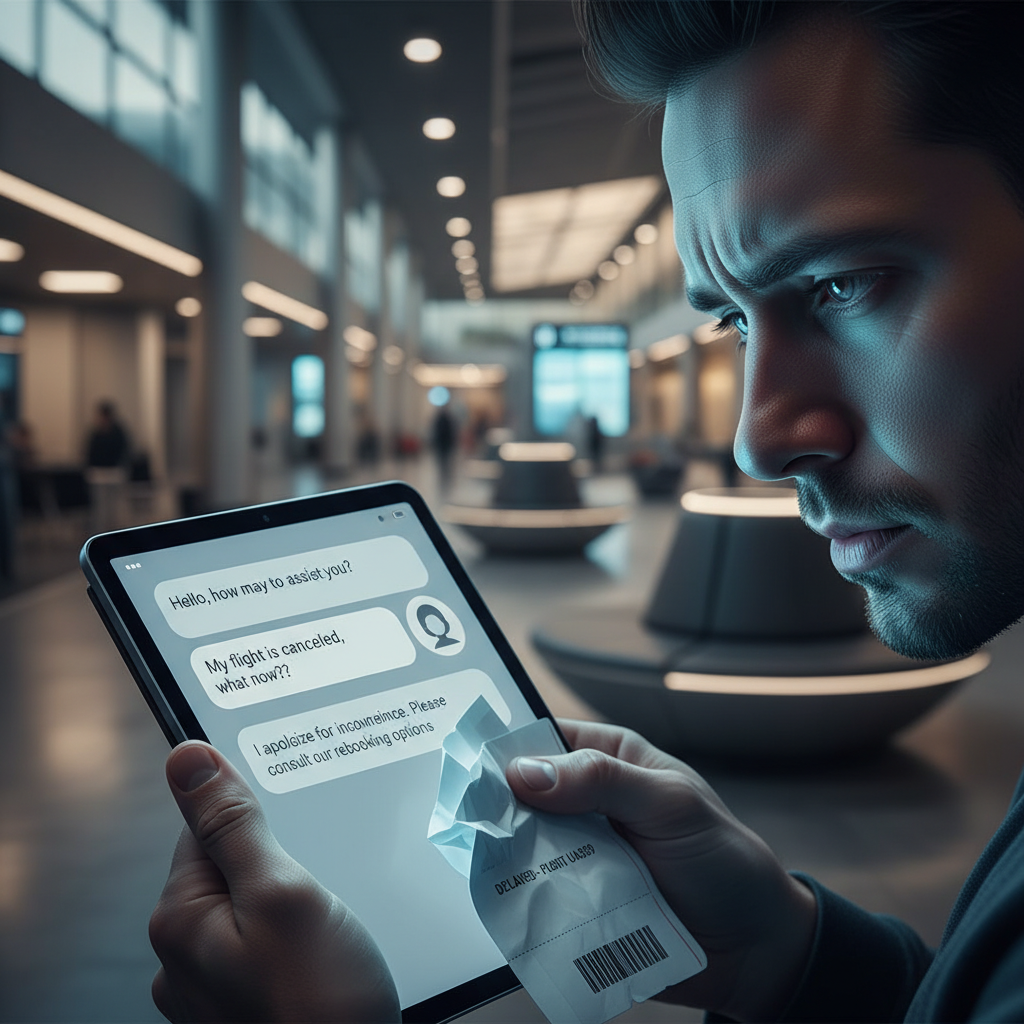
My travel plans hit a snag on March 31 when an email from Norse Atlantic Airways landed in my inbox. My $940 round-trip flights to Rome were abruptly canceled, with a curt instruction to request a refund within 14 days. Little did I know, this was just the beginning of a frustrating journey into the world of AI-driven customer service and its unexpected pitfalls.
Initial calm quickly dissolved as the company’s refund request page repeatedly failed to load across multiple browsers and devices. After sending several unanswered emails, the absence of a phone number became glaringly apparent. A quick search on Reddit revealed dozens of similar complaints, painting a concerning picture of Norse Atlantic’s allegedly haphazard customer support operations.
The AI Gamble: Norse Atlantic’s Digital-First Approach
My personal experience prompted me to file a public records request with the Federal Trade Commission (FTC), hoping to gauge the extent of these issues. I eventually received approximately 75 detailed complaints, many of which described a vacuum in customer service where human assistance was non-existent. This void, it seemed, was eagerly filled by scammers preying on frustrated travelers.
Of the 41 complaints that reported a specific monetary loss, a staggering 21 claimed to have lost more than $1,000. While Norse Atlantic Airways does employ human customer service personnel, the airline has significantly embraced a tech-forward approach in recent years. This strategy heavily relies on AI agents to manage most customer interactions.
Bård Nordhagen, Norse Atlantic’s chief customer and communications officer, explained to WIRED that technology is meant to enhance availability and support while keeping fares low. However, my experience and the numerous complaints suggest this digital-first approach often results in a time-consuming, frustrating, and even financially detrimental process for customers.
Formed in February 2021, Norse Atlantic Airways has branded itself as a “modern, long-haul, low-cost airline” with a “lean” workforce. Early on, they implemented a tool from Sprinklr for a “unified” inbox, and archives show they never listed a customer service number. By January 2025, the AI company Kindly detailed its development of a chatbot named “Odin” or “Odin’s Wingman,” which became the primary support channel after the customer support email was removed.
However, Odin was “sunset” by January 2026, replaced by the current AI agent, Freya, developed by Delight.ai. Delight.ai reported that Freya dramatically increased the airline’s no-human-intervention inquiry resolution rate from 60 percent to 80 percent within just two weeks of its introduction. Norse’s chief product officer, Alf Lim, lauded Freya as a “core part of the team,” envisioning customer support staff as “AI agent managers” who optimize and step in when human touch is truly necessary.
Nordhagen further asserted to WIRED that Freya has been a resounding success, now managing an astonishing 99 percent of inquiries from passengers. Yet, the overwhelming number of FTC complaints tells a very different story about the real-world impact of this reliance on automated support.
A Scam Epidemic: The Human Cost of Automated Support
A disturbing theme emerged from the FTC complaints: many customers, needing to change a flight or adjust a booking, searched online for a Norse Atlantic Airways phone number. A shocking 18 complaints explicitly detailed falling victim to scams after encountering fraudulent websites and phone numbers in search results. These scammers often impersonated legitimate representatives, demanding payments for services that should have been free or for flights already paid.
Customers reported being told they owed money for existing bookings or faced exorbitant fees to modify their itineraries. Tragically, many provided credit card information, and in some cases, even their Social Security numbers. Soon after, massive unauthorized charges appeared on their credit card statements, leading to significant financial distress.
One particularly harrowing complaint from March 2025 described an individual attempting to buy tickets over the phone. They disclosed information for three different credit cards and even the last four digits of their Social Security number, believing payments weren’t going through. By the time they realized they’d been scammed and canceled their cards, an unidentified charge for $1,258.88 had appeared, leaving the elderly couple “scared” and seeking help.
The problem has become so pervasive that Norse Atlantic Airways’ official website now features a prominent warning about “online scam and fraud.” Despite this, a recent Google search for “Norse Atlantic Airways phone number” still returned links to Yelp pages listing two different numbers, both of which appear to be scams. WIRED’s investigation revealed one number connected to a purported Star Alliance representative (which Norse is not a member of), and the other to a non-existent “Flight Travel Portal.”
Seeking Recourse: Navigating a Labyrinth of Frustration
Beyond scams, many customers simply found themselves stranded and helpless. One Los Angeles customer reported being “denied boarding” on a flight from Rome due to the complete absence of Norse Atlantic staff at the airport. With only contracted employees lacking airline contact information, and the chatbot being the sole communication channel, they were forced to “secure urgent, costly alternative arrangements” to avoid being stranded abroad with a child.
Attempts to seek assistance from third-party booking agents or credit card companies often led back to the same dead end: Norse Atlantic Airways. An August 2024 complaint from a New York customer highlighted this issue after purchasing a flight through Priceline with cancellation insurance. When they couldn’t make the flight, Priceline directed them to Norse, where they subsequently fell victim to a scam after searching for a phone number online.
Despite contacting Priceline, Xcover, and Affirm, the customer received no help and expressed concern about appearing to have missed the flight, complicating any refund efforts. This illustrates the frustrating cycle customers face when traditional support avenues are either nonexistent or unhelpful, leaving them to navigate a complex problem alone.
Norse Atlantic’s former CEO, Bjørn Tore Larsen, stated in a 2024 earnings call that the company heavily invests in technology to become more efficient, seeing a “very quick payback” in reduced costs and increased revenues. More recently, in early May, Norse announced a 35 percent cut in administrative staff, and CEO Eivind Roald confirmed the airline is exploring opportunities for a sale or merger.
Erie Meyer, a senior fellow at the Center for Law and the Economy and former chief technologist at the FTC, described the complaints about Norse’s customer service as “particularly egregious.” She emphasized that customers are “not just vulnerable to scammers, but served up on a silver platter to the scammers.” Meyer advises customers to file claims with their state attorney general’s office, as they are often more responsive and proactive in investigating such widespread issues.
As for my own canceled flights, I eventually found a solution by bypassing the automated system altogether and reaching a human. The same day I filed my public records request, I directly emailed Nordhagen, Norse Atlantic’s chief customer and communications officer. While I clarified my outreach as a customer and not a journalist, this unconventional approach may not be feasible for everyone.
Within an hour of my email, I received a confirmation that my refund was being processed, and it appeared in my bank account just two days later. My experience underscores a critical point: while AI can streamline operations, the absence of accessible human support can create significant distress and financial risk for travelers, highlighting the complex balance between technological efficiency and genuine customer care in the modern airline industry.
Source: Wired – AI
