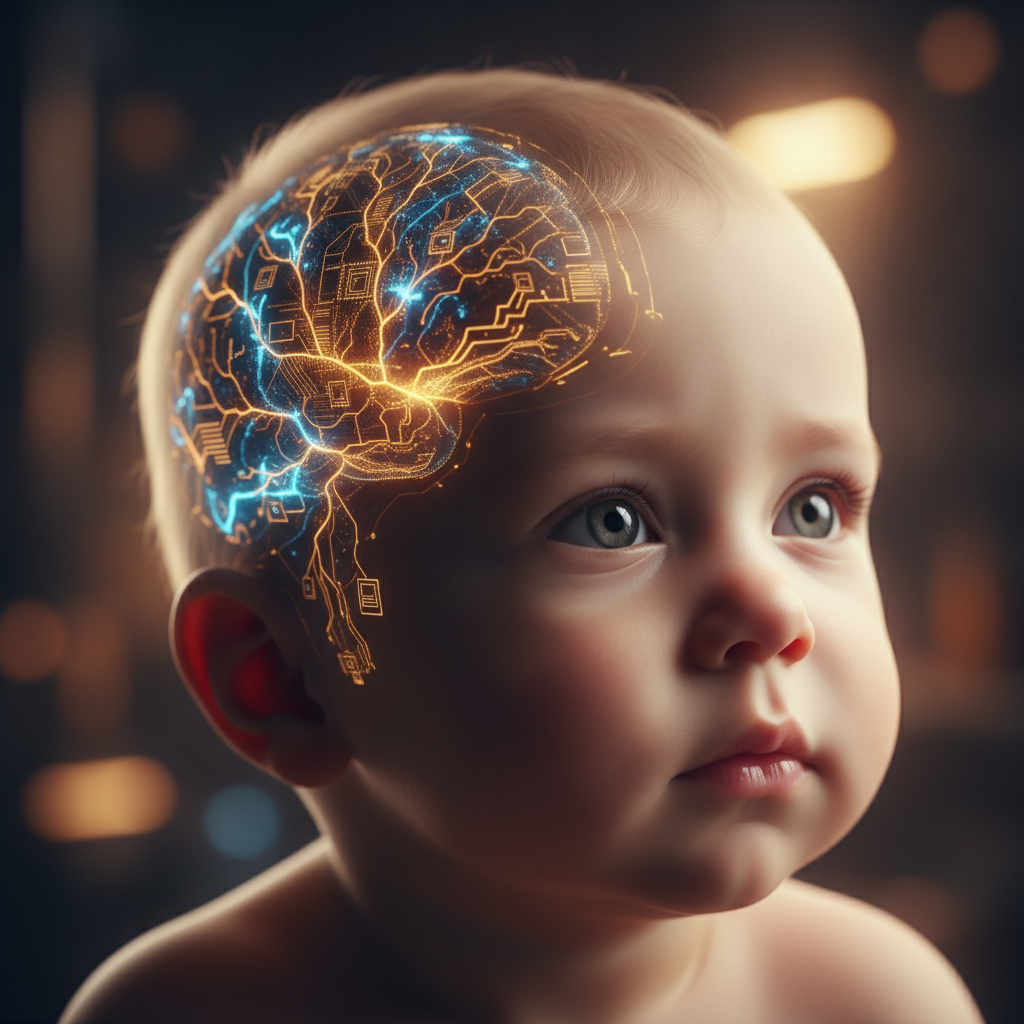
We often marvel at the sophisticated intelligence of AI models, powered by countless cutting-edge computer chips and vast datasets. Yet, if we truly want to understand efficient learning, we should look no further than a 1-year-old human baby.
While infants may not be solving complex algorithms or debating philosophy, they possess an extraordinary ability to learn about the world with remarkable efficiency. Unlike AI models that guzzle data and energy on a country-sized scale, babies grasp new concepts and identify objects after seeing them just once or twice, learning through fleeting observations and physical interactions.
The Baby Brain: A Blueprint for Better AI
The architecture of a baby’s brain holds crucial insights for advancing artificial intelligence. Developing more “baby-like” AI could lead to frontier models that are significantly less costly and energy-intensive. This approach would also be invaluable for AI-powered robots, enabling them to learn about their environments in a far more natural and intuitive manner.
To explore this exciting new frontier, a collaborative team of researchers from Meta, Stanford University, the University of Tokyo, and France’s École Normale Supérieure has created a novel test. This challenge aims to highlight the unique learning skills of infants and push AI developers to design algorithms that can truly match them.
Introducing the EgoBabyVLM Challenge
The new benchmark is called the EgoBabyVLM Challenge, and it evaluates how effectively vision-language models (VLMs) can interpret the world from an infant’s perspective. VLMs, which learn from both text and imagery, are tasked with describing their environment after processing approximately 1,000 hours of video footage. This footage was genuinely collected from cameras strapped to the heads of infants and toddlers, offering a unique “ego-centric” view of early learning.
Remarkably, current cutting-edge AI models perform terribly when fed this realistic, often messy, baby-perspective footage. This stark failure strongly suggests that there’s something fundamentally different about the design of the baby brain, enabling it to learn so rapidly and effectively from such limited information.
Babies don’t learn from perfectly curated datasets; instead, they experience a kaleidoscopic view of reality. This includes parents discussing unseen objects, indicating things with gestures or gaze, and talking about past or future events rather than just the immediate present. Michael Frank, a cognitive scientist at Stanford University specializing in language learning and involved in EgoBabyVLM, emphasizes that babies learn not only from language but from a rich, multimodal, and tactile experience. “It’s clear that there’s more [than just language] that’s needed” for AI to truly understand the world.
Beyond Language: Common Sense and Physical Reasoning
The EgoBabyVLM Challenge is the latest example of scientists leveraging AI to explore the intricacies of human intelligence. Another notable initiative, the BabyLM challenge introduced in 2023, tasked AI models with learning language syntax using a dataset comparable to what a 10-year-old child processes – millions of words, rather than the trillions fed to conventional AI. Interestingly, transformer-based AI models excelled at this, a finding that even challenges long-held theories by Noam Chomsky about innate language structures.
However, understanding the physical world presents a different set of obstacles. Ryan Cotterell, a linguist at ETH Zurich and creator of BabyLM, notes that “there isn’t going to be a large corpus of human interactions—there’s no internet of human interactions.” Joshua Tenenbaum, a cognitive scientist at MIT, adds that BabyLM revealed models still lack “common sense” regarding the physical world, social dynamics, or theory of mind. “Pure pattern learning systems are not able to take the kind of data that a baby or a child receives and learn all the things that they do,” Tenenbaum asserts.
The Future of Baby-Inspired AI
A fundamental debate in cognitive science and neuroscience revolves around how much learning capability is hardwired into the brain evolutionarily. The human brain is incredibly complex, boasting significant built-in structure and architecture. While basic VLMs have shown they can learn simple concepts like what a ball is purely from infant-head data, this is still far from sophisticated reasoning.
The EgoBabyVLM paper’s authors propose that integrating insights from cognitive science and neuroscience could propel us toward more humanlike learning algorithms. This includes designing models that can maintain attention over extended periods and accurately interpret social cues. Stanford’s Frank and his team have already demonstrated this potential by testing a new model adept at learning causality and visual-temporal relationships using the same baby-head video data. Their model more effectively learned the dynamics of different objects, a crucial foundation for physical reasoning.
This research presents a tantalizing possibility: perhaps models specifically designed to quickly grasp concepts like physics and social relationships could become overall more efficient learners. Brendan Lake, a cognitive scientist at Princeton University involved in the project, expressed enthusiasm, calling EgoBabyVLM “a wonderful challenge” and eager to see the “new architectures, approaches, and ingredients researchers come up with.”
Source: Wired – AI
