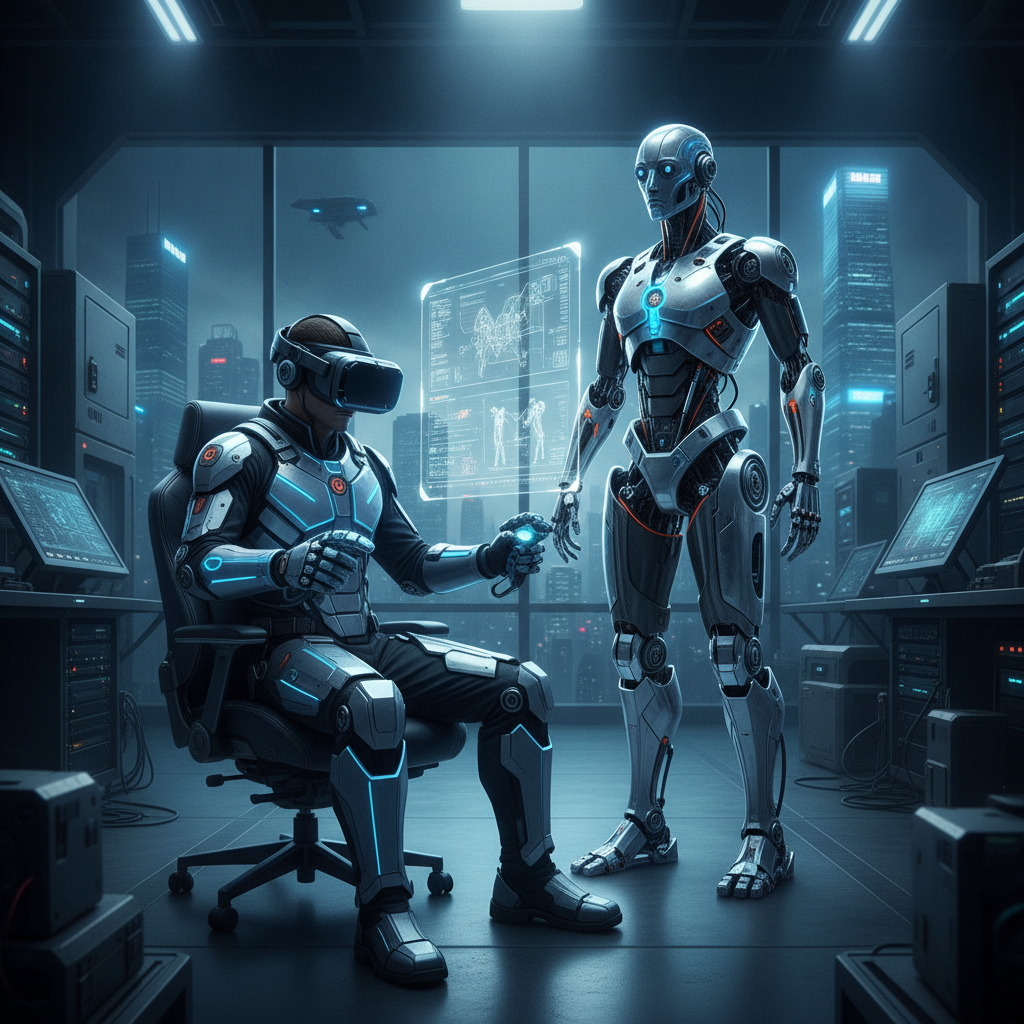
Step into a glimpse of tomorrow, and you might find yourself surrounded by a fascinating new frontier of blue-collar work. Just 45 minutes north of downtown Shenzhen, China, at a startup called IO-AI Tech, I witnessed a revolutionary approach to labor. Here, workers don specialized virtual reality (VR) headsets, handheld controllers, and advanced motion-tracking gear, all to remotely operate humanoid robots in diverse workplaces, from bustling factory floors to local convenience stores.
The company’s ambition is twofold: these robots are designed to perform practical tasks, such as meticulously stocking shelves or efficiently picking items from bins. Crucially, every movement and interaction is also recorded, generating invaluable training data that could one day empower these bots to operate entirely autonomously. This dual-purpose strategy paves the way for a future where human oversight gradually transitions into full AI independence.
Hands-On with the Future of Robotics
To truly showcase their innovation, IO-AI Tech invited me to their offices for a hands-on demonstration. I was given a custom motion-tracking glove, a device that allowed me to simultaneously control ten different humanoid robotic hands, each from a unique manufacturer. My finger movements were instantly and flawlessly transferred to all fifty robotic digits, creating an immediate and profound sense of connection.
Admittedly, my first instinct with this futuristic gear was to make all ten hands perform a rather cheeky gesture. Once that childish impulse was out of my system, I was genuinely astonished by the technology’s responsiveness; my movements transferred with incredible speed and precision. Even more impressive was the bidirectional feedback: I could distinctly feel the sensation of a ball being placed into one of the electronic hands, a testament to the system’s advanced haptic capabilities.
The company also offered a trial run of a system currently being tested by a major Chinese convenience store chain. Donning a VR headset and wielding a pair of grippers, I attempted the task of picking boxes of medication from a shelf. Initially, the experience was disorienting, requiring me to adapt to a slight delay between my physical movements and the robot’s actions visible through the headset. However, with just a little practice, I quickly found myself confidently stacking shelves, mastering the art of remote robotic retail.
Bridging the Gap: Human Expertise and Robot Autonomy
Beyond my personal experiments, I observed other individuals fully immersed in their tasks, wearing VR headsets and body-tracking sensors that brought to mind scenes from ‘Ready Player One.’ In one expansive room, workers were utilizing various systems to control diminutive Unitree humanoids. One operator marched alongside a Unitree robot, which flawlessly mirrored their every movement within a meticulously mocked-up apartment setting.
Wearing a headset and perceiving the world through the robot’s eye-level cameras, the human operator meticulously went through the motions of removing a shirt from a hanger and folding it. This demonstration highlighted IO-AI Tech’s core expertise: developing algorithms that seamlessly transfer a person’s movements to a wide array of robot forms. This is particularly valuable given the dozens of different humanoid and robotic hand designs currently available in China.
A crucial aspect of their technology lies in combining human control with a degree of inherent autonomy. Because a human operator and a robot will never be identical in shape, size, or weight, the robot requires some independent movement capabilities to maintain its balance and stability. Without this intelligent integration, the robot would simply topple over, underscoring the delicate dance between human guidance and AI-driven self-preservation.
Shenzhen: The Cradle of Robot Innovation
IO-AI Tech’s strategic location in Shenzhen, a city renowned for housing thousands of manufacturers, provides an unparalleled advantage. Si Chin, one of the company’s co-founders, emphasizes that this environment significantly accelerates the development and refinement of new prototypes. The immediate access to manufacturing resources and a vibrant tech ecosystem fosters rapid innovation and iteration.
Furthermore, IO-AI Tech is actively collaborating with numerous local manufacturers eager to automate labor-intensive tasks. A notable partnership is with Jack Sewing Machines, a Chinese company specializing in clothing manufacturing equipment. They are working with IO-AI Tech to train two-armed robots to perform intricate tasks like ironing shirts, a process traditionally done by hand.
An executive from Jack Sewing Machines explained that these advanced robots can be seamlessly integrated into existing production lines, thereby automating work that currently demands human intervention. This collaboration exemplifies how IO-AI Tech is directly addressing the industrial need for enhanced efficiency and reduced manual labor through sophisticated robotic solutions.
The Path to Fully Autonomous AI
Many roboticists believe that amassing vast quantities of tele-operation data is the key to unlocking highly capable and generalized AI models in the future. While Si Chin acknowledges this potential, she also advocates for a pragmatic, incremental approach to deploying AI-powered automation. This measured strategy ensures reliability and allows for continuous improvement.
“It is similar to self-driving cars,” Chin explains, drawing a parallel to how autonomous vehicles have gradually been introduced into more settings with increasing levels of autonomy. She stresses the necessity of “this training data that’s more focused on the specific thing you’re trying to address” for successful real-world application. Intriguingly, robot teleoperation is even gaining significant traction in some Chinese vocational schools, preparing the next generation for this evolving field.
China’s formidable manufacturing capabilities already produce high-quality, cost-effective robots, exemplified by companies like Unitree. If the advancements seen at IO-AI Tech are any indication, China is poised to play a pivotal role in helping artificial intelligence truly master the complexities of the physical world, driving a new era of automation and intelligent systems.
Source: Wired – AI
