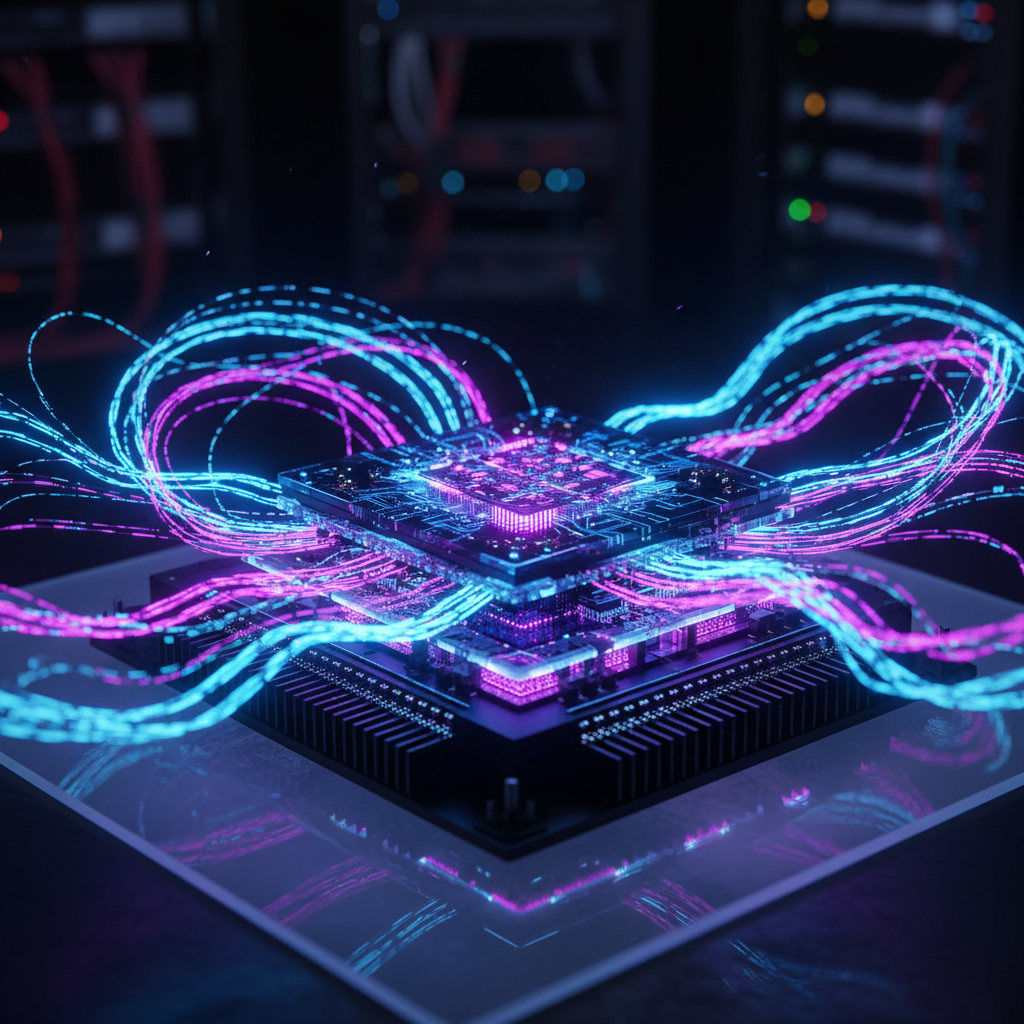
Ever wonder what truly powers the incredibly smart features embedded in your favorite Google products? From lightning-fast search results to remarkably accurate translations, there’s a secret sauce behind the scenes: custom-designed hardware engineered specifically for artificial intelligence. These powerhouses are known as Tensor Processing Units, or TPUs, and they are the unsung heroes performing the complex mathematical heavy lifting that makes modern AI possible.
Google began developing TPUs over a decade ago, recognizing early on the monumental computational demands that AI and machine learning would soon place on traditional processors. While CPUs and GPUs are versatile, they weren’t optimized for the specific, repetitive, and massive scale of matrix multiplications that form the core of neural networks. TPUs were designed from the ground up to excel at precisely these kinds of calculations, providing a dramatic leap in efficiency and performance for Google’s burgeoning AI ecosystem.
The Brains Behind the AI Revolution
At their core, TPUs are application-specific integrated circuits (ASICs) meticulously crafted to accelerate machine learning workloads. Unlike general-purpose CPUs that handle a wide range of tasks or GPUs that are excellent for parallel graphics processing, TPUs have a singular, laser focus: running AI models with unparalleled speed and efficiency. This specialization allows them to achieve incredible computational density and power savings, which are critical in Google’s vast data centers.
The architecture of a TPU is optimized for the operations most common in deep learning, particularly matrix multiplication and convolution. They feature a large “systolic array,” a network of interconnected processing elements that can perform thousands of parallel operations simultaneously, allowing data to flow through the chip with minimal overhead. This design makes them exceptionally good at both training complex AI models and performing inference—the act of using a trained model to make predictions or decisions.
- Unmatched Efficiency: TPUs are engineered for high performance per watt, significantly reducing the energy consumption required to power Google’s massive AI infrastructure.
- Scalability: Designed to work together in large clusters, known as “TPU pods,” they can scale to handle even the most demanding AI research and production workloads.
- Specialized Precision: TPUs often use lower-precision arithmetic (like bfloat16) where appropriate for AI, allowing for faster computations and reduced memory footprint without sacrificing model accuracy.
- Deep Integration: Seamlessly integrated with Google’s software stack, including TensorFlow, JAX, and PyTorch, making them highly accessible for AI developers both internally and through Google Cloud.
TPUs in Action: Powering Your Everyday Google Experience
While you might not see a TPU directly, their influence is felt across almost every Google service you interact with daily. They are the silent workhorses enabling the innovative AI features that make Google products so powerful and intuitive. Without TPUs, many of the advanced capabilities we now take for granted would simply not be feasible at their current scale and speed.
Consider the myriad ways TPUs enhance your digital life:
- Google Search: TPUs help understand complex queries, rank search results, and provide relevant answers by processing vast amounts of information.
- Google Translate: They enable real-time language translation, accurately converting text and speech across dozens of languages.
- Gmail: Smart Reply suggestions and advanced spam filtering rely on TPU-accelerated AI models to make your inbox more manageable.
- Google Photos: TPUs power intelligent image recognition, allowing you to search for specific objects or people within your vast photo library.
- YouTube: They drive personalized video recommendations and assist in content moderation, helping to ensure a safe and engaging platform.
- Google Cloud AI Platform: External developers and businesses can harness the power of TPUs to train and deploy their own custom AI models through Google Cloud.
A Decade of Innovation and Beyond
The journey of TPUs began over ten years ago, and their evolution has been continuous, pushing the boundaries of what’s possible in AI. The newest generation of TPUs boasts staggering capabilities, delivering a remarkable 121 exaflops of compute power. To put that into perspective, an exaflop represents a quintillion (a billion billion) floating-point operations per second—an almost unfathomable level of mathematical processing.
This latest iteration also features double the bandwidth of previous generations, meaning data can flow through the processing units even faster, further accelerating AI model training and inference. This relentless drive for improvement ensures that Google can continue to innovate, tackle increasingly complex AI challenges, and deliver smarter, more responsive experiences for users around the globe. The story of TPUs is a testament to Google’s long-term commitment to pushing the frontiers of artificial intelligence, both for its own products and for the broader developer community.
Source: Google Blog (The Keyword)
