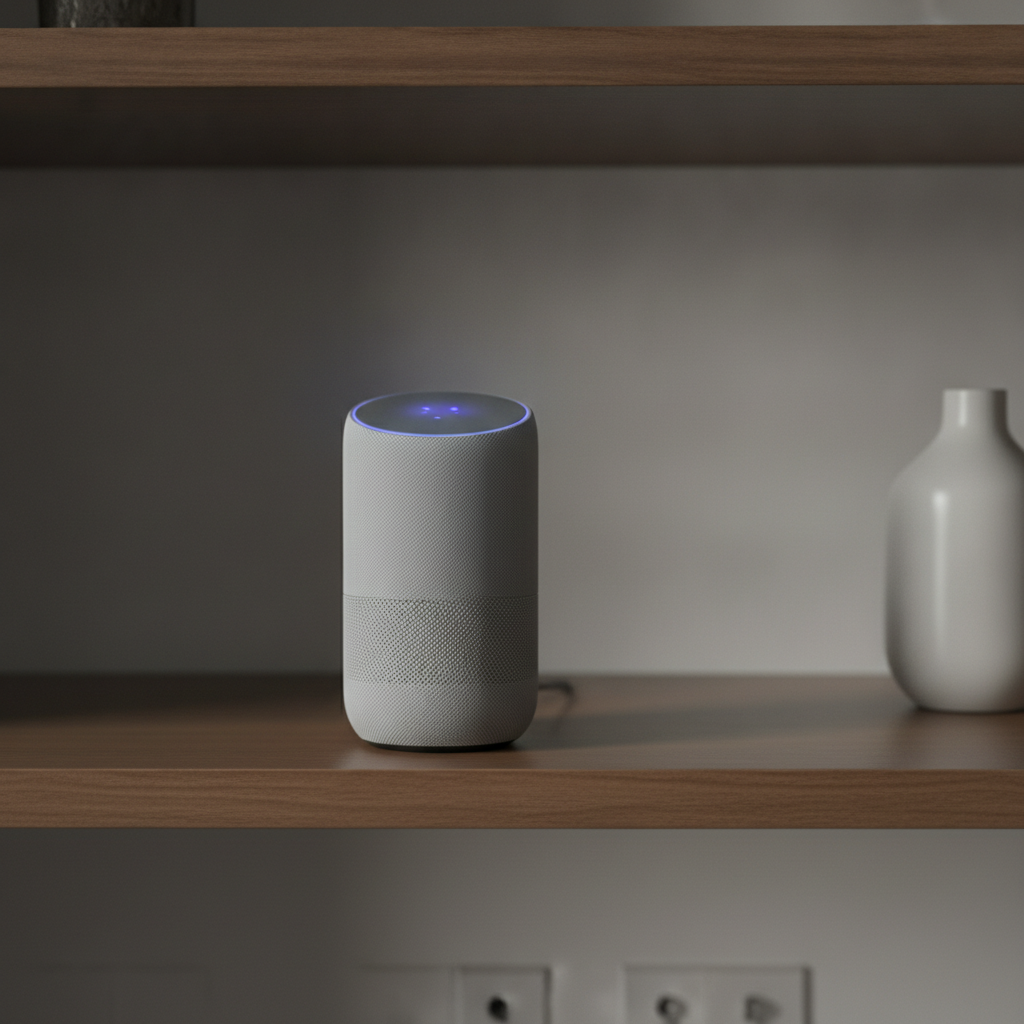
Google has always been at the forefront of smart home technology, constantly evolving its offerings to integrate cutting-edge AI. The latest addition to its smart speaker lineup, a new device retailing for $100, aims to bring Google’s advanced Gemini AI directly into your living space, signaling a significant transition from the familiar Google Assistant.
However, early observations suggest that while the hardware is sleek and the price accessible, the case for this new speaker as a truly revolutionary Gemini-powered device might be underwhelming. Many are questioning whether Gemini’s advanced capabilities genuinely shine through in this particular form factor, leaving users to wonder if it’s merely another smart speaker.
Introducing Google’s Latest Smart Speaker
The new Google smart speaker, priced at an accessible $100, follows the minimalist design philosophy we’ve come to expect from the tech giant. It’s a compact, unassuming device designed to blend seamlessly into any home decor. Its core function remains providing voice-activated assistance for common tasks, much like its predecessors.
Users can expect to control smart home devices, play music, set timers, and get answers to basic queries, all hands-free. This speaker represents Google’s continued commitment to embedding ambient computing throughout our daily lives. Yet, the real buzz — and indeed the central point of contention — revolves around its supposed integration with the much-hyped Gemini AI.
Gemini’s Promise Versus Speaker Reality
Gemini, Google’s formidable new AI model, has been showcased across various platforms, demonstrating impressive capabilities in complex understanding and creative generation. The expectation was that bringing such a powerful AI to a home speaker would unlock a new level of intelligent, contextual interaction.
Unfortunately, the reality within the confines of a $100 smart speaker appears to fall short of these ambitious expectations. Many reviewers find the Gemini experience on this device largely indistinguishable from what Google Assistant has offered for years, with basic commands and smart home controls functioning as before, but the promised “intelligence upgrade” often feeling absent.
This lack of clear differentiation raises a critical question about the value proposition. If Gemini isn’t delivering significantly enhanced capabilities on a smart speaker compared to the existing Assistant, then the primary selling point for the next-generation AI becomes moot. Gemini’s advanced reasoning and multimodal understanding don’t effectively translate to this entry-level audio-only device.
The “Weak Case” for Gemini in the Home
The argument that this new speaker makes a “weak case” for Gemini in the home stems from several key observations that dim its luster. Firstly, for many users, the core functionality offered by this new device largely mirrors that of older, often cheaper, Google Assistant devices. People primarily rely on their smart speakers for routine tasks: playing music, setting alarms, checking the weather, and controlling smart home gadgets – all functions Google Assistant has competently handled for years.
This creates a significant dilemma regarding perceived value. If an existing Google Home Mini, which can be found for a fraction of the price, performs 90% of the same daily tasks with similar accuracy and speed, then the justification for upgrading to a $100 Gemini-powered speaker becomes difficult to articulate. The “smart” aspect of the speaker, powered by Assistant or Gemini, must offer a truly compelling difference to entice consumers.
- Limited advanced conversational abilities: Gemini’s speaker integration doesn’t consistently show superior multi-turn conversation or contextual understanding over Assistant.
- Absence of multimodal interaction: As an audio-only device, it can’t fully leverage Gemini’s power to process diverse data types like images or video.
- Unclear performance boost: For everyday queries, speed and accuracy don’t appear dramatically improved, leading to a “same old” user experience.
- Market competition: In a saturated market, Google needs a more compelling reason for consumers to upgrade, especially if the AI isn’t noticeably superior.
Therefore, while Google might view this as a foundational step to integrate Gemini more broadly, consumers are left wondering what the tangible benefits are right now. The $100 price tag, while not exorbitant, feels like an investment in potential rather than proven cutting-edge AI performance for today. It suggests Google is still adapting its advanced AI for the ambient, voice-first speaker environment.
What Does This Mean for the Future of Smart Homes?
Google’s strategy with this new speaker could be interpreted as a cautious, iterative approach to integrating Gemini into its broader hardware ecosystem. It might serve as a foundational step, allowing Google to gather crucial user data and feedback on Gemini’s performance in a real-world, home setting. This measured rollout could inform future integrations, especially for devices with screens like smart displays, which are far better equipped to leverage Gemini’s true multimodal potential.
However, the current iteration presents a challenge for Google: demonstrating tangible benefits of its advanced AI in a limited audio-only format. For consumers, the takeaway is clear: while Gemini represents a significant technological leap, its impact on the everyday smart speaker experience is currently understated. Those seeking a transformative AI experience might need to await devices that fully capitalize on Gemini’s capabilities.
Until then, the case for rushing out to purchase this specific Gemini-powered speaker rests more on faith in future updates than on immediate, revolutionary utility. It leaves many wondering if Google missed an opportunity to make a more impactful first impression for its next-gen AI in the smart home, especially in a competitive market.
Source: Google News – AI Search
