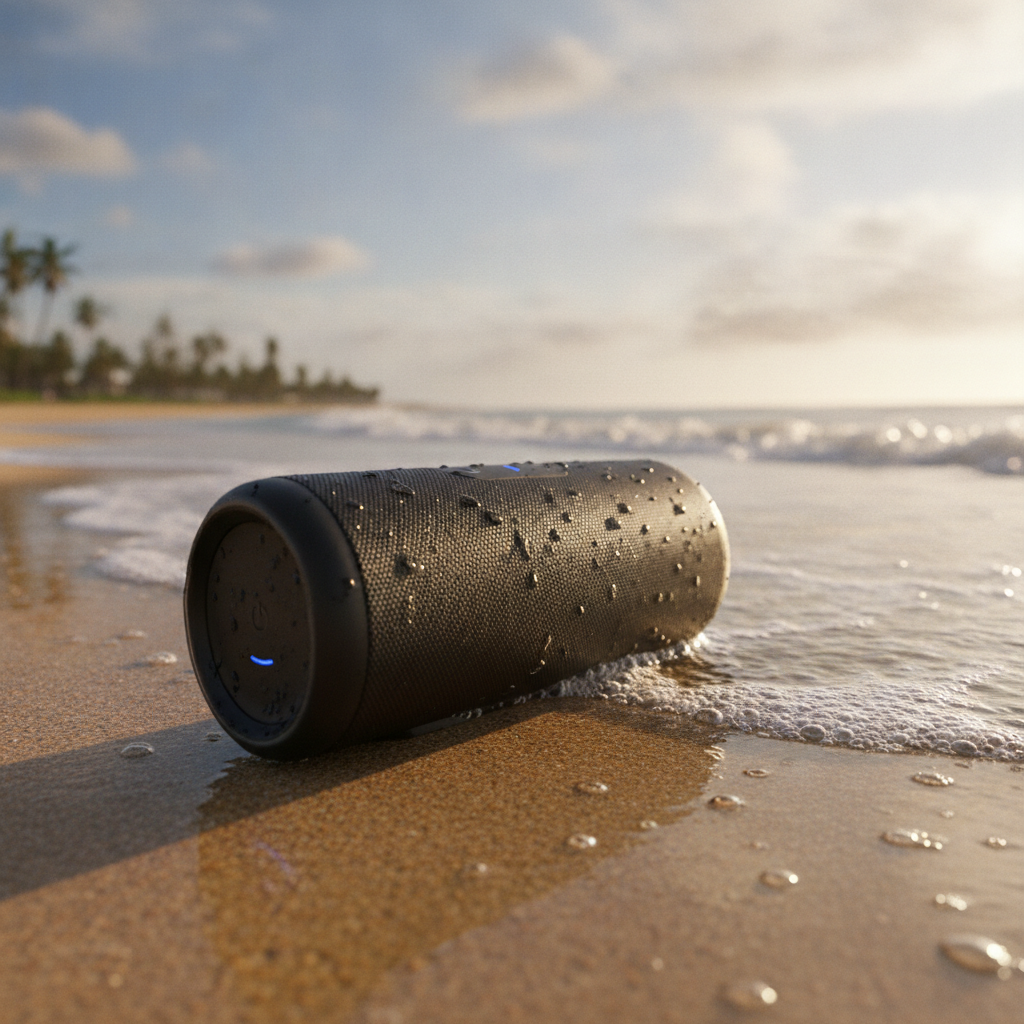
There’s nothing quite like a summer escape to the beach, especially when you’re a Georgian heading to the sunny shores of Florida. This year, my trip to Pensacola Beach wasn’t just about relaxation; it was a prime opportunity to put some of the latest portable Bluetooth speakers through their paces in the ultimate real-world environment.
While testing headphones or speakers in a quiet home office or backyard provides valuable insights, true performance is revealed when you face the unpredictable challenges of loose sand, crashing ocean waves, and even the rumble of a nearby naval base. This rigorous approach is part of how ZDNET independently tests and researches products, ensuring our recommendations are based on tangible experiences.
For this seaside showdown, I brought along three popular contenders: the Bose SoundLink Plus, the JBL Charge 6, and the Sonos Play. Each day, a different speaker became my beach companion, allowing me to gauge its audio quality, battery life, and overall resilience against the elements.
Our commitment to you, the reader, means delivering accurate information and expert advice to help you make smarter buying decisions. Rest assured, our editorial content is never influenced by advertisers, and we always aim to provide unbiased, fact-checked reviews.
Beach-Ready Audio: Deep Dive into Performance
First up, the JBL Charge 6 quickly impressed with its thoughtful design. Its horizontal orientation and integrated carrying strap make it incredibly easy to transport, a real plus when juggling beach gear.
One of its standout features is Auracast, allowing seamless multi-speaker pairing across different brands, a significant advantage over competitors like Bose, which limits pairing to its own single-speaker Party Mode, or Sonos, which has its own system.
JBL advertises a hefty 24 hours of playtime, extendable to 28 hours with its Playtime Boost feature. However, in a noisy beach environment, cranking up the volume to overcome waves and jets significantly reduced this duration, a common trade-off for any portable speaker.
During my six hours of loud playback, the battery dropped by about 45%, suggesting roughly 13 hours of total playtime under these demanding conditions. While I didn’t need its reverse USB-C charging feature for my phone, it’s a handy option that would further impact playtime.
The Bose SoundLink Plus instantly caught my eye with its sleek, minimalist design and attractive color options, garnering compliments from fellow beachgoers. If aesthetics are as important as audio for you, Bose truly delivers.
Its powerful bass response is undeniably its strongest asset, thanks to a configuration of a tweeter, midwoofer, and four passive radiators. Even amidst the crashing waves, the deep bass cut through, creating a rich listening experience.
Despite playing it loudly for nearly six hours, the SoundLink Plus still had almost 70% battery remaining, closely aligning with Bose’s advertised 20 hours. This impressive battery efficiency, even at high volumes, makes it a reliable companion for extended outdoor use.
The Sonos Play is renowned for its exceptional sound quality, powered by three Class-H amplifiers, two tweeters, and a midwoofer, delivering Sonos’s signature smooth audio. Its Automatic Trueplay feature, available even over Bluetooth, proved effective in optimizing sound for the dynamic beach environment.
The inclusion of Sonos Voice Control over Bluetooth, offering basic commands, was a convenient touch when my hands were covered in sand. However, its vertical orientation proved challenging on uneven sand, affecting sound dispersion when laid horizontally.
After five hours of use, the Play’s battery was halved, indicating a real-world playtime closer to 10 hours rather than the advertised 24 hours in outdoor, high-volume conditions. While a fantastic speaker, it’s clear its premium features like Wi-Fi streaming and full voice assistant functionality shine brightest within your home network.
Durability & Final Verdict: Which Speaker Reigns Supreme?
When it comes to outdoor speakers, durability ratings are paramount, and all three speakers put up a strong fight. The Bose SoundLink Plus and Sonos Play both boast an IP67 rating, meaning they are fully protected from dust and can withstand submersion in water up to three feet deep for 30 minutes.
The JBL Charge 6, however, edges them out with a superior IP68 rating, allowing it to handle submersion up to three-and-a-half feet for the same duration. This makes the JBL technically the most resilient of the trio.
In practice, all three speakers performed admirably against the sandy beach environment, emerging unscathed after a quick rinse with freshwater. Their robust ingress protection ensures they can handle splashes, dust, and even brief submersions without compromising performance.
Choosing between the Bose SoundLink Plus and the JBL Charge 6 for outdoor adventures is a tough call. Objectively, the Bose demonstrated better power handling at high volumes, while the JBL offered superior durability and the innovative Auracast feature; both also support convenient reverse USB-C charging.
Subjectively, I found myself reaching for the Bose SoundLink Plus first, primarily for its stylish design and powerful, resonant bass that truly enhanced my beach experience. It effortlessly cut through ambient noise.
While the Sonos Play is a fantastic speaker for its sound quality and features, its full potential is best realized within the confines of your home’s Wi-Fi network. For truly wild outdoor escapades beyond your property line, the Bose and JBL prove to be more adaptable and feature-rich companions.
Source: ZDNet – AI
