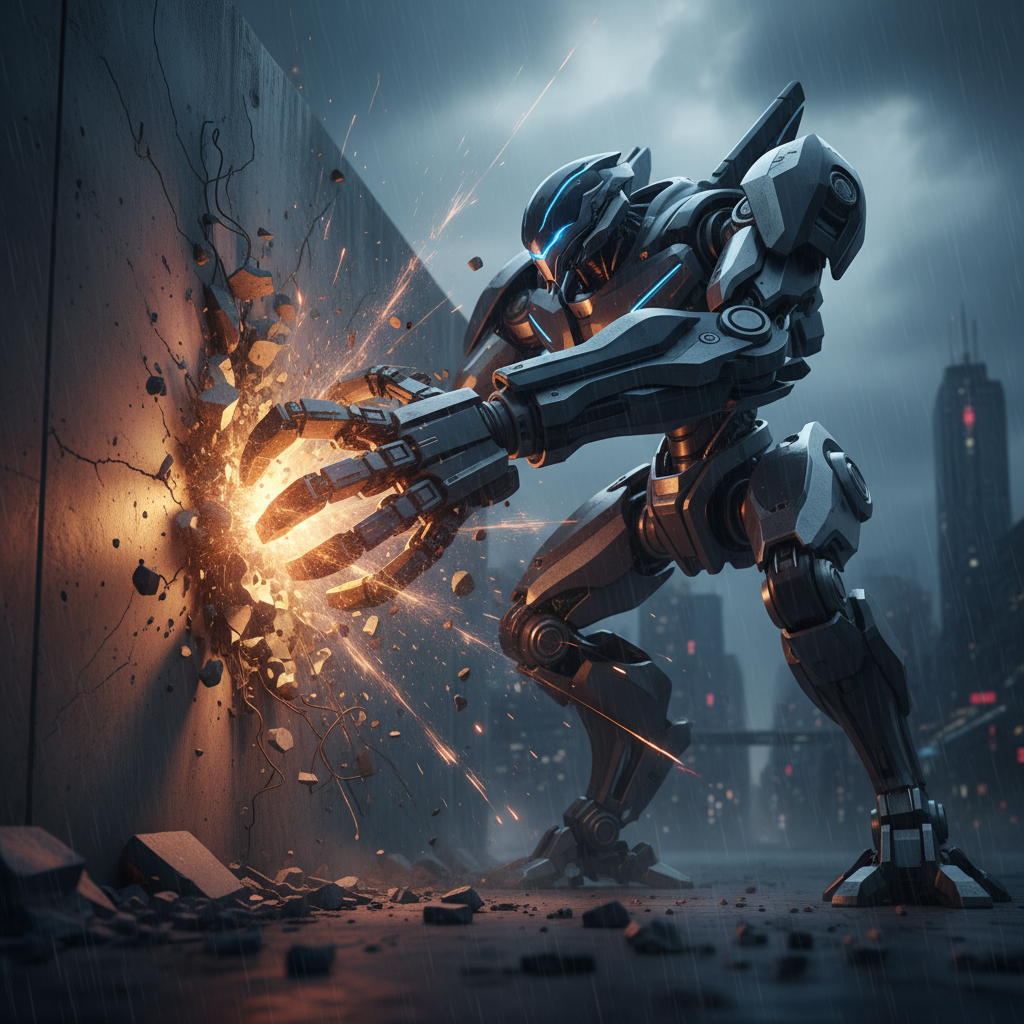
Unitree, a Chinese robotics company renowned for its agile and surprisingly affordable robots, has just unveiled its most ambitious creation yet: the GD01. This isn’t your average dancing robot; it’s a colossal, transforming “mecha” capable of walking, crawling, and even smashing walls. This significant departure from their usual fare has certainly captured attention worldwide.
The GD01’s reveal was accompanied by an electrifying introductory video, complete with a thundering rock guitar soundtrack. It features Unitree’s founder and CEO, Xingxing Wang, connecting with the robot before ascending into its open-air cockpit. A playful, yet stern, disclaimer on Unitree’s social media post reminds users: “Please everyone be sure to use the robot in a Friendly and Safe manner.”
The video showcases the GD01’s impressive capabilities, including a scene where, even without a human pilot, it effortlessly demolishes a wall of cinder blocks. Further footage reveals the red-limbed robot contorting into various positions, demonstrating its remarkable flexibility by bending backward and even crawling on its “hands” and “legs.” While the operator’s comfort in such a crabwalk position might be questionable, the sheer spectacle of the machine takes precedence.
Unitree’s Rise to Robotics Stardom
Based in Hangzhou, China, Unitree has rapidly ascended as a leading robotics startup. The company already boasts the world’s most popular four-legged and humanoid robots, with their G1 humanoids frequently seen on social media performing intricate dances, acrobatics, and even kung-fu. The GD01 marks their exciting first venture into the realm of giant mechas, confirming to WIRED that this is indeed a genuine product for sale, not an elaborate stunt.
A key factor in Unitree’s success is the remarkable affordability of its robots. For instance, the entry-level G1 humanoid model costs around $15,000, a stark contrast to US-made humanoid robots which can command prices ten times higher. Experts attribute this cost-effectiveness to Unitree’s unparalleled mastery of China’s extensive and complex hardware supply chain, giving them a significant advantage in manufacturing robots at lower price points.
Beyond cost, Unitree’s hardware is also praised for its user-friendliness, making it easy for researchers to configure and deploy various AI programs. The company is anticipated to go public this year, solidifying its position as a rising star within the Chinese tech landscape. Their robots recently stole the show at a televised spring festival event, performing synchronized parkour and martial arts routines, showcasing their ability to communicate wirelessly for precisely coordinated movements.
Beyond Destruction: The GD01’s Purpose and Future
While Unitree’s existing robots are typically remotely controlled or execute relatively simple autonomous actions, and their humanoids are not yet equipped for complex tasks in chaotic real-world environments, the GD01 appears to serve a different, more audacious purpose. It seems designed as much for spectacular destruction as it is for generating significant publicity for Unitree.
In an era where AI companies are minting millionaires and billionaires, the GD01 offers an unconventional, extravagant way to flaunt newfound wealth. Forget the classic Ferrari or a high-end Patek Philippe; imagine turning up to the office in a GD01, perhaps even smashing through a wall to make an unforgettable entrance. This mecha truly redefines “power move” in the tech world.
Unitree’s focus remains on pioneering accessible and innovative robotics. The GD01, while an impressive demonstration of engineering prowess, also highlights the company’s bold vision for the future of human-robot interaction and the sheer entertainment value these machines can provide. It’s an exciting glimpse into what’s possible when cutting-edge robotics meets a touch of theatrical flair.
Source: Wired – AI
