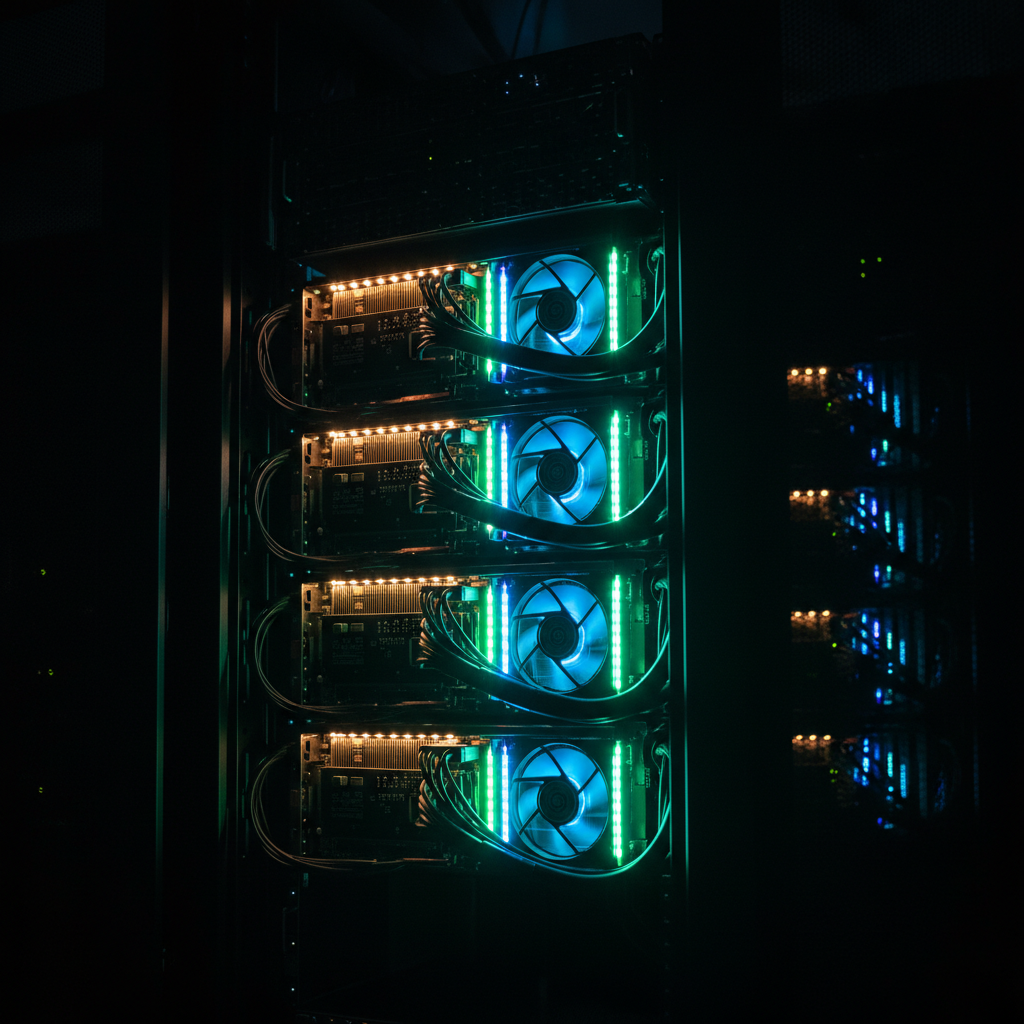
In the high-stakes world of artificial intelligence, hardware choices dictate power and possibility. Google has been aggressively championing its custom-designed Tensor Processing Units (TPUs), hoping they’ll become the go-to alternative for AI workloads.
However, a significant challenge to this vision has emerged from a trio of prominent cloud providers: Nebius, Lambda, and CoreWeave. These key players are reportedly opting out of Google’s TPU ecosystem, choosing instead to double down on NVIDIA’s dominant Graphics Processing Units (GPUs).
This collective “no” sends a powerful message, highlighting the entrenched position of NVIDIA and the complex dynamics at play in the rapidly evolving AI infrastructure market. It’s a strategic decision that speaks volumes about developer preferences, software ecosystems, and the competitive landscape for cutting-edge AI computation.
Google’s Vision for AI Acceleration with TPUs
Google introduced its Tensor Processing Units, or TPUs, years ago as specialized chips designed from the ground up to accelerate machine learning workloads. Optimized specifically for neural network calculations, TPUs have powered much of Google’s own groundbreaking AI research and products, from Search to Translate.
The company has heavily invested in making TPUs available through Google Cloud, positioning them as a high-performance, cost-effective alternative to GPUs for training and inference. Google’s strategy aims to offer a differentiated hardware option, hoping to capture a significant share of the booming AI cloud market.
This push is part of a broader trend where hyperscale cloud providers are developing custom silicon to gain an edge and optimize their infrastructure. TPUs represent Google’s ambitious effort to control its own destiny in the critical realm of AI hardware, rather than relying solely on third-party vendors.
Why the Resistance? The Allure of NVIDIA’s Ecosystem
Despite Google’s best efforts, Nebius, Lambda, and CoreWeave are sticking with NVIDIA, and there are compelling reasons why. The primary factor is NVIDIA’s long-standing dominance and its incredibly robust software ecosystem, centered around CUDA.
CUDA is NVIDIA’s parallel computing platform and programming model, widely adopted by AI researchers and developers worldwide. It offers a comprehensive suite of tools, libraries, and frameworks that have become the de facto standard for machine learning development.
This deep integration means that migrating existing AI models and workflows from a CUDA-based environment to TPUs often requires significant re-tooling and code rewriting. Such an undertaking can be costly, time-consuming, and carries inherent risks for companies with substantial AI operations.
Furthermore, developers are simply more familiar and comfortable with NVIDIA GPUs, reducing the learning curve and accelerating development cycles. While TPUs excel at specific types of tensor operations, many perceive NVIDIA GPUs as offering greater versatility and broader applicability across a wider range of AI models and computational tasks.
Strategic Moves in the AI Cloud Arena
The decision by Nebius, Lambda, and CoreWeave isn’t just about technical preference; it’s also a shrewd strategic play. These companies are carving out significant niches in the AI cloud market by specializing in providing premium NVIDIA GPU infrastructure.
CoreWeave, for instance, has gained prominence specifically for its extensive offerings of NVIDIA GPUs, positioning itself as a go-to provider for demanding AI and visual effects workloads. Similarly, Lambda is a dedicated provider of GPU cloud services, catering directly to the developer community that lives and breathes NVIDIA.
Nebius, a new cloud provider founded by former executives of Yandex Cloud, is also making a bold statement by prioritizing NVIDIA GPUs. Their choice signals a clear commitment to leveraging the industry-standard hardware, potentially appealing to a broad base of enterprises and startups looking for robust, familiar AI infrastructure outside of the hyperscalers.
These providers recognize that securing a steady supply of NVIDIA’s in-demand GPUs, especially models like the H100 and A100, is a major differentiator. By building strong relationships with NVIDIA and ensuring availability, they can offer immediate access to the hardware developers want most.
The Future of AI Hardware and Cloud Choices
This ongoing competition between custom silicon like Google’s TPUs and general-purpose GPUs from NVIDIA highlights a critical juncture in AI infrastructure. While Google continues to invest heavily in its TPU development and adoption, the market’s response underscores the powerful inertia of established ecosystems.
For AI developers and businesses, this landscape presents both challenges and opportunities. They must weigh the benefits of specialized hardware optimization against the ubiquity and flexibility of industry-standard platforms.
Ultimately, the choices made by cloud providers like Nebius, Lambda, and CoreWeave will continue to shape the options available for powering the next generation of AI innovation. The battle for AI hardware dominance is far from over, ensuring a dynamic and competitive future for cloud computing.
Source: Google News – AI Search
