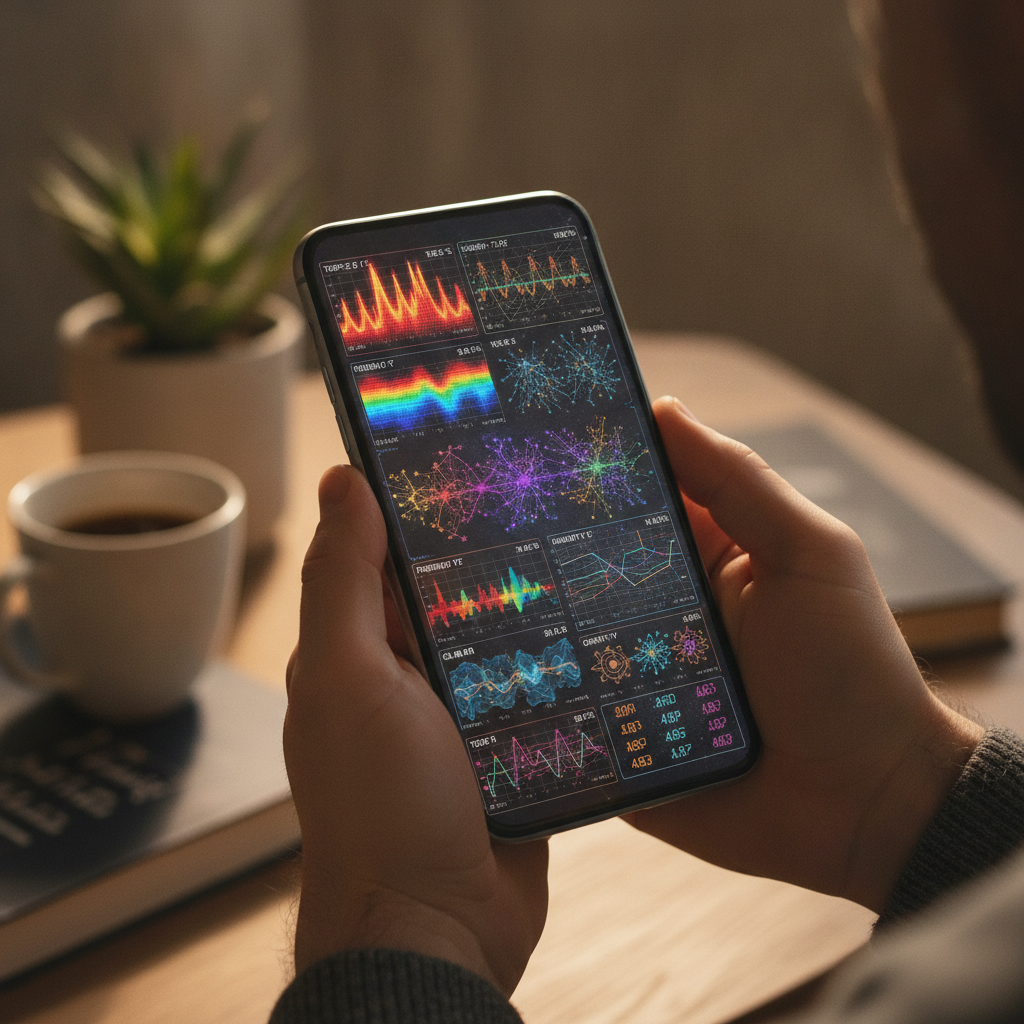
Ever wished you could transform your everyday smartphone into a powerful scientific toolkit? Imagine having access to dozens of experimental instruments, all packed into one convenient, pocket-sized device. Good news – with one ingenious app, your Android phone can become just that, unlocking a world of discovery.
I recently turned my own Android phone into a comprehensive 35-tool science kit using a completely free, open-source application called Phyphox. This app, short for “physical phone experiments,” leverages your device’s advanced sensors to measure, analyze, and understand the physical world around you.
Unlocking Your Phone’s Hidden Scientific Potential
Modern smartphones are packed with sophisticated sensors, powering many core functions. These miniature scientific instruments can measure everything from ambient light to magnetic fields.
Phyphox, developed by Aachen University, acts as a bridge, allowing direct access to these capabilities. This remarkable app reads real-time data from various sensors, transforms it into actionable insights, and allows data export for deeper analysis.
What exactly does Phyphox access? A surprising amount! It taps into your phone’s accelerometer, gyroscope, microphone, magnetometer, light sensor, and GPS. If your device includes a barometer, Phyphox also utilizes that for accurate atmospheric pressure readings.
Hands-On Experiments: Putting Phyphox to the Test
The true magic of Phyphox begins when you start experimenting with your surroundings. I quickly found myself looking for everyday phenomena to measure, eager to uncover hidden data points. For instance, I used the app to determine the incline of my office loft stairs, discovering it was a consistent -32 degrees.
My curiosity continued, leading me to measure the audio spectrum in my office, pinpointing the peak frequency at 93.75 Hz. The built-in barometer also allowed me to instantly check atmospheric pressure, which read 999.524 hPa on a typical day. These precise measurements illustrate the app’s potential.
The app proved incredibly versatile for various practical applications, like using its luminance meter to compare light levels. I noted a stark contrast between a dimly lit corner (0.177 luminance) and the bright output from my main monitor (3.4 luminance). Such data is invaluable for optimizing workspaces or for photography.
Another fascinating feature records the Hue, Saturation, and Value (HSV) of colors. This precise color information can be incredibly useful for design projects, helping find exact shades for painting or digital work. It truly brings scientific precision to creative endeavors.
Explore the World with 35 Scientific Tools
Phyphox is packed with an impressive total of 35 distinct experiments and tools, each designed to provide unique insights. Ever wondered about your microwave’s magnetron strength, or wanted to compare magnetic fields from different devices? Phyphox has a tool for that.
I personally used the magnetometer to compare magnetic fields from various equipment, like my Steinberger guitar. I visually confirmed that the neck and bridge pickups produced significantly stronger fields than the center pickup, settling a long-standing curiosity.
Beyond magnetism, the app offers incredible utility for time-based measurements, including four different stopwatches: acoustic, motion, optical, and proximity. This variety provides immense flexibility for timing events based on sound, movement, light changes, or object closeness.
Music enthusiasts will appreciate the Audio Spectrum tool, which not only identifies peak frequencies but also translates them into musical notes and “cents”—a logarithmic unit for measuring musical intervals. This level of detail is perfect for understanding sound waves, instrument tuning, or acoustic analysis.
Get Started with Phyphox Today
While Phyphox’s sheer depth might seem daunting, using the app is surprisingly straightforward once you understand each tool’s function. Its intuitive interface encourages exploration, making scientific inquiry accessible.
If you have a knack for experimentation, a deep curiosity about how things work, or simply enjoy tinkering, Phyphox is a must-have. I initially wasn’t sure how much I’d use it, but once I started delving into its features, I found myself captivated.
This free, open-source app is available right now on the Google Play Store. Even if you don’t intend to conduct elaborate experiments, simply seeing the wealth of data your Android phone can capture is an eye-opening experience. Download Phyphox today and transform your smartphone into a personal science lab.
Source: ZDNet – AI
