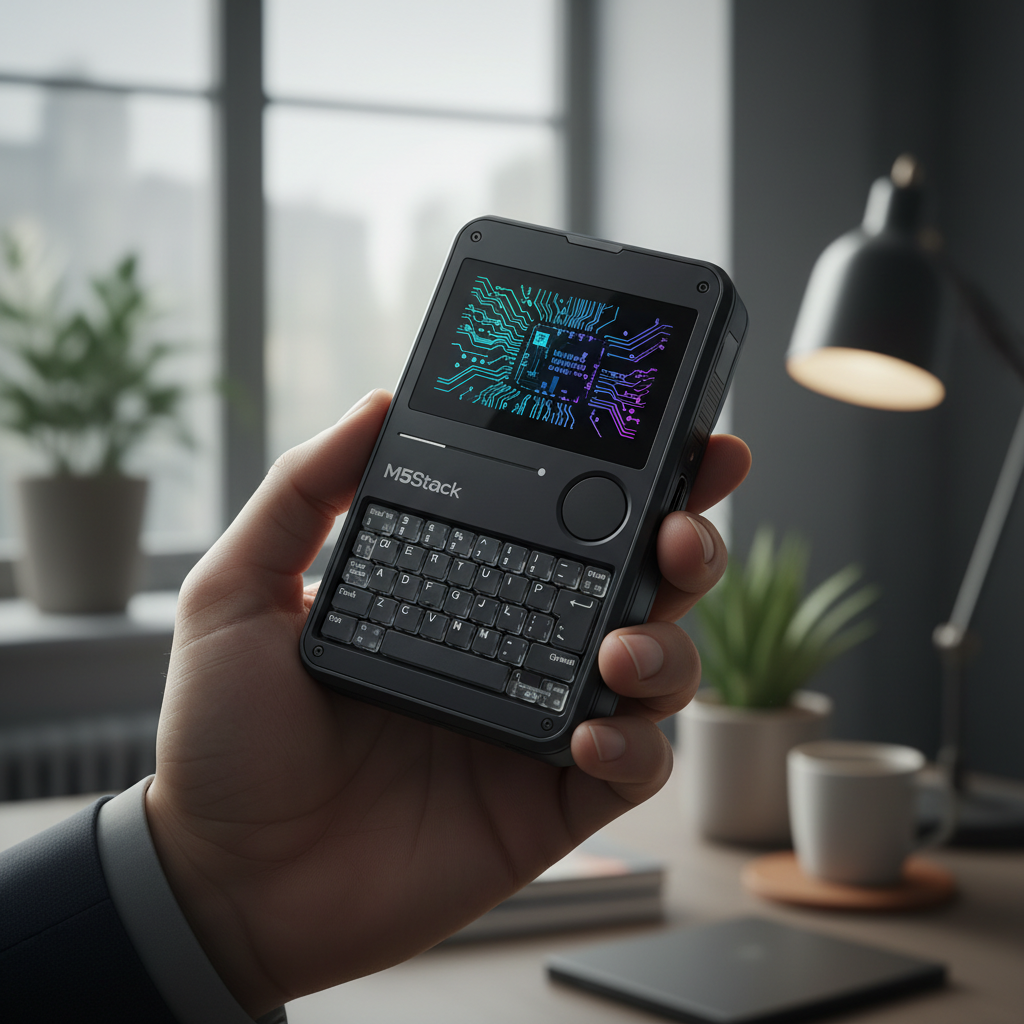
Imagine a computer so compact it could slip into your pocket, yet powerful enough to fuel your most creative DIY projects. The M5Stack Cardputer Adv is exactly that — a remarkable, programmable card-sized computer designed for makers, hobbyists, and anyone eager to dive into the world of embedded systems and rapid prototyping.
While some might compare it to a Raspberry Pi or a Flipper Zero, the Cardputer Adv truly carves its own niche. It’s an intriguing piece of kit, blending portability with surprising functionality for those ready to get their hands dirty with coding and hardware.
Introducing the M5Stack Cardputer Adv
At first glance, the M5Stack Cardputer Adv is a compact marvel. Roughly the thickness of a stack of credit cards, this portable device packs a full QWERTY keyboard and a tiny but surprisingly readable color display, making it a truly self-contained unit.
It’s built around the M5Stack Stamp-S3A core, a low-power, dual-core system-on-a-chip with built-in Wi-Fi and Bluetooth 5.0 Low Energy capabilities. This robust foundation makes it ideal for a wide range of applications, from industrial control to smart home projects and general rapid prototyping.
Our evaluation rates the M5Stack Cardputer Adv at a 4 out of 5, earning a “Very Good” recommendation. Its strengths lie in its neat, well-made, and portable design, alongside a very competitive price. It also benefits from a large, active support and development community, providing an excellent resource for new users.
- Pros:
- Neat, well-made, and highly portable design.
- Supported by a large, active community for development and troubleshooting.
- Very competitively priced, offering great value.
- Cons:
- Features a relatively steep learning curve for beginners.
- Doesn’t offer the direct capabilities of a Raspberry Pi or Flipper Zero, requiring different expectations.
Hardware That Packs a Punch
Despite its small stature, the Cardputer Adv boasts an impressive array of hardware features. The 56-key keyboard, while miniature, is surprisingly usable, even for those with minor dexterity challenges. Complementing this is a sharp 1.14-inch color LCD panel that delivers clear visuals for its size.
For audio, it includes an ES8311 codec, a high-quality MEMS microphone, and a 3.5mm audio jack. Sensing capabilities are robust, featuring a six-axis inertial measurement unit (IMU) and an IR emitter for controlling other devices. Storage is expandable via a microSD card slot, and connectivity is broad with a 0-4P Grove port and an EXT 2.54-14P expansion bus for external peripherals.
Thoughtful design touches enhance its utility, such as magnets embedded in the base for attaching to ferrous surfaces and LEGO-compatible holes for seamless integration into physical builds. Powering this entire package is a substantial 1,750mAh Li-ion battery, providing excellent endurance for on-the-go projects. The device itself is covered in helpful graphics, explaining the function of different components, aligning with M5Stack’s user-friendly design philosophy.
Diving into Software and the Learning Journey
Out of the box, the Cardputer Adv comes loaded with a selection of basic applications to get you started. These initial tools allow you to explore features like the six-axis motion sensor, IR emitter, Wi-Fi scanning, audio recording, and even rudimentary long-range radio (LoRaChat) capabilities.
To truly unlock its potential, you’ll need to familiarize yourself with the M5Burner app, which is used for uploading new applications and custom code. While setting up M5Burner might involve a bit of tinkering and driver installation, this initial hurdle is part of the learning process and connects you with the extensive online support community.
The real magic happens when you start programming the device yourself. You can choose M5Stack’s visual UIFlow 2.0 integrated development environment or opt for the highly popular Arduino platform. The learning curve here varies depending on your existing programming knowledge, but starting with small, manageable projects is the key to building confidence and skill.
Cardputer Adv vs. Its Rivals: Flipper Zero and Raspberry Pi
Many wonder how the Cardputer Adv stacks up against popular devices like the Flipper Zero or a Raspberry Pi. While the Cardputer is a cool tool with potential for ethical hacking tasks, it has distinct hardware limitations compared to the Flipper Zero. For instance, its IR functionality is emitter-only, meaning it can’t clone remotes, and it lacks sub-GHz or NFC/RFID support, as well as USB-RS232 capabilities.
However, the Cardputer Adv boasts out-of-the-box Wi-Fi support, a feature the standard Flipper Zero doesn’t offer, though the Flipper Zero generally has more refined software support for its specialized functions. When compared to a Raspberry Pi, the Cardputer is a different beast entirely. A Raspberry Pi offers a full operating system and a more mature ecosystem, making it generally easier to get started with for desktop-like computing.
We see the Cardputer Adv as more akin to a focused development board, like the Adafruit HUZZAH32. It’s a superb platform for developers seeking a compact device to run Arduino code, or for enthusiasts who want a safe and accessible environment to learn Arduino programming. While the Cardputer will certainly get you coding, its strength lies in this specialized application rather than direct competition with general-purpose single-board computers.
The Verdict: A Unique Tool for the Curious Maker
The M5Stack Cardputer Adv is a testament to portable innovation, offering a powerful yet incredibly compact platform for DIY electronics. Its active and supportive community makes it an inviting space for newcomers, providing assistance that’s often harder to find in larger ecosystems.
Priced around a very accessible $42, it offers significant value for its capabilities, comparable to what you might spend on a basic Raspberry Pi. While it presents a definite learning curve, especially compared to more conventional gadgets, the journey of mastering the Cardputer Adv is incredibly rewarding, acting as a catalyst for deep learning and creative exploration in embedded systems.
Source: ZDNet – AI
