At ZDNET, our commitment is to provide you with the most reliable and insightful recommendations. We understand that navigating the world of tech products and services can be daunting, which is why we dedicate countless hours to rigorous testing, thorough research, and comprehensive comparison shopping. Our goal is simple: to empower you with the knowledge needed to make the best possible buying decisions.
Our “ZDNET Recommends” process is built on a foundation of independent analysis. We meticulously gather data from a diverse array of sources, including official vendor and retailer listings, alongside other trusted independent review sites. Crucially, we delve into real customer reviews, seeking to understand the experiences and priorities of actual users who interact with these products and services daily.
Our Editorial Integrity: Your Trust is Paramount
Transparency is key to our relationship with you. When you click through our site to a retailer and make a purchase, ZDNET may earn an affiliate commission. This financial support enables us to continue our in-depth work, but it never influences our editorial content, what we choose to cover, or how we present it. Rest assured, the price you pay for any product or service remains unaffected by our commissions.
Neither ZDNET nor our authors receive direct compensation for these independent reviews. We adhere to strict internal guidelines that completely insulate our editorial decisions from advertiser influence. Our dedicated editorial team writes with your best interests at heart, meticulously reviewing and fact-checking every article to ensure the highest standards of accuracy and reliability.
Should an error or misleading information ever appear in our content, we are committed to promptly correcting or clarifying the article. Your feedback is invaluable, and we encourage you to report any inaccuracies you spot via our dedicated report form. This commitment ensures that our advice remains as knowledgeable and precise as possible.
Waze vs. Google Maps: The Ultimate Navigation Showdown
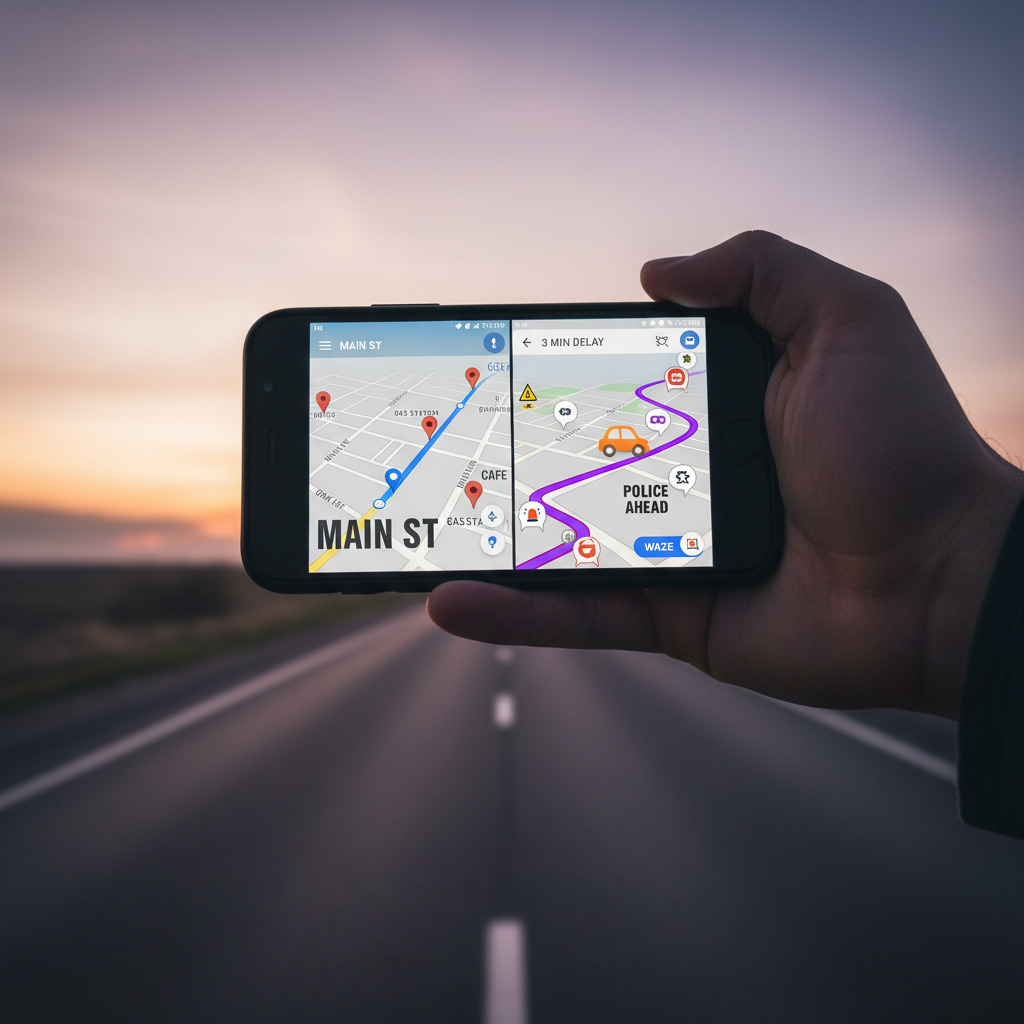
As a long-time Google Maps loyalist, I’ve often scoffed at claims that Waze could ever truly surpass it. But as a tech editor, setting aside personal bias is part of the job. So, I periodically challenge myself to explore alternative navigation apps, including Waze, which, interestingly, Google acquired back in 2013.
If you’re curious about how these two navigation titans stack up, feature by feature, you’ve come to the right place. I’ve put both Waze and Google Maps through their paces to determine which one excels at getting you to your destination faster, smarter, and more efficiently. Let’s dive into a detailed comparison to see if the final scorecard holds any surprises.
Route Prioritization and Driving Experience
Waze prioritizes speed above all else. It’s designed for drivers who want the quickest route, automatically rerouting you the moment traffic builds up. This decisive approach means it might send you down unexpected side streets, but it certainly shaves off precious minutes.
Google Maps, in contrast, offers a more nuanced approach. It considers factors like road types, current traffic patterns, and even fuel efficiency for different vehicles when calculating the best path. Its directions can also incorporate landmarks, making navigation more intuitive with prompts like “Turn left after the Shell station” instead of just distances.
While Waze focuses on immediate rerouting, Google Maps pre-warns you about traffic jams and closures even before you begin your journey. Newer features like Immersive Navigation offer 3D route previews, Street View context, and clearer trade-offs for different routes, giving you more control over your journey. Personally, I appreciate having the final say on reroutes; but if speed is your absolute top priority, Waze often delivers.
Beyond the Wheel: Public Transit and Other Modes
When it comes to versatility, Google Maps is the clear winner for non-driving modes. Waze is exclusively built for drivers, whether you’re in a car or on a motorcycle. It simply doesn’t support walking, biking, buses, or trains.
Google Maps, however, offers comprehensive solutions for almost every travel method. Whether you’re navigating on foot, planning a multi-leg public transit journey, or cycling, it provides detailed routes, live schedules, and real-time updates. Recent enhancements even include Gemini assistance for walking and cycling, making multimodal travel smarter and more integrated.
Traffic and Incident Reporting: Community Power
Waze pioneered real-time, driver-submitted information, which has long been its core strength. Users can report everything from traffic jams and road hazards to construction, speed traps, and even adverse weather conditions. As you drive, you can confirm or dismiss alerts, ensuring the map remains accurate and dynamic.
Waze’s Conversational Reporting allows natural language input, so you can simply say, “Looks jammed ahead,” and it translates that into a map report. It also provides granular road warnings for speed bumps, sharp curves, tolls, and emergency vehicles. Google Maps has made significant strides in catching up, now allowing users to report crashes, slowdowns, road closures, and even speed traps.
These reports are displayed on your map and are even starting to appear in Waze through a limited pilot in certain countries. The key difference remains: Waze automatically reroutes you based on this live data, while Google Maps leaves the rerouting decision to you. While Google Maps has closed the gap significantly, Waze’s long-standing, robust community-driven reporting still gives it an edge here.
Offline Capabilities and Data Use
For those times when your signal drops or you’re traveling off the grid, Google Maps stands out with superior offline functionality. Waze heavily relies on a data connection for almost all its features; while it can cache a route initially, once you lose signal, its live updates and rerouting capabilities become severely limited.
Google Maps, conversely, allows you to download entire regions or cities ahead of time. These offline maps come complete with turn-by-turn directions, making them an absolute lifesaver in remote areas or during international travel where data might be scarce or expensive.
Interface, Design, and Discovery Features
Waze brings a unique personality to navigation with its colorful, cartoony design, prominent icons, and playful alerts. It also offers quirky features like streaming music through its built-in player (hello, Spotify integration!), choosing celebrity voice “sidekicks,” and setting your “mood” for other Wazers to see.
Google Maps offers a more mature and feature-rich interface, excelling in discovery. It’s a powerhouse for exploring neighborhoods, researching businesses, and finding restaurants or attractions. Features like Street View allow you to preview locations, while various layers (satellite, terrain, air quality, 3D buildings) provide rich contextual information. Google Maps also boasts an AR-powered Lens feature for identifying real-world locations and answering questions about them, alongside Gemini-powered insider tips and an updated Explore tab.
While Waze’s quirky extras appeal to some, Google Maps has evolved far beyond a simple navigation tool into a comprehensive platform for travel planning and local discovery. For users who prefer a feature-packed interface that helps them learn about and interact with their surroundings, Google Maps is the stronger contender.
AI Voice Assistance and EV Navigation
Google Maps takes a decisive lead in AI voice assistance with its deeper Gemini integration. While Waze offers Conversational Reporting, allowing you to say things like “Looks jammed ahead” to report incidents, Google Maps leverages Gemini much more extensively. You can ask Gemini in Maps to find a vegan restaurant along your route with parking, share your ETA with friends, or receive natural directions that incorporate landmarks.
Gemini integration extends to walking and cycling, and the “Ask Maps” feature enables complex, conversational queries about places. Even Lens is powered by Gemini, allowing you to ask questions about real-world objects seen through your camera. Google Maps uses Gemini as a comprehensive connective tissue across search, discovery, navigation, and trip planning, offering a far more integrated and intelligent experience.
For electric vehicle (EV) owners, Google Maps is also the superior choice for smarter EV trip planning. It provides extensive information on charging stations, filtering by plug type and charging speed. Crucially, it supports EV battery predictions for over 350 Android Auto EV models in the US, recommending charging stops, predicting charger availability, and estimating your charge level upon arrival.
Waze allows EV drivers to input vehicle details and prioritize routes with charging stations, but Google Maps offers a more robust solution for the complex “battery math” and range anxiety often associated with EV travel. Its comprehensive features make it the undisputed leader for EV navigation.
Source: ZDNet – AI
