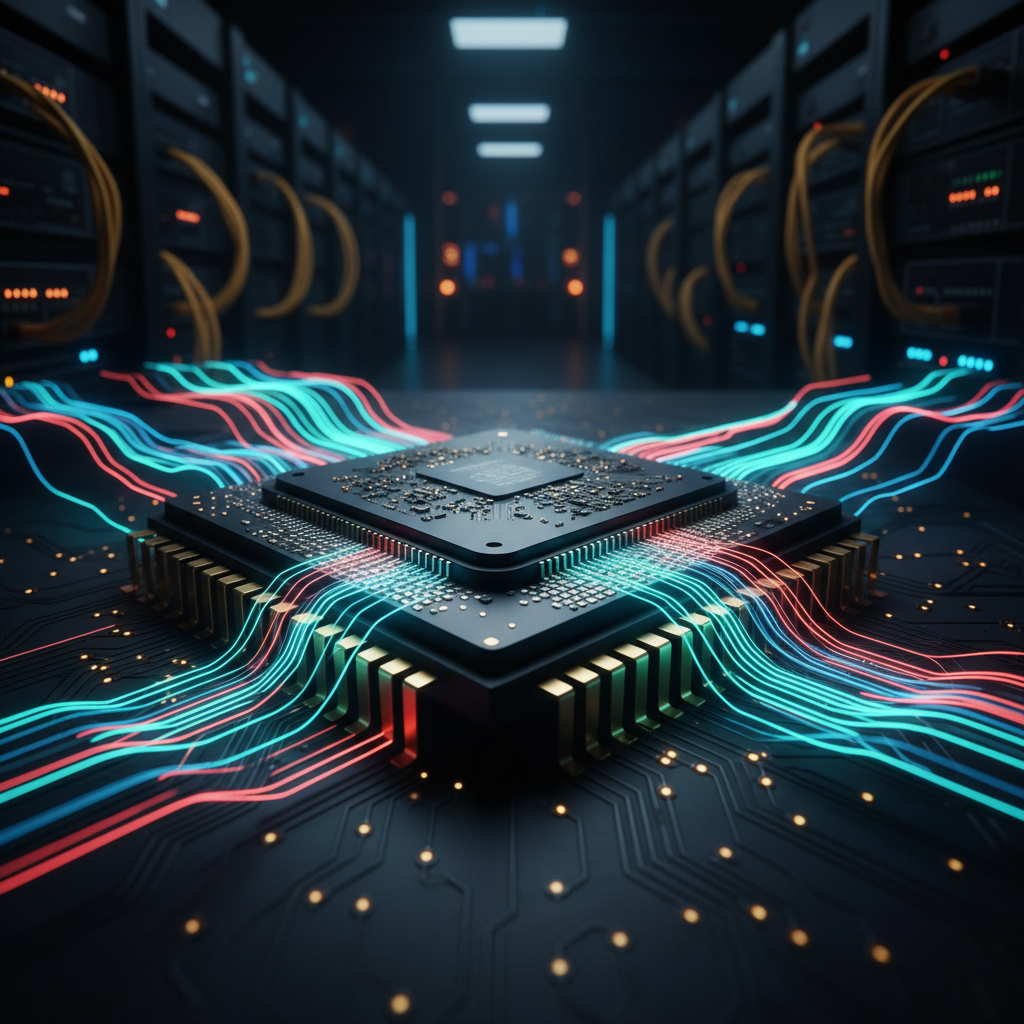
The landscape of artificial intelligence is evolving at an unprecedented pace, with AI models growing exponentially in complexity and scale. From sophisticated natural language processing to cutting-edge generative AI, these demanding workloads require an equally advanced infrastructure. This is precisely where Google’s Tensor Processing Units, or TPUs, step in, providing the specialized horsepower needed to train and deploy the most ambitious AI initiatives.
At their core, TPUs are Application-Specific Integrated Circuits (ASICs) meticulously designed by Google specifically for machine learning tasks. Unlike general-purpose CPUs or graphics-focused GPUs, TPUs are engineered from the ground up to excel at the fundamental computations that underpin neural networks. Their architecture is highly optimized for the massive matrix multiplications and convolutions central to AI, enabling breakthroughs that would be far less feasible on conventional hardware.
The Dawn of AI-Specific Acceleration
For years, CPUs were the workhorses of computing, and GPUs subsequently took the lead for highly parallel tasks like graphics rendering and initial AI training. While GPUs offered a significant leap in parallel processing compared to CPUs, their fundamental design still carried legacy baggage from their graphics origins. AI’s unique computational patterns, particularly the repeated execution of matrix operations, demanded an even more focused approach.
Google recognized this critical need early on, leading to the creation of the first TPU generation back in 2016. These specialized chips boast a unique systolic array architecture, allowing data to flow through the processor in a highly efficient, pipelined manner. This design minimizes data movement and maximizes computation density, translating directly into superior performance and energy efficiency for AI workloads.
This fundamental difference means TPUs can perform far more tensor operations per second, per watt, and per dollar for AI tasks compared to general-purpose hardware. They are tailored to accelerate both the intense computation required for model training and the rapid execution demanded by real-time inference. By focusing solely on machine learning primitives, TPUs eliminate unnecessary components, leading to a much more streamlined and potent processing engine for AI.
Driving AI Innovation at Scale
TPUs are not just powerful standalone chips; they are designed for massive scalability, often deployed in interconnected clusters known as TPU pods. These pods can link thousands of individual TPU chips, creating supercomputers capable of tackling the largest and most complex machine learning models imaginable. This distributed architecture is crucial for training foundation models that can take weeks or months on lesser hardware.
Google’s commitment to continuous innovation is evident in the evolution of TPU generations. From the inference-focused TPU v1 to the training-optimized v2 and v3, and the highly advanced v4 with its groundbreaking optical interconnects, each iteration has brought significant performance improvements and greater energy efficiency. The recent introduction of TPU v5e further democratizes access, offering a cost-effective, versatile option for a wide range of training and inference needs.
The benefits of this specialized hardware are multifaceted, making TPUs indispensable for modern AI development:
- Unparalleled Performance: TPUs deliver exceptional computational throughput for the tensor operations at the heart of AI.
- Superior Energy Efficiency: Their purpose-built design significantly reduces power consumption, especially important at data center scale.
- Massive Scalability: TPU pods enable the distributed training of colossal models, pushing the boundaries of AI research.
- Accelerated Development: Faster training times allow researchers and developers to iterate on models more rapidly, fostering innovation.
- Cost-Effectiveness: For large-scale AI projects, the long-term operational costs are often lower due to efficiency gains.
Real-World Impact: TPUs in Action
TPUs are the invisible power behind many of the Google services you interact with every day. They play a critical role in enhancing the accuracy of Google Search results, improving the fluidity of Google Translate, and personalizing recommendations on YouTube. These demanding applications rely on TPUs to process vast amounts of data and execute complex AI models with incredible speed and efficiency.
Furthermore, TPUs are at the forefront of the generative AI revolution, powering the development and deployment of large language models (LLMs) like Gemini. Training these colossal models requires immense computational power and memory, and TPU pods provide the essential infrastructure to bring such cutting-edge capabilities to life. They enable these models to learn from massive datasets, generating human-like text, code, and even images.
Beyond Google’s internal use, TPUs are also made available to developers and businesses globally through Google Cloud AI. This democratizes access to state-of-the-art AI infrastructure, allowing organizations of all sizes to leverage specialized hardware without the prohibitive costs and complexities of building their own. This accessibility is accelerating AI innovation across various industries, from healthcare to finance.
The Road Ahead: Pioneering AI’s Future
As AI continues its rapid advancement, the demand for specialized, high-performance computing will only intensify. New frontiers in multimodal AI, advanced robotics, and scientific discovery will push the limits of what’s currently possible. Google’s commitment to innovating with TPUs ensures that the hardware will continue to evolve, staying ahead of the curve and enabling the next generation of AI breakthroughs.
The journey of TPUs underscores a fundamental truth in the age of AI: specialized hardware is key to unlocking specialized intelligence. By providing unparalleled computational efficiency and scale, TPUs are not just processing data; they are powering the imagination of AI researchers and engineers. They empower us to tackle increasingly complex challenges and bring sophisticated, intelligent capabilities to the world, shaping the future of technology one tensor at a time.
Source: Google News – AI Search
