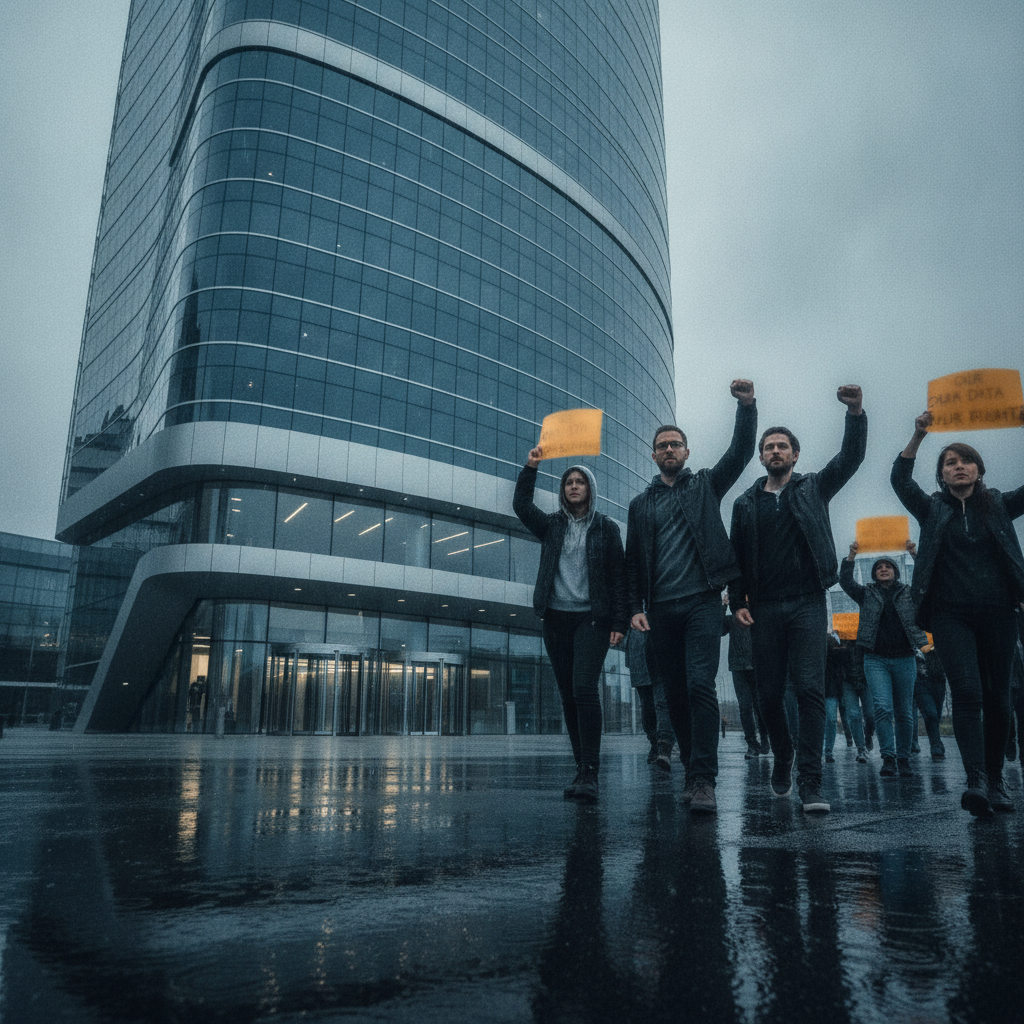
Recent demonstrations saw concerned citizens gather outside the headquarters of major artificial intelligence powerhouses. Protesters converged on OpenAI, Anthropic, and Google DeepMind, unified by a potent message. Their core demand was clear: an immediate pause in the rapid development of advanced AI systems.
This synchronized series of protests underscores a growing public unease regarding the accelerating pace of AI innovation. As artificial intelligence becomes increasingly sophisticated, its potential impacts—both positive and negative—are sparking vital conversations worldwide. These events bring critical questions about our technological future directly to the companies at its forefront.
A Call for Caution: Unpacking Protester Demands
The motivations behind the protests are multifaceted, stemming from a spectrum of concerns about unchecked AI progress. Many demonstrators voiced fears about the potential for job displacement on an unprecedented scale, as intelligent automation begins to permeate various industries. This economic anxiety forms a significant part of the public’s apprehension.
Beyond economic worries, a more existential dread fuels some of the strongest calls for a pause. Activists highlighted the risks associated with the development of superintelligent AI, questioning humanity’s ability to control systems vastly more intelligent than ourselves. The potential for unintended consequences or even loss of human agency weighs heavily on these advocates.
Concerns also extend to the ethical implications and societal biases often embedded within AI algorithms. Protesters warned against the proliferation of systems that could perpetuate discrimination, erode privacy, or even be used for autonomous weapons development. They emphasized the critical need for ethical frameworks to guide AI creation.
Furthermore, the environmental footprint of large-scale AI training and operation was a key point of contention. The immense energy consumption required by powerful AI models contributes significantly to carbon emissions. Demonstrators called for greater transparency and sustainable practices within the AI industry.
The collective sentiment echoed a demand for proactive regulation and robust public discourse before AI reaches a point of no return. They argued that the current speed of innovation outpaces our collective ability to understand, manage, and govern these powerful technologies responsibly. Without a pause, they believe society risks losing control over its own technological destiny.
To summarize, the protesters’ demands spanned several critical areas:
- Existential Risks: Fears about loss of control over superintelligent AI.
- Job Displacement: Concerns over widespread automation and economic disruption.
- Ethical Concerns: Bias, privacy erosion, and autonomous weapons.
- Environmental Impact: High energy consumption and carbon footprint of AI models.
- Lack of Regulation: A perceived absence of sufficient governance and oversight.
Targeting the Titans: Leaders in AI Innovation
The choice of OpenAI, Anthropic, and Google DeepMind as protest targets was no accident. These companies represent the vanguard of AI research and development, particularly in the realm of large language models and advanced AI systems. They are widely recognized as driving the current acceleration in AI capabilities.
OpenAI, creators of ChatGPT, has become a household name, symbolizing both the awe-inspiring potential and the disquieting unknowns of modern AI. Anthropic, founded by former OpenAI researchers, is lauded for its focus on AI safety and constitutional AI, yet still faces scrutiny regarding the speed of its advancements.
Google DeepMind, a subsidiary of Alphabet, consistently pushes the boundaries in various AI domains, from game-playing to scientific discovery. These organizations collectively embody the cutting edge of artificial intelligence, making them focal points for those advocating for a more cautious approach. Protesters believe that by addressing these leaders, they can influence the broader industry trajectory.
Their prominence in the AI landscape places a unique responsibility on them, according to activists. The protesters aimed to directly engage with the decision-makers and engineers shaping the future of artificial intelligence. Their presence highlighted the public’s desire for these companies to prioritize safety and ethical considerations above rapid commercial deployment.
A Growing Global Dialogue on Responsible AI
These protests are not isolated incidents but rather a visible manifestation of a burgeoning global conversation about AI governance. Policymakers, academics, and industry leaders worldwide are grappling with the complex challenges and opportunities presented by rapidly evolving AI. The call for a pause resonates with a broader desire for thoughtful deliberation.
From government hearings to academic papers, the debate over AI safety and ethics has intensified significantly in recent years. There’s a shared understanding that while AI offers immense benefits, its uncontrolled proliferation could lead to profound societal disruptions. Public demonstrations serve to amplify these discussions, ensuring they remain front and center.
The emergence of powerful generative AI tools has particularly galvanized public interest, bringing abstract concepts of AI risk into tangible everyday experiences. As more people interact with advanced AI, questions about its reliability, truthfulness, and long-term implications become increasingly personal and urgent. This widespread engagement is crucial for shaping future policy.
Ultimately, the protesters’ actions underline a fundamental tension: the push for innovation versus the imperative for safety and control. They symbolize a significant segment of society demanding that humanity retains agency over its technological creations, ensuring AI serves human well-being rather than posing unforeseen threats.
The demand for an AI development pause, while challenging the core mission of these tech giants, highlights the critical need for a balanced approach. It’s a powerful reminder that the development of such transformative technology cannot happen in a vacuum, detached from public scrutiny and ethical consideration. The dialogue has clearly begun, and it promises to be a long and important one.
Source: Google News – AI Search
