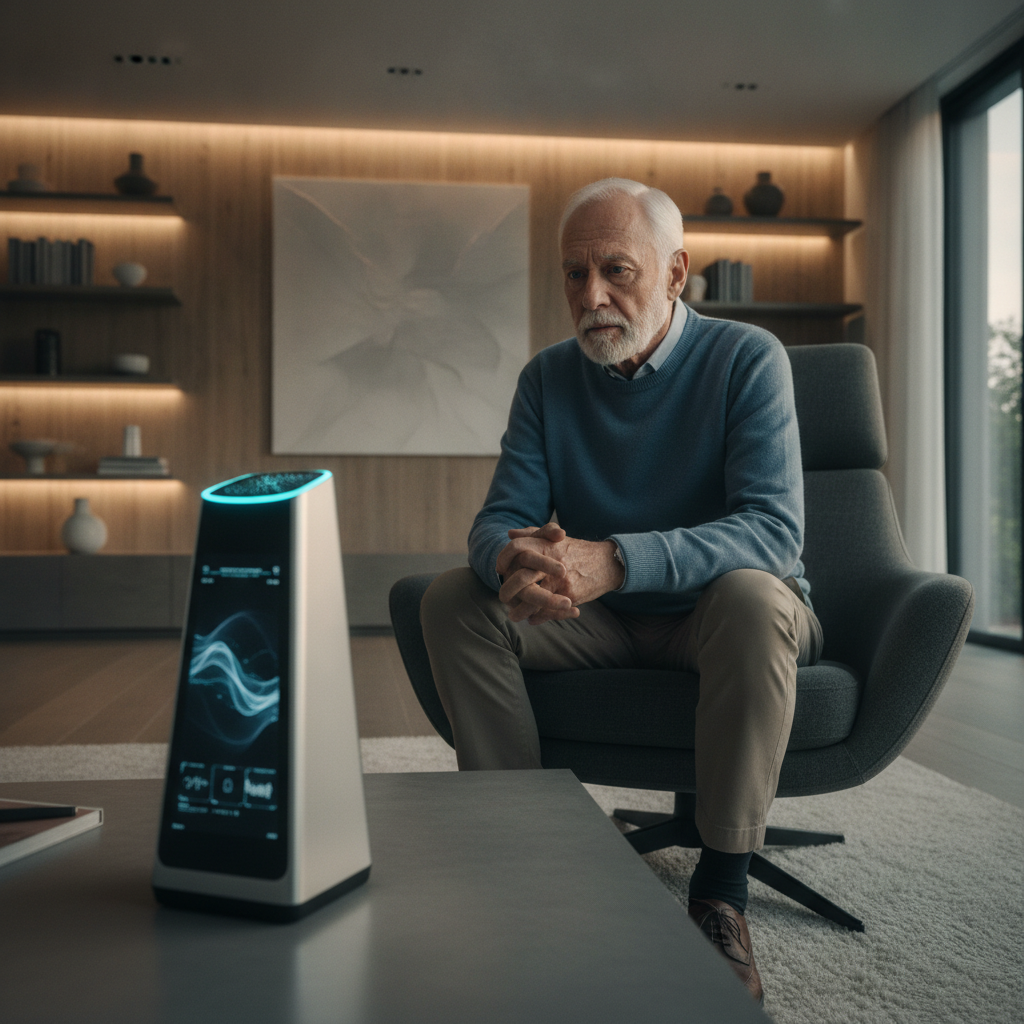
In January 2026, my 86-year-old father, living in North Seattle, found himself increasingly unsteady on his feet. “I’m stumbling around here,” he confided to a guest, a moment I only learned about months later, thousands of miles away in Austria. This intimate detail came to me via a transcript from Sensi.ai, an always-on, AI-enabled microphone that had been monitoring his home for nearly a year.
Sensi records everything: his coughs, the flush of a toilet, and even snippets of private conversations. It was initially offered as a complimentary addition to his care, driven by his desire, like many older adults, to remain in his familiar home. His house, once a modest clapboard, had been updated with amenities like a steam room and bidet—features that never quite appealed to him, unlike the carpeted staircase which became his preferred daily exercise, despite his increasingly unsteady gait.
The Dilemma of Independence and Surveillance
Concerns about my father’s risk of falling began in 2024. I staunchly defended his choice to stay home, seeing it as a sanctuary dedicated to my late mother. I even found studies suggesting that moving into nursing homes can accelerate cognitive decline, a fear amplified by my mother’s brief, unsettling stay in an institutional facility.
Sensi presented an appealing solution: a discreet white box that promised to silently monitor for danger, allowing him to maintain independence while offering me peace of mind. It seemed like a way to bridge the gap between his desire for autonomy and our worries about his safety. However, my father, a deeply private individual, was initially resistant due to his own privacy concerns.
After some gentle persuasion from my sister and me, he eventually agreed to the installation. Sensi soon flagged him as having a “possible high risk of falls” and began listening for specific trigger words. When the device overheard him utter the word “fall,” that private exchange was automatically sent to his caregivers.
Unveiling the “Spy” in the Home
Weeks later, out of curiosity, I requested the transcripts of everything Sensi had recorded in my father’s home. Reading his personal conversations, I couldn’t shake the feeling of being a spy, with Sensi as my unwitting accomplice. Despite advocating for the device myself, I felt a deep unease, especially when I realized my father didn’t remember being informed that Sensi was actively eavesdropping.
When I read his own words back to him, his reaction was telling. After a moment of silence, he sounded edgy. “Well,” he finally said, “it’s pretty weird that it hears words.” He seemed genuinely baffled that his everyday conversations would be deemed worthy of transcription, though he conceded, “But I guess it’s worth it,” before quickly changing the subject.
This acceptance, however reluctant, prompted me to delve deeper into the technology I had introduced into his life. Sensi, I discovered, is part of a growing ecosystem of AI devices aimed at senior care. These devices, unlike typical smart speakers, don’t wait for a command like “help.” They are designed to begin recording after specific events—sounds like thuds, coughs, screams, or movements indicating a fall.
For example, Earzz and Ally Cares monitor residents for coughs, falls, and unusual movements in care homes. Cherish Serenity, disguised as a stylish retro speaker, uses radar to detect falls or slumping. Crucially, in Sensi’s case, the device doesn’t always explicitly inform the senior it’s recording, which explains my father’s surprise at its capabilities.
The Algorithm and Its Accuracy
Sensi’s algorithm, purportedly built on “1,000 years” of audio data, claims to identify subtle deviations in a person’s routine, from new coughs to unusual movement patterns. However, when I pressed the company’s co-founder and CEO, Romi Gubes, about the algorithm’s construction, she vaguely stated that models are “trained on anonymized datasets” without providing specifics on their content or origin.
Steve Kamau, a coordinator at Husky Senior Care, shared instances where Sensi proved invaluable. In one case, it detected a senior’s fall and cries for help, allowing Kamau to dispatch emergency services promptly. Another time, an early cough detection might have prevented a more serious illness. While Sensi boasts a 90 percent accuracy rate, with human review for edge cases, Kamau also noted instances where a dropped remote was mistaken for a fall.
Despite Sensi’s impressive $100 million in funding and claims of adoption by 80 percent of North America’s largest home care networks, its broader claims face skepticism. Sensi also markets itself as a tool for tracking cognitive decline by identifying changes in speech patterns, tone, and activity. However, neurologist Ihab Hajjar, who studies AI-based dementia detection, remains unconvinced, noting that clinical models often misidentify cognitive impairment in a significant percentage of patients.
The Business of Care and Dignity of Risk
The success of companies like Sensi comes amid a widespread public wariness of nursing homes, which are not only expensive—averaging over $108,000 annually for a private room—but can also deplete seniors’ savings. It’s no surprise, then, that many older Americans strive to remain in their homes, accepting the inherent risks.
My father’s desire to stay home reflects the “dignity of risk”—the right to make choices, including potentially risky ones, as essential to self-esteem. Devices like Sensi promise to dissolve this tension, offering security without institutional constraints. However, the company’s investor materials reveal a different focus: home care agencies are the primary clients, benefiting from increased revenue and client retention through Sensi’s services. Testimonials on Sensi’s website boast significant client growth and increased billable hours.
This raises an unsettling question: Is my father’s physical safety the ultimate goal, or is he, in some way, contributing to his agency’s bottom line? As the caregiving economy faces a deepening shortage—with over 9 million positions needing to be filled by 2031—devices like Sensi are poised to become a default solution. My father has seen eight caregivers come and go within a year, while Sensi remains a constant, listening silently under the table.
Privacy vs. Protection: An Ongoing Debate
When I questioned Kamau about whether seniors truly understand the implications of these “omniscient” devices, he acknowledged that some might forget what was in the privacy agreement. Others, he added, resist for months before reluctantly giving in to family fears.
Clara Berridge, a professor at the University of Washington School of Social Work, views devices like Sensi as making surveillance a de facto condition of care. She worries that presenting seniors with choices like “nursing home or this device” constrains ethical decision-making and erodes their sense of home. Privacy, she emphasizes, is deeply linked to autonomy and emotional release—the ability to close one’s door and process feelings without being monitored.
Regardless of privacy concerns, AI devices for seniors are undeniably a growing trend. AARP reports that 25 percent of caregivers already use remote monitoring technologies, nearly doubling since 2020. With investors pouring billions into AI-powered health-tech startups, these tools are becoming a baseline for an aging population. Yet, as one Reddit user remarked, the idea of an AI device translating a mother’s heartbreak into a “sterile notification” highlights the profound ethical and emotional complexities inherent in this evolving landscape of care.
Source: Wired – AI
